Working group and guide ASIL metrics in the vehicle electrical system
11.06.2026
With increasing electrification, automated driving functions and growing functional safety requirements, the automotive electrical system is also coming more into focus. ASIL assessments in accordance with ISO 26262 are already established for control units and active electrical and electronic components. However, the quantitative assessment of failure rates is much more complex for passive vehicle electrical system components such as cables, connector systems, fuses, splices or screw connections.
This is precisely where the working group AK ASIL - FIT rates in the vehicle electrical system comes in.
The Automotive Cluster of Bayern Innovativ GmbH initiates and coordinates working groups with the automotive industry focusing on automotive wiring systems. Over the years, an open community of OEMs, wiring system manufacturers, cable manufacturers, contact manufacturers, component manufacturers, machine manufacturers, plant manufacturers, development service providers and research institutes has developed here. Central future topics of the wiring system are worked on together. These include new materials, automation, high data rates, variant reduction and ASIL in the wiring system with a focus on failure rates.
Since 2016, around 40 companies from the automotive value chain have been working together in the working group on a pre-competitive basis. Participants include OEMs, wiring system manufacturers, component manufacturers, machine manufacturers, development service providers and experts from research and consulting. The working group is organized and moderated by Bayern Innovativ.
The aim of the working group is to create a common technical basis for determining failure rates and fault distributions for characteristic wiring system components. The focus is on the FIT rate (Failure in Time) as a quantitative parameter for the reliability of passive vehicle electrical system components.
In addition to considering the overall vehicle electrical system, the individual components must also be taken into account. Possible failure modes, failure rates, failure probabilities and causes of failure are considered in terms of the "physics of failure". With the help of mathematical models and a comparison with faults observed in the field or in tests, failure rates can be derived from this.
Technical guide: 2nd edition 2026 published
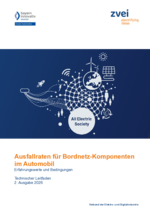
The technical guideline "Failure rates for wiring system components in automobiles - empirical values and conditions" was developed together with the ZVEI. Following the first edition from 2021, the second edition is now available with additions in many aspects.
The guide describes procedures for determining failure rates and fault distributions for central vehicle electrical system components. Among other things, it considers
- electrical cables
- Electrical connector systems
- passive electrical fuses
- screw contacts
- non-detachable electrical connections (splices)
The 2nd edition has been comprehensively updated, expanded and more differentiated. Among other things, content on data cables, power contacts, screw connections and non-detachable electrical connections with larger cross-sections has been added. In addition, field data evaluations, laboratory tests as well as application and calculation examples have been further elaborated.
The guide thus offers practical orientation for companies that want to determine or evaluate the failure rates of wiring system components in a comprehensible manner. The information contained is non-binding in nature and serves as a common methodological basis for technical discussions along the automotive value chain.
The following companies participated in the second edition:
Aptiv Services Deutschland GmbH, AUDI AG, BMW Group, Coficab Deutschland GmbH, DRÄXLMAIER Group, DSG-Canusa GmbH, FEP Fahrzeugelektrik Pirna GmbH & Co. KG, Fujikura Automotive Europe GmbH, Gebauer & Griller Kabelwerke Ges.m.b.H, KBE Elektrotechnik GmbH, KOSTAL Kontakt Systeme GmbH, Kugler Maag CIE by UL Solutions, Lear Corporation Engineering GmbH, LEONI Bordnetz-Systeme GmbH, LEONI Kabel GmbH, Littelfuse Europe GmbH, MAGNA STEYR Fahrzeugtechnik GmbH & Co. KG, MD ELEKTRONIK GmbH, MOLEX Deutschland GmbH, Nexans autoelectric GmbH, One Mobility Autokabel GmbH, Physical Software Solutions GmbH, Prysmian Kabel und Systeme GmbH, Rosenberger Hochfrequenztechnik GmbH & Co. KG, Schulte & Co. GmbH, Schunk Sonosystems GmbH, Strunk Connect automated solutions GmbH & Co. KG, Sumitomo Electric Bordnetze SE, TE Connectivity Germany GmbH, TELSONIC AG, Tucker GmbH, STANLEY Engineered Fastening, TÜV SÜD Auto Service GmbH, Universität der Bundeswehr München, VOITAS Engineering GmbH, Volkswagen AG and Yazaki Systems Technologies GmbH

Your contact