How can connected medical devices be operated safely over many years and protected against cyberattacks?
This question is a constant in medical technology, from development through to daily use. Many devices remain in service for ten to twenty years, while new attack methods emerge and security requirements change. Outdated software cannot always be easily updated; at the same time, devices connect to hospital networks and cloud services. How can these systems be secured in the long term—and where do manufacturers with limited resources begin?
The cross-cluster project MEDSEC is a joint initiative of the Medical Technology Cluster, along with its supporting organizations Bayern Innovativ and Medical Valley EMN, as well as the Cybersecurity thematic platform at Bayern Innovativ. It explores the question of what technologies, solutions, and expertise the medical technology sector in Bavaria needs to improve cybersecurity—particularly small and medium-sized enterprises. The white paper “Securely Connected?” compiles the results of a qualitative survey of 18 experts from the medical technology and cybersecurity sectors.
Insights
- Thinking About Patient Safety and Cybersecurity Together
- Integrating Safety into Product Development from the Start
- Managing Vulnerabilities and Updates Throughout the Entire Lifecycle
- Build Expertise and Clearly Define Responsibilities
- Supplement Regulatory Requirements with Technical Safety Assessments
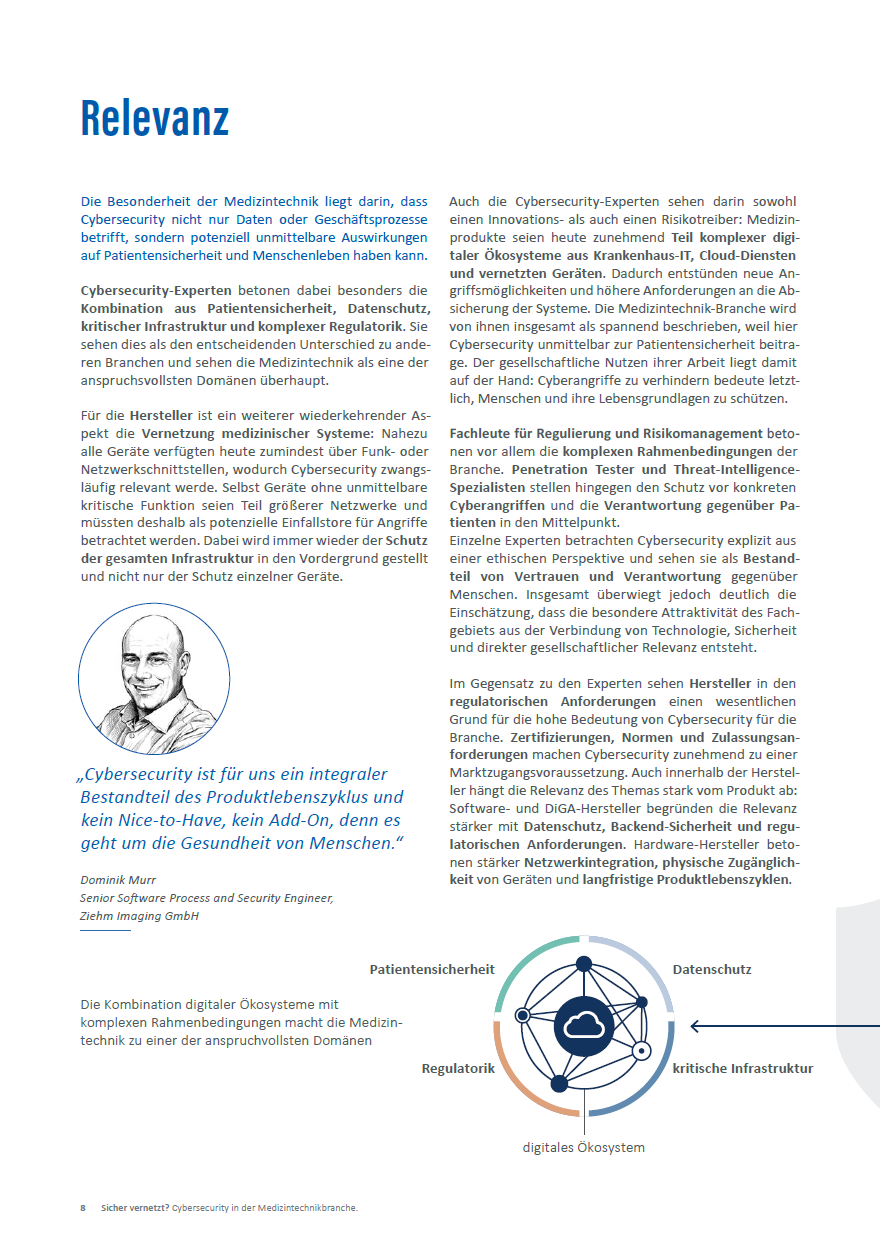
Connected medical devices, cloud connections, and complex hospital networks increase the attack surface for cyberattacks. At the same time, many devices remain in use for ten to twenty years—while attack methods evolve much more rapidly. Outdated software, updates that are difficult to implement, and a shortage of skilled personnel make it challenging to ensure security. For manufacturers, this is not only about protecting sensitive health data, but also about ensuring the secure operation of their products and patient safety.
This is where MEDSEC comes in. The project investigates which cybersecurity technologies, solutions, and expertise the medical technology sector in Bavaria needs—particularly small and medium-sized enterprises. The white paper compiles the insights of 18 experts from the medical technology and cybersecurity fields who were surveyed. The focus is on specific tasks: incorporating security requirements into the product architecture from the outset, securing communication interfaces, systematically identifying vulnerabilities, and continuously monitoring shipped products. The interviews also highlight where tight budgets, regulatory requirements, and existing system architectures complicate implementation.
The findings are particularly relevant for manufacturers of networked medical devices and medical software—specifically for executives, product managers, development teams, and cybersecurity leads. They also offer operators and research institutions insights into the challenges throughout the product lifecycle—from secure development to operation in heterogeneous IT environments.
After all, a secure medical device is not created by certification alone. The respondents emphasize that “security by design” must be supplemented by clear responsibilities, qualified personnel, and regular security assessments. The exchange between manufacturers and operators helps to bring together different requirements and experiences.
Learn about the risks posed by long product lifecycles and networked systems, the role of threat modeling, penetration testing, and vulnerability management, and why regulatory requirements alone do not guarantee security. Download the MEDSEC white paper now and use the findings to assess the need for action in your product development and organization.




Questions about the Medical Technology Cluster?