From Forecasts to Decisions: How AI and Optimization Work Together
Series of Articles on Fleet Electrification
November 11, 2026
As electrification increases, the requirements for the operational planning of commercial vehicle fleets are also changing. Travel times, energy consumption, and electricity prices cannot always be predicted with precision. Forecasts help assess potential developments early on. But how do these forecasts translate into concrete decisions for fleet operations? In the third installment of our series, we show how artificial intelligence (AI) and mathematical optimization can work together.
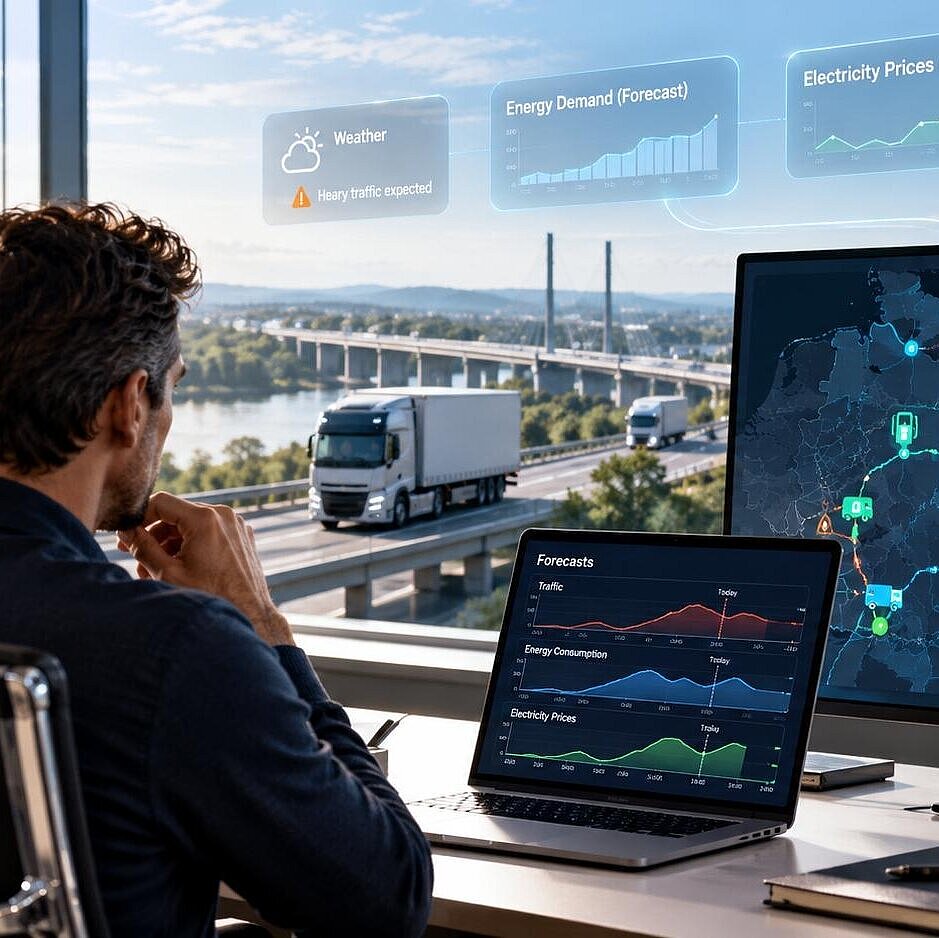
AI can analyze large amounts of data, identify patterns, and make predictions based on them. In electric fleet operations, for example, this can be used to forecast estimated travel times, vehicle energy consumption, or trends in electricity prices. Such information improves the basis for planning. However, it does not yet answer the question of which course of action makes the most sense under the given conditions.
Mathematical optimization identifies suitable courses of action
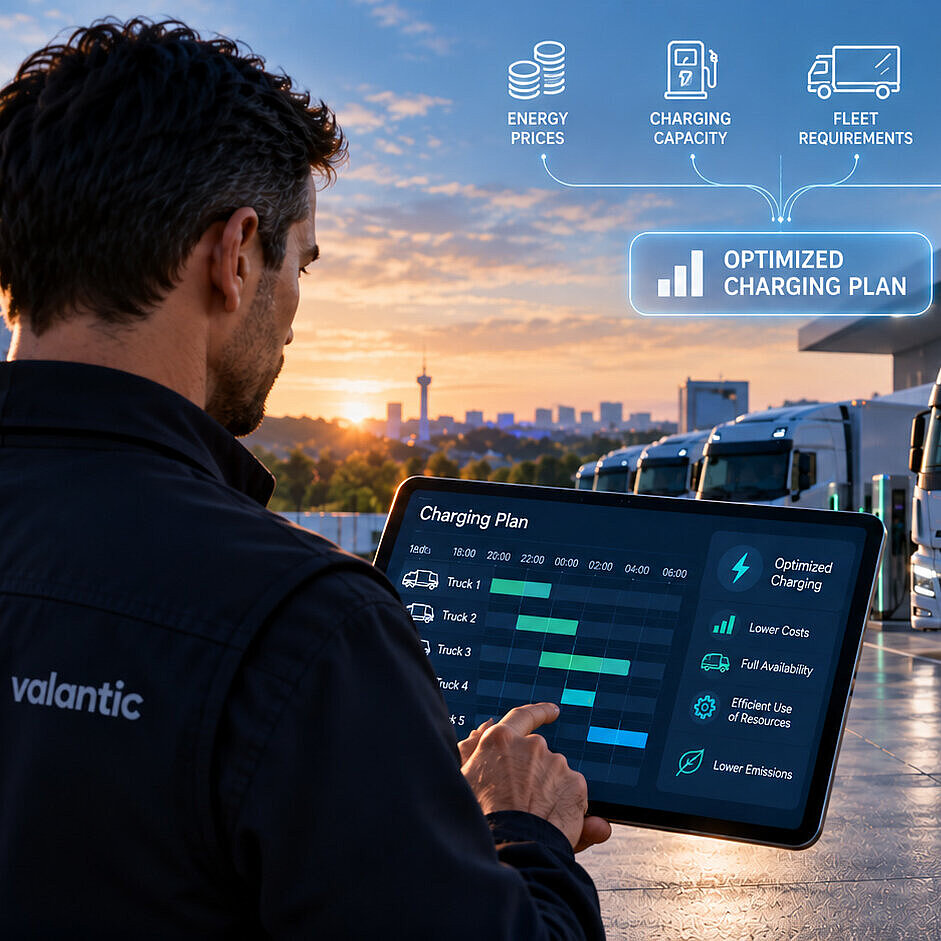
For example, a predicted delay indicates that a route may not proceed as planned. What adjustments should be made as a result depends on other factors. This is where mathematical optimization comes into play: It takes into account defined objectives and operational constraints to identify suitable courses of action. These include, for example, delivery time windows, available charging capacity, energy costs, and the required operational readiness of the vehicles.

"The key added value comes when we don't just forecast what might happen, but use that information to make better operational decisions. To achieve this, forecasts, operational requirements, and optimization must work together effectively."
Cihan Gökduman
Business Development Manager, Mobility, valantic Software & Technology Innovations GmbH
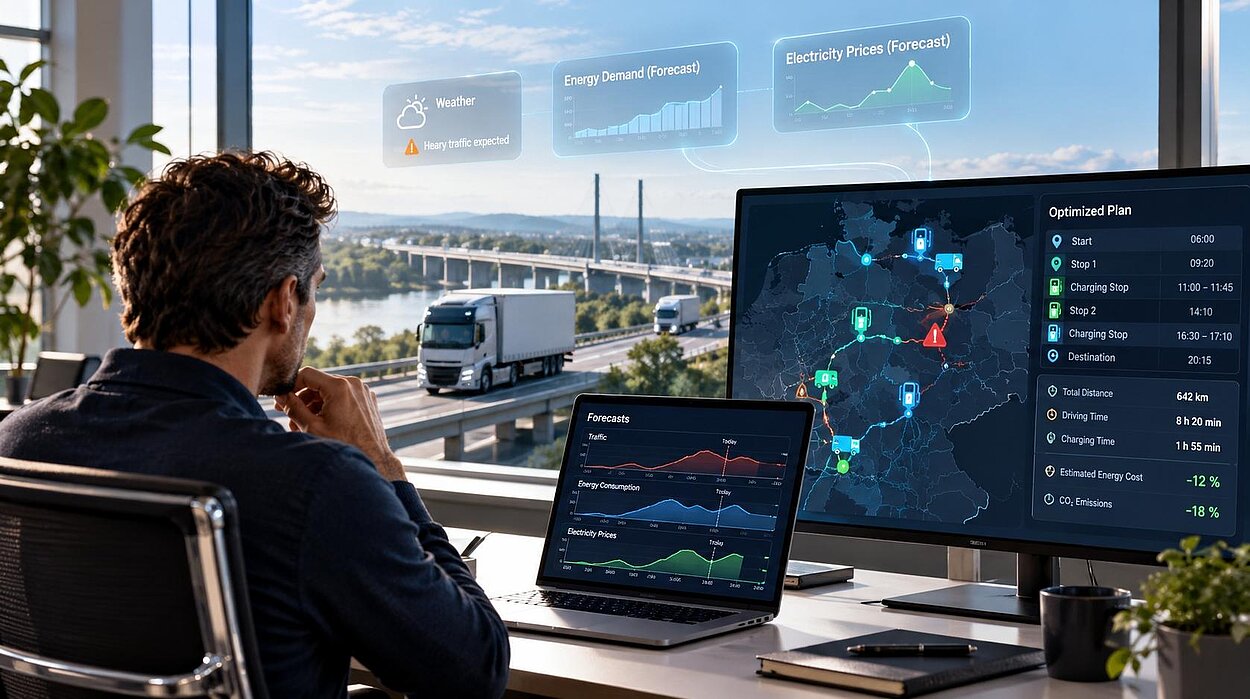

An example from electric route planning
An electric truck is on a scheduled route. Due to current traffic conditions, a longer travel time is expected. This could not only delay arrival at the customer’s location but also affect subsequent charging requirements or the vehicle’s availability for its next assignment.
An AI-based forecast can estimate the expected delay and its potential impacts. Mathematical optimization can then use this information to evaluate various courses of action: Does the rest of the route need to be adjusted? Would a different charging stop make sense? How can the remaining time windows and energy requirements be taken into account?
Which solution is appropriate depends on the available alternatives, operational requirements, and the respective optimization goals. The interplay of both approaches makes it possible to incorporate expected developments already during the planning phase, rather than having to react to deviations only after the fact.
Added value arises from the interplay between AI and optimization
Neither more precise forecasts nor powerful optimization methods alone guarantee better decisions. What matters most is a suitable data foundation, reliable predictions, and a realistic representation of operational requirements. If the actual situation changes, the results must also be reviewed and the plan adjusted as needed.
For electrified commercial vehicle fleets, this combination opens up new possibilities: decisions can be made with greater foresight, different courses of action can be systematically evaluated, and conflicting objectives can be made more transparent.
For AI and optimization to realize their full potential, they must be integrated with the data and systems of fleet operations. Step by step, this lays the foundation for smarter and more adaptable mobility solutions.