When Shopping Becomes a Task to Optimize
Series of Articles on Fleet Electrification
October 12, 2026
The electrification of commercial vehicle fleets is advancing rapidly in Europe. Many companies are investing in charging infrastructure, expanding public charging networks, or broadening their offerings related to charging services. Our partner, valantic Software & Technology Innovations GmbH, focuses on the further development of fleet electrification, charging, telematics, and digital mobility platforms. In the second installment of our series, we address the question of how complex charging decisions in electric fleet operations can be resolved.
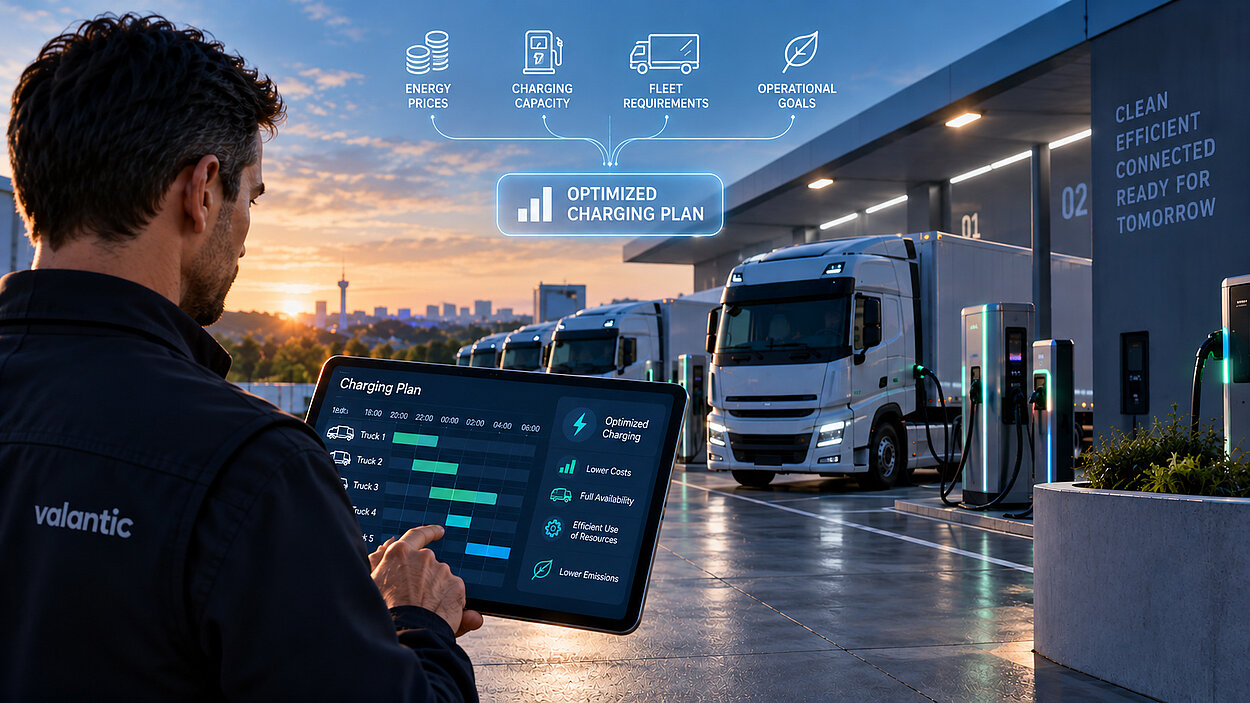

Operators of electric commercial vehicle fleets face a very specific question: When should which vehicle be charged? What may still seem simple for individual vehicles can quickly become complex when dealing with a larger fleet. Multiple vehicles return at different times, require varying amounts of energy, and must be available again by specific times. At the same time, only a certain number of charging points and a limited amount of connected power are available. Fluctuating electricity prices can also influence the decision.
This means that several objectives must be balanced: The vehicles should be charged in time, the existing infrastructure should be used as efficiently as possible, and unnecessarily high energy costs should be avoided.
A simple example illustrates this: Several electric trucks are parked at a depot in the evening. Not all of them need to start at the same time the next morning, and not all of them require the same amount of energy. At the same time, not all vehicles can be charged at full power simultaneously. So the question is not just whether charging is possible. The key factor is which vehicle should be charged, when, and to what extent.

"The larger an electric vehicle fleet becomes, the more complex the question of how to allocate available charging resources becomes. From our perspective, a key challenge is therefore to identify, from among the many possible options, the one that best fits operational requirements."
Cihan Gökduman
Business Development Manager, Mobility, valantic Software & Technology Innovations GmbH
Mathematical optimization methods identify suitable combinations of decisions
In this process, the relevant conditions and objectives are modeled. The method then determines an appropriate combination of decisions based on this model. In the example of the depot, the model could take into account, among other things, when the vehicles will be needed again, how much energy they require, which charging points are available, and at what prices electricity can be purchased. The result is not a one-size-fits-all charging plan, but rather a solution tailored to the specific situation.
And this is precisely where another advantage lies: The calculation can be repeated if the situation changes. If a vehicle returns later, a charging point goes out of service, or the framework conditions change, a new plan can be calculated.
Optimization Becomes a Dynamic Tool
Optimization becomes a dynamic tool for ongoing operations—rather than a one-time planning exercise. This principle can also be applied to other decisions where multiple options, resources, and constraints come into play. For example, vehicle allocation, battery storage, or the use of external charging infrastructure can be the subject of such models. With increasing electrification, a capability that goes beyond the mere provision of charging infrastructure is thus gaining importance: systematically deriving sound decisions from complex operational situations.
The next stage of development involves combining such models with forecasting and artificial intelligence. This will allow not only current situations to be evaluated but also expected developments to be factored into decisions. We’ll explore exactly how AI and optimization can work together in a future post in our series.