When Companies Become Learning Environments
September 8, 2026
During the 1,000+ Project Week at the Technical University of Munich, master’s students spend a week working on specific tasks from companies. The format combines hands-on learning with new perspectives on business challenges. In April 2027, the project week will enter its next round. As a cooperation partner, Bayern Innovativ supports the initiative by connecting suitable companies from its networks with the students.
How can established processes be reimagined? What solutions emerge when disciplines that rarely collaborate on a task in everyday work come together? The 1,000+ Project Week at the Technical University of Munich addresses these kinds of questions. The format brings master’s students and companies together for a week to work on a joint practical project.
A Real-World Problem as a Starting Point
Participating companies present a specific problem from their work environment. A team of up to five master’s students analyzes the task on-site, familiarizes itself with operational processes, and develops its own solution. Teams are assembled from various TUM degree programs based on the technical requirements.
For the students, the project week offers the opportunity to apply academic knowledge in a real-world business setting. At the same time, they gain insight into professional fields and corporate cultures outside the everyday university environment. The companies, in turn, gain an unfiltered perspective on a problem they are already familiar with and can compare their existing solutions with the team’s findings.
Bayern Innovativ Bridges the Gap to Real-World Applications
As a cooperation partner, Bayern Innovativ brings its cross-industry network to the project week. The goal is to bring together companies from the fields of health, mobility, energy and construction, digitalization, materials and production, and security with TUM students. To this end, Bayern Innovativ specifically reaches out to companies in its networks, shares information through its own communication channels, and promotes the initiative at relevant events.
This provides companies in the health and MedTech sectors, in particular, with additional access to the project week. Through the Health Innovation Network, Bayern Innovativ reaches more than 140 partner organizations and supports the exchange between industry, science, and emerging academic talent. This collaboration thus fosters new approaches to solving business challenges, facilitates the transfer of knowledge into practice, and enables early contact with digital talent.
Different Perspectives in Dialogue
It is precisely the interdisciplinary composition of the teams that shapes the collaboration. Diverse professional backgrounds lead to assumptions being questioned and problems being examined from multiple perspectives.
One participating company reports that five people who had not known each other previously quickly developed into a functional team. Despite the tight timeline, they were able to generate well-founded insights and tangible results. A participant from the health and nutrition sector describes the dialogue in particular as valuable. Through these exchanges, aspects came to light that had not previously been considered internally.
Such experiences show that the value of the project week lies not solely in a final proposed solution. Equally important is the collaborative work process: companies gain new food for thought, while students gain insights into real-world decision-making and development processes.
Conclusion and Networking
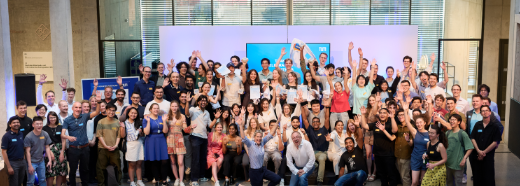
At the end of the project week, the teams first present their results at their respective companies. At a joint closing event on the Garching campus, selected projects are presented and experiences are shared. This also gives participating companies the opportunity to strengthen their connections within the TUM community.
The next 1,000+ Project Week is scheduled for April 2027. Registration for companies is set to open in October. Further information is available at https://1000plus.cit.tum.de/.