Contactless Health Monitoring: How Radar Technology and Artificial Intelligence Are Redefining Sleep Analysis
September 14, 2026
Artificial intelligence and digital health technologies are increasingly transforming how and where health data is collected and used for medical care. While many examinations have so far been possible only with specialized equipment in hospitals, doctors’ offices, or laboratories, new technologies now make it possible to obtain relevant health information outside of these traditional settings as well. Contactless solutions are particularly promising. They allow for continuous, real-life monitoring without placing an additional burden on patients. Radar technology, for example, can measure breathing patterns, body movements, and heartbeats without the need to attach sensors or electrodes directly to the body. Combined with artificial intelligence, such data could open up new avenues for health monitoring in the future. In an interview with Bayern Innovativ, Prof. Dr. Björn Eskofier provides insights into his research on radar-based sensor technology, contactless sleep phase detection, and AI-supported therapy decisions.
Professor Eskofier, could you briefly introduce yourself to our readers and explain what your current research focuses on?
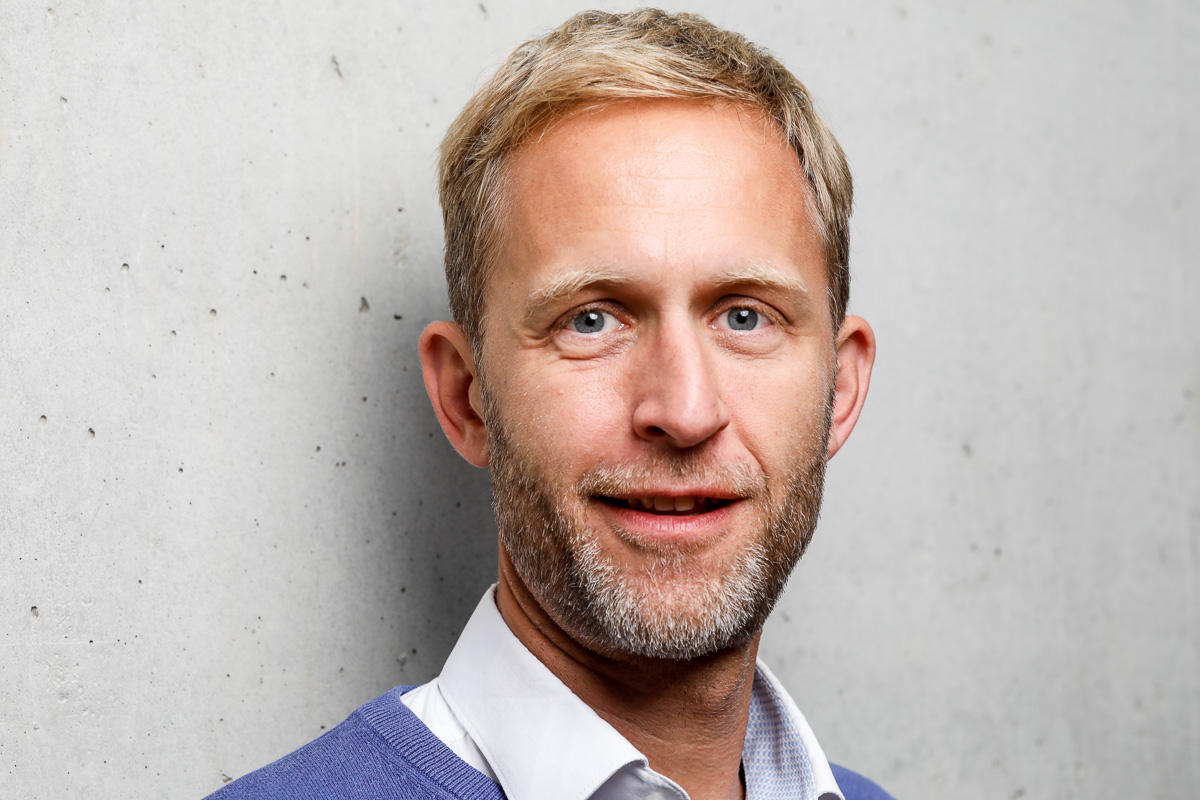
Björn Eskofier: I’d be happy to. My name is Björn Eskofier, and I am a professor and head of the Chair of AI-Supported Therapeutic Decision-Making at Ludwig Maximilian University (LMU) in Munich. I also head the Institute for Artificial Intelligence in Medicine (IKIM) at LMU Medical Center. My research focuses primarily on how we can apply artificial intelligence and digital technologies to healthcare in a way that improves medical decisions and outcomes for patients.
A key focus of my work is the transfer of technologies from the laboratory to clinical practice. For example, we conduct research in the field of digital biomarkers—that is, measurable health-related characteristics derived from data collected by wearables and contactless sensors—as well as AI methods for analyzing biomedical data. We also focus on adaptive healthcare systems that continuously evolve based on real-world treatment data. Our goal is to transform healthcare from a predominantly reactive approach to a proactive, preventive, and personalized model.
Your research group focuses on contactless health monitoring. What clinical or practical challenges led you to pursue this research approach?
Björn Eskofier: We want to base medical decisions more strongly on objective measurement data. While conventional measurement systems and devices—such as wearables—provide very good data, they can also be cumbersome and sometimes even influence the behavior we actually want to observe under conditions that are as natural as possible. Furthermore, if, for example, a person forgets to wear a device, no data can be collected.
That’s why we asked ourselves whether we could capture relevant physiological signals without touching patients—that is, from a distance and without direct physical contact. Radar technology is particularly well-suited for this purpose, as it can measure important biosignals—such as breathing patterns, body movements, and heartbeats—discreetly and without direct physical contact. These signals can provide important information about sleep quality, the various sleep stages, and overall health.
One of your most recent studies examines sleep stage detection using radar and transfer learning, a machine learning technique. What is the idea behind this approach?
Björn Eskofier: Sleep is an essential part of our lives. On average, we spend one-third of our lives sleeping. Sleep can provide us with important insights into our health if we are able to track it accurately. Until now, comprehensive sleep analysis has mainly taken place in specialized sleep labs, typically using polysomnography—which requires attaching numerous sensors and electrodes to the head and body. In our work, we have therefore used radar as a new and interesting measurement technology, along with machine learning methods, to identify relevant patterns and determine whether a person is awake or in light sleep, deep sleep, or REM sleep (REM stands for Rapid Eye Movement; REM sleep is the dream sleep phase characterized by rapid eye movements, vivid dreams, and high brain activity while skeletal muscles are paralyzed—it is the final phase of a sleep cycle). The exciting thing is that all of this is possible without electrodes and without direct physical contact. This means that people can sleep in their own beds, and clinically relevant and important health information can be collected at home.
When we compare radar-based sleep monitoring with traditional sleep lab studies or wearables—what do you think are the main advantages and current limitations?
Björn Eskofier: Sleep labs provide a wealth of physiological information, including data on brain activity, eye movements, and muscle signals. They are not going to disappear from diagnostic practice anytime soon. Wearables such as smartwatches are easily accessible, but they require active participation. You have to remember to use them and also remember to charge them. Some people, for example, don’t wear their watch at night because it’s on the charging station while they sleep.
Radar occupies an interesting middle ground here. The technology works entirely contactlessly and—aside from the initial installation—requires virtually no effort on the part of users. A Radar sensor could, for example, be mounted on the ceiling. This makes the technology particularly promising for long-term monitoring, such as for older adults or sick individuals who must spend a lot of time in bed due to their illness. Of course, it’s also suitable for people who simply do not want to wear sensors close to their bodies.
However, there are also limitations. Radar does not directly measure all relevant physiological signals, such as brain activity. Instead, the technology provides so-called surrogate signals. For example, rapid eye movements can be indirectly detected, but they are not measured directly. For this reason, radar-based monitoring cannot completely replace polysomnography, which is currently considered the gold standard. Before the technology can become a reliable alternative, it must also be continuously validated in larger and more diverse populations.
What advantages does transfer learning offer, particularly in the field of medical AI?
Björn Eskofier: Transfer learning is particularly helpful when there aren’t sufficiently large datasets available for a specific problem, but larger datasets from related application areas can be drawn upon. In machine learning, the general rule is: the more data available for training, the better. However, particularly in the field of medical AI, the required amounts of data are often not available. With transfer learning, a larger dataset from a related application area can be used initially, and the model trained on that data can then be further trained in a targeted manner using a smaller dataset that is actually relevant to the specific problem. This means that the knowledge a model has acquired in a specific context can be efficiently transferred to another context.
In practice, this means we don’t have to start from scratch every time we work with a new dataset, a different population, or a modified setup. Instead, we can adapt the existing model specifically to the respective application. While we still need carefully annotated data from the target domain—the collection of which is time-consuming and expensive—this approach allows us to reduce the volume of new data required. I am convinced that this principle will play a very important role in the future if we want to apply AI methods to real-world healthcare.
Can you describe the key findings from the study? What do they reveal about the future potential of contactless sleep monitoring?
Björn Eskofier: A key finding was that contactless radar measurements contain relevant information for distinguishing between different sleep stages. Our results showed promising accuracy. Another important observation was that transfer learning significantly improved generalization performance. I think this aspect will become increasingly important in the future.
Overall, it is clear that clinically relevant health information can also be obtained outside of hospitals and specialized facilities such as sleep labs. This does not mean that sleep labs will disappear. Rather, we could use them in a more targeted manner in the future. For example, contactless sensors could be used at home, while more complex and costly examinations could continue to take place in specialized diagnostic facilities.
Where do you see other potential applications for contactless, radar-based monitoring technologies?
Björn Eskofier: We and many other research groups are investigating potential applications in stress management—that is, in measuring stress and monitoring mental health. Radar technology is also being researched in connection with neurological disorders such as Parkinson’s disease. Contactless sensor technology can also be used to support rehabilitation by detecting early signs of clinical symptoms or a decline in health. In long-term care facilities, for example, such technologies could be used to monitor older adults, thereby providing a comprehensive picture of a person’s health status.
The goal should be to approach healthcare in a more continuous rather than episodic manner. The more comprehensive the information base, the better we can understand how a person’s health changes over time.
Many people are excited about the possibilities of AI-based health monitoring. At the same time, there are concerns regarding data privacy and continuous monitoring. How can researchers and healthcare providers build trust in this technology?
Björn Eskofier: That’s a very good question. I always say that the use of AI in healthcare can only advance as quickly as trust can be built. The needs of patients must always come first. Technologies should address specific patient needs or clinical requirements and be able to demonstrate clear benefits. When people recognize that a technology improves their health and supports them in meaningful ways—for example, by helping them better manage a chronic condition—they become more willing to use it, allow measurements to be taken, and share their data. Another crucial factor is transparency. People need to know what data is being collected, how it is processed, who has access to it, and how they themselves can maintain control over it. An important part of my research therefore focuses on the development of health data spaces designed to provide people with information about their health while ensuring they retain control over their data. Equally important is the principle of “privacy by design.” Data protection must not be added as an afterthought but must be incorporated from the very beginning of the development of such systems. And last but not least, we must establish scientific evidence of the benefits of these technologies. This involves carefully validating them, evaluating them under real-world conditions, and implementing them responsibly. Our team collaborates with experts who advise us on how such technologies can be meaningfully integrated into real-world healthcare.
Ultimately, the question is not whether we should use AI in healthcare—because I am convinced that AI has become an indispensable part of healthcare—but rather how we can use AI in healthcare in a way that truly benefits patients and earns their trust.
Thank you very much for the interview, Professor Eskofier!