Data as the Key to Innovation in Medical Technology
August 31, 2026
Before measurement values can be turned into a diagnosis, a testing process, or a new medical application, one thing is essential: data. And ideally, data that is reliable, precise, and readily available. This is exactly where our partner, Gantner Instruments, comes in. Headquartered in Austria with a location in Lauf an der Pegnitz in Middle Franconia, the company has for many years been laying the technological foundation for collecting and processing data from a wide variety of sources and making it usable for innovation—from energy and research technology to medical technology.
Gantner Instruments has a clear mission: to collect high-resolution data—nearly in real time—so that it can be used for analysis, automation processes, or processing by AI models.
“Our goal is to provide data in a way that allows it to be used immediately for evaluations, digital applications, and new technologies,” says Dana Kaufmann, Key Account Manager for Academic & Research, describing the company’s approach.
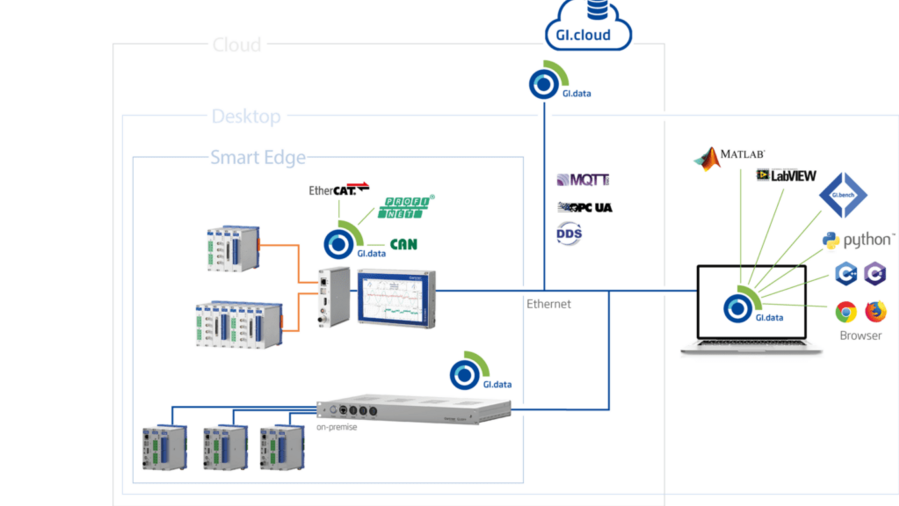
The solutions offered by this medium-sized company are used wherever information needs to be reliably collected, processed, and analyzed. They serve as the interface between a wide variety of sensors and the applications that rely on the corresponding data. From individual measurement points to complex large-scale systems, a wide range of scenarios can be accommodated.
Gantner Instruments is also active in the medical technology sector. Among other things, its technologies support the development and testing of MRI and CT systems, as well as quality assurance for medical technology components and manufacturing processes. The company does not supply the sensors themselves, but rather focuses on providing the infrastructure for processing, digitizing, and delivering the captured data.
A key driver of current developments in medical technology is the increasing use of artificial intelligence. For Gantner Instruments, however, this does not represent a fundamentally new trend. “We have been providing high-resolution data for decades. As a result, our systems today serve as an important foundation for many AI applications,” explains Kaufmann. At the same time, the medium-sized company is observing how AI can be more closely integrated into industrial processes and technical systems in the future.
The company views its European roots as a particular strength. Gantner Instruments conducts most of its development and production in Europe and relies on regional supply chains as well as short lead times in development and manufacturing. This also allows individual customer requirements to be implemented quickly. “Our European focus and high flexibility in development and production enable us to efficiently implement even very specific solutions,” says Kaufmann. Looking ahead, the company expects further momentum—particularly in the healthcare sector—from new imaging techniques, digitalization, and data-driven development processes. Regardless of specific applications, the precise collection and processing of data remain a key prerequisite for technological innovation.
As a new partner in the Health Innovation Network, Gantner Instruments aims to intensify its exchange with stakeholders in the healthcare industry. The focus is on forging new connections, gaining a deeper understanding of the unique characteristics of the healthcare market, and gaining insights into research and technology transfer structures. “We want to better understand how innovations in the healthcare sector emerge and how research, industry, and healthcare delivery interact,” explains Kaufmann.
By combining measurement technology, data expertise, and many years of industry experience, Gantner Instruments brings valuable perspectives to the Bayern Innovativ partner network. The network supports companies in establishing new collaborations, exchanging knowledge, and bringing innovations to market more quickly.
Contact us