Workshop at ITER shows progress in international cooperation and industrialization of fusion energy
29.04.2026
Lavender fields, pine forests and the bright limestone landscape of Provence characterize the region around Cadarache in the south of France.
The region is known for its Mediterranean lifestyle and centuries-old cultural landscape. People think of pleasure, tranquillity and tradition, rather than one of the most technologically sophisticated energy projects of our time.
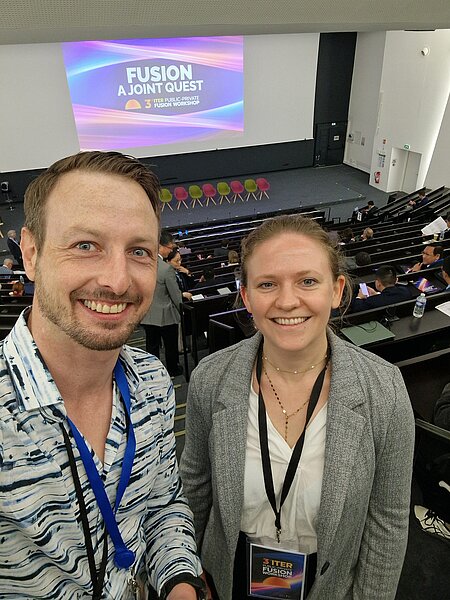
And yet this is precisely where one of the most ambitious projects in global energy research is taking shape. Our fusion team led by Dr. Kathrin Baumgartner and Dr. Christopher Zenk travelled around 1,000 kilometers from Nuremberg to Cadarache to see ITER, the world's largest fusion research facility, for themselves. The occasion was the "3rd ITER Public-Private Fusion Workshop".
On site, we are involved in the international exchange between public research and private-sector fusion companies. The focus here is not on a uniform approach to solutions, but on bringing together different perspectives in a targeted manner. The aim is clear: to strengthen cooperation between them.
ITER as a key global fusion energy project
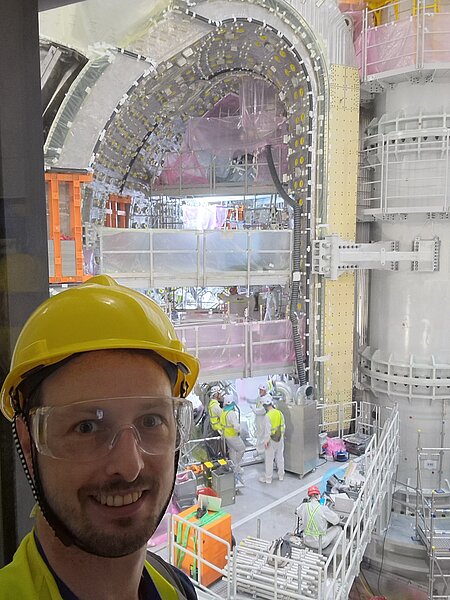
ITER (International Thermonuclear Experimental Reactor) is one of the largest international research projects in the world. It involves 35 partners, including the European Union, the USA, China, India, Japan, Russia and South Korea.
The aim of ITER is to demonstrate the scientific and technological feasibility of generating energy through nuclear fusion on an industrial scale. Unlike a power plant, ITER is not intended to feed electricity into the grid, but to demonstrate that a fusion plasma can release more energy than is required to heat it up.
The facility is based on the so-called tokamak principle. A plasma, an ionized gas, is heated to temperatures of around 150 million degrees Celsius and enclosed in a ring-shaped vacuum chamber by strong magnetic fields. ITER is expected to achieve a fusion power of 500 megawatts with an input heating power of around 50 megawatts, demonstrating an energy amplification factor of 10 for the first time.
Focus on industrial implementation and cooperation
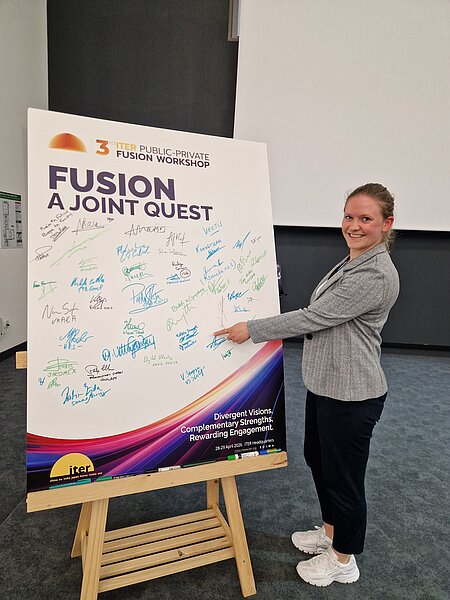
The workshop will highlight the extent to which fusion research is already moving towards industrial implementation. The focus will be on specific topics such as the exchange of design data, engineering experience, manufacturing concepts and lessons learned from the construction, assembly and operation of highly complex systems.
This will be complemented by discussions on key technologies such as robotics and remote handling, AI-supported planning, high-temperature superconductors and tritium circuits. Issues relating to codes, standards and project management also play a central role.
One key result: fusion energy is not created in isolation, but in cooperation with international partners. Resilient, globally networked supply chains are becoming a decisive factor for success.
Impetus for Bavaria and German industry
For us, the focus is on transferring these findings. The aim is to identify specific points of contact for companies along the fusion value chain, for example in the fields of mechanical engineering, materials, sensor technology, automation or additive manufacturing.
Through direct exchange on site and integration into international networks, we strengthen the position of industry players in the emerging global fusion ecosystem. This makes opportunities visible at an early stage and initiates targeted cooperation between research and industry.
Our team returns to Bavaria with new contacts, a sharpened view of technological challenges and a deeper understanding of global cooperation models. The goal is clear: to actively shape the industrialization of fusion energy.
And that can only be done together. Talk to us and let us find out how you can become part of this future market.