Fraunhofer IEG Successfully Hits a Mine at a Depth of 120 Meters
The project is intended to open up new opportunities for municipalities, municipal utilities, and project developers to use flooded mines for heating and cooling, as well as for storing excess energy.
October 30, 2026
Source: Fraunhofer IEG
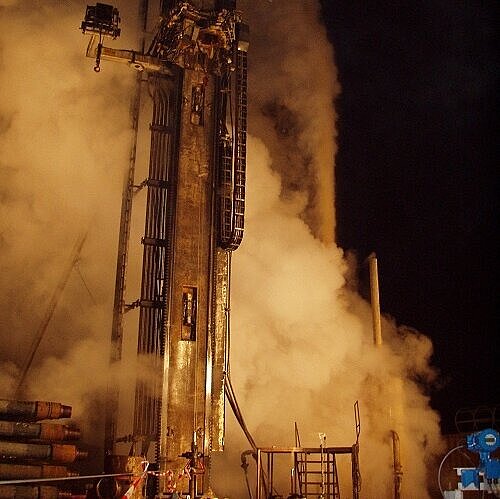
Former mines could play an important role in the future in supplying heat and cooling to residential and commercial buildings. As part of the EU PUSH-IT project, Fraunhofer IEG has now successfully completed four drillings in a former, now flooded coal mine in Bochum. Using its mobile drilling rig BO.REX, the team encountered a tunnel just a few meters wide at a depth of approximately 120 meters in each borehole: This demonstrates that precise drilling is possible at low cost even with drilling rigs designed for near-surface geothermal energy. The drillings demonstrate that flooded mines can be tapped using conventional geothermal drilling technology and can thus be utilized as heat sources or heat storage for residential buildings, data centers, and other commercial applications.
“The subsurface is a resource that has been largely overlooked in heat transformation. The project has shown that mine water can be tapped using conventional drilling techniques, even in mines that are no longer accessible. Instead of relying on complex directional drilling techniques from the oil and natural gas industry, we can also gain access to flooded mines using medium-sized equipment,” explains Florian Hahn, head of the “Post-Mining Land Use” Competence Center at Fraunhofer IEG. Even though there are natural geological formations that contain enough water for thermal applications, mines generally offer higher flow rates. In addition, they are often located in urban areas—that is, where the heat is needed for heating or as process heat. Mine water reservoirs are also ideally suited for long-term heat storage, such as from data centers, following the principle of “heating in winter, cooling in summer.”
“We can now reliably access even narrow mine cavities with a mobile system,” says Jonas Güldenhaupt, head of drilling operations at Fraunhofer IEG. “The ability to make flooded mines accessible again opens up new avenues for project developers and companies to tap into mine water for their heating or cooling needs. We combine our knowledge of the subsurface with our own drilling and measurement technology to solve complex subsurface challenges.”
From Lifetime Costs to Lasting Benefits
The high precision achieved with a medium-sized rig is particularly remarkable. At a depth of approximately 120 meters, mining voids only a few meters wide were encountered. Fraunhofer IEG planned four boreholes and carried them out using the mobile drilling rig BO.REX (Bochum Research and Exploration Drilling Rig). Despite a pulling force of 40 metric tons and a mast height of over 12 meters, the drilling rig is only 2.5 meters wide, allowing for precise operation even in small open spaces between buildings. Specially adapted counterweights on the drill string, detailed knowledge of the subsurface, and precise advance planning helped guide the drill bit deep into the flooded mine area.
Until now, abandoned mines have primarily been regarded as a long-term challenge for the mining industry. The drilling operations demonstrate that former mines can become part of the energy infrastructure for the heating transition in the future. The possibility of tapping into flooded mines through drilling can be an important option for municipal utilities, local governments, mine owners, and project developers for heating and cooling supply.
The Subsoil Is a Resource for the Heat Transition
Old mines fill with water after mining operations cease. Mine water can store a great deal of thermal energy: flooded mines can thus serve as a large “geobattery.” In the PUSH-IT project, researchers are investigating how a mine can be developed and utilized as a storage facility for excess heat with minimal effort. The boreholes provide access to the mine water body; through them, the water can be extracted and, after use, discharged elsewhere.
Stefan Klein, project manager of the Bochum-based PUSH-IT project, and his team have installed state-of-the-art measurement sensors in the boreholes and used an underwater drone to investigate the mining cavities. The images show typical clear and turbid water layers as well as the lateral rock walls and confirm that the boreholes have penetrated the correct cavities as planned. All results from the investigations will be used for further applied research at the site. The boreholes also form the basis for the upcoming storage test, which is intended to determine the site’s potential thermal storage capacity. Only then will it be possible to assess whether and how the mine can serve in the future as a heat source or heat storage facility for local users such as data centers or buildings in southern Bochum, and whether investments in surface infrastructure are economically viable.
European Project on Heat Storage
PUSH-IT stands for “Piloting Underground Storage of Heat in GeoThermal Reservoirs.” The project is testing three types of underground heat storage systems at six sites. The Bochum site features an old flooded mine that is intended to serve as an underground heat storage facility. The Fraunhofer IEG and Ruhr University Bochum are jointly developing the site. The project, involving 18 European partners, will run from January 2023 to December 2026. The grant reference number is 101096566. The EU is providing 3.8 million euros in funding for PUSH-IT at Fraunhofer IEG; the total budget is 17.9 million euros.