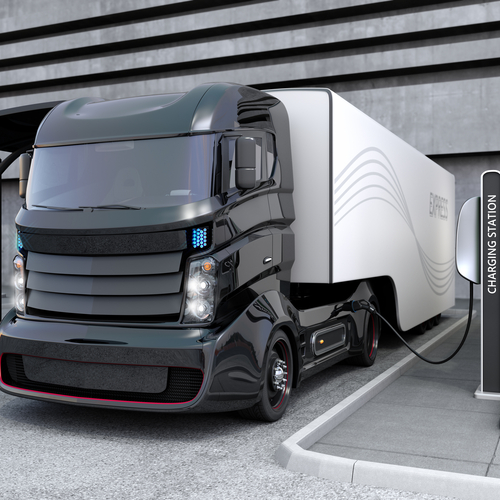
Sobering Forecast for the Rollout of Electric Trucks
A new survey of manufacturers shows that the slow expansion of the charging infrastructure and economic uncertainties, in particular, are slowing the transition to climate-friendly commercial vehicles.
November 23, 2026
Source: E & M powernews
The transition to zero-emission trucks is being delayed by up to five years. This is shown by a manufacturer survey conducted by the Federal Ministry of Transport and NOW GmbH.
In Germany, the share of zero-emission powertrains in sales of heavy trucks weighing over 12 metric tons is expected to rise to only about 30 percent by 2030. Two years ago, commercial vehicle manufacturers had forecast a 68 percent share for 2030. They now expect a market share of more than 60 percent only by 2035.
This is according to the “Cleanroom Report” published on November 19. To prepare the report, the Federal Ministry of Transport (BMV) and NOW GmbH surveyed commercial vehicle manufacturers in the spring. NOW GmbH, based in Berlin, supports the federal government on the issue of climate-friendly mobility.
During the so-called “Cleanroom” discussions, manufacturers submit their sales forecasts and technical data to a secure data room. An independent law firm anonymizes and consolidates the data before NOW evaluates it. According to NOW, the participating manufacturers represent approximately 75 percent of the market for heavy commercial vehicles in Germany and Europe. The results reflect their expectations, not confirmed market trends.
That said, electric mobility in road freight transport has certainly made progress recently. In 2025, for example, Germany’s share of purely electric trucks weighing over 3.5 metric tons among new registrations was above the EU average (as we reported). However, the latest NOW study shows that manufacturers expect a slower ramp-up for heavy-duty commercial vehicles than they did two years ago.
Battery-powered trucks are gaining ground
According to the report, however, little has changed in terms of the fundamental technological trend. Battery-electric trucks are expected to account for just under 50 percent of new registrations in Germany by 2035, thereby replacing diesel as the primary powertrain. Fuel cell trucks and trucks with hydrogen combustion engines are projected to account for a combined total of around 11 percent. However, their regular series production is not expected to begin until 2029 or later. In addition, manufacturers’ assessments of the cost-effectiveness of these powertrains vary.
For the first time, NOW has also used the sales forecasts to calculate a possible trend in the vehicle fleet. According to these calculations, the share of diesel in heavy-duty commercial vehicles in Germany will drop from 97 percent in 2026 to about 63 percent in 2035. Battery-electric trucks would then account for about 27 percent of the fleet.
In terms of technology, manufacturers now consider battery-electric trucks to be practical. They cite ranges of 500 to 600 kilometers. According to manufacturers’ estimates, due to lower energy and maintenance costs, these vehicles could already be more cost-effective than diesel trucks over their lifetime in certain applications. Most manufacturers expect that, given sufficient mileage and affordable electricity costs, battery-electric trucks will be just as economical as diesel trucks in various applications by 2030.
Charging Infrastructure Remains a Bottleneck
The manufacturers surveyed cite the slow expansion of the charging infrastructure and a lack of economic incentives in many European countries as key obstacles (as we reported). In particular, the expansion of public fast-charging stations is progressing too slowly. Charging at depots is also important. Here, lengthy procedures and limited grid capacity are complicating the connection process.
The German Association of the Automotive Industry (VDA) had already voiced this criticism a few months ago (as we reported). It cited data from the National Charging Infrastructure Control Center, which is part of NOW. According to this data, there were 390 public truck charging stations in Germany at the end of August, with a combined capacity of 106 MW. A significant portion still uses the Combined Charging System (CCS) and is not designed for megawatt charging. The VDA estimates that there will be approximately 4,000 public charging points equipped with the Megawatt Charging System (MCS) by 2030.
Meanwhile, the federal government is working on a truck fast-charging network along highways. According to NOW, contracts have been awarded for locations at unstaffed rest stops. Grid connections have been ordered for the truck charging sites. The company also points to subsidy programs and the extended toll exemption for zero-emission trucks through mid-2031.
Chinese Manufacturers Increase Competitive Pressure
Competition from China is also a concern for European manufacturers. New entrants could accelerate electrification, but at the same time put pressure on established companies. Chinese manufacturers were surveyed for the first time, but their sales figures were not included in the forecasts.
The 27-page study,“Market Development of Climate-Friendly Technologies in Heavy-Duty Road Freight Transport,” is available for download as a PDF on the NOW GmbH website.
Author: Davina Spohn