Creative Tech: Why Deep Tech Needs Creative Perspectives
The Intersection of the Creative Industries and Future Technologies
October 26, 2026
From artificial intelligence and extended reality to robotics and other deep tech fields: Future technologies are changing the way we work, shop, and design digital experiences. Technological progress creates new opportunities, but successful innovations only emerge when technology and user needs come together.
Imagine walking into a store from the comfort of your own sofa. You can look around, discover products, and interact with other people—all within a virtual world.
This is exactly where Creative Tech comes into play. Whether it’s artificial intelligence, robotics, or extended reality: When creative ideas meet innovative technologies, new applications and future-proof solutions can emerge.
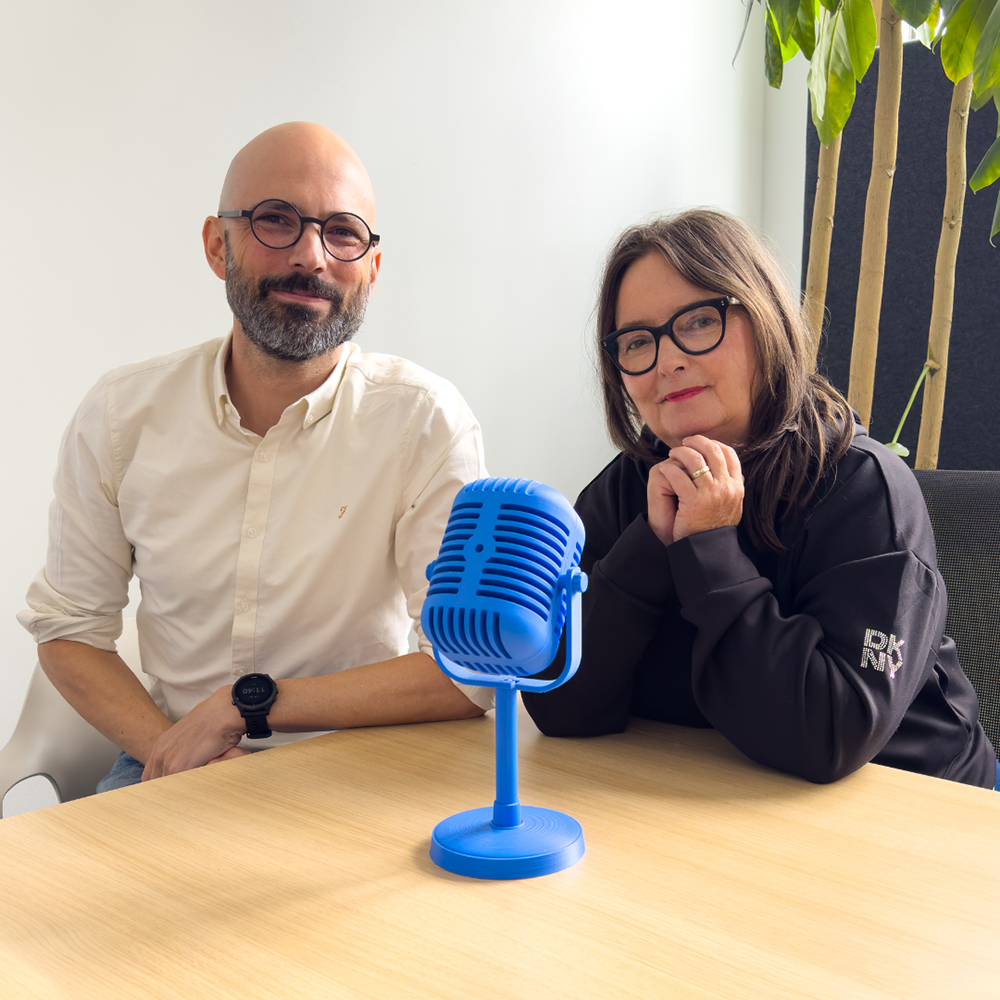
In this interview, Andreas Auberger, Head of the CreativeTechHUB at Bayern Innovativ, offers insights into the potential of Creative Tech and explains why collaboration between the technology and creative industries is so important.
What do you mean by “Creative Tech,” and what’s new about it?
Andreas Auberger: That’s a really exciting and relevant question, because there hasn’t been a uniform definition of “Creative Tech” yet. We’ve defined Creative Tech for ourselves as the targeted synergy of creative and technological expertise, aimed at enabling better products, better services, and better collaborations in specific use cases.
And in Creative Tech, creativity isn’t just the packaging, the color, or the bow—it’s an essential, fundamental component that makes technology more tangible, while also allowing us to draw inspiration from technology from a different perspective, thereby becoming even more creative and continuing to learn.
So, ideally, creativity and technology come together in the middle of the development phase—or perhaps even at the very beginning?
Andreas Auberger: Wherever it makes the most sense in the process. The sooner, the better, I’d say. The sooner you can bring in a different, more nuanced perspective, the better. And that’s also a good transition to the question of what’s actually new about this.
We want it to no longer be a matter of chance—or depend on connections—whether I, as a technology company, can reach out to someone who brings this artistic and creative perspective to the table. Instead, we want the whole process to have a structure and be approached in a planned manner. We want to create a place, a space, a context that facilitates an accessible convergence of these perspectives and a collaboration that, above all, leads to cross-industry partnerships.
Apparently, when it comes to future technologies, it’s not enough to simply look at things through an engineer’s lens—creativity is also needed. Why?
Andreas Auberger: To put it simply: Technological feasibility does not automatically guarantee a good application. From an engineering perspective, I naturally develop the best AI, the best chip, or the best VR headset available on the market. But if the context, the use case, the integration, and the human-machine interaction aren’t carefully considered and designed, then a gap emerges somewhere.
And that, I believe, is the crux of the matter—where these two disciplines, if you will, can enrich one another. But behind each of these disciplines—creative and tech—lies a diverse portfolio of very different players who are hardly comparable.
And that is both the challenge and the potential of the work we’ve set out to do: figuring out these one-to-one relationships. Who is a good fit for whom because they can enrich each other? Who needs whom? And who is actually out there?
And what questions do I actually need to ask myself—ones I wouldn’t even think of on my own because I lack the perspective to recognize them and critically examine my own product development? These are precisely the key points.
And what has been your experience so far? Are both technologists and creative professionals open to this kind of collaboration?
Andreas Auberger: My experience from personal conversations over the last three to four months—during which I’ve been delving deeply into the topic—is that there’s always a big question mark at the beginning when you bring up the term “Creative Tech.” What’s actually behind it, and how does it relate to me?
In most cases, though, that confusion clears up within a minute or two once you outline the concept a bit, just as we’ve done now. Then you suddenly see it in the other person’s eyes: a fireworks display of ideas is about to go off.
Immediately, a great many points of intersection become apparent—areas where you can get involved, benefit, and find common ground that makes perfect sense to leverage structurally. That’s what I’ve observed so far.
You just explained what “Creative Tech” means. Many people initially think of media, games, or design when they hear that term. But you also focus on technologies like artificial intelligence, robotics, and extended reality. Why these areas in particular?
Andreas Auberger: This is partly due to Bayern Innovativ’s strategy, which is to focus on high-tech and deep-tech applications in order to establish a specialized profile and, above all, to delve into applications that are still in a very exploratory phase.
It is precisely there that what we outlined earlier becomes evident: an engineering world that aims to develop the best available technology—if I may put it that simply.
At the same time, it is particularly important with these high-tech and deep-tech applications to integrate design, creative, interaction, and context-oriented disciplines and perspectives from the very beginning and to ensure accessibility.
There could be no better scenario than if we in Bavaria had the closest possible integration between technology and creative professionals, enabling the Bavarian economy to bring the most creative and best technology products to market.

That sounds logical and makes sense. Do you have any examples that particularly illustrate how creative approaches have turned a technology into a concrete application?
Andreas Auberger: I came across one example at Tech Days. Although we at CreativeTechHUB weren’t directly involved yet, I still find it very illustrative.
An artist, musician, and singer acquired sensor gloves and integrated them with music. This allows her to generate sounds through the movements of her hands and body. She programmed this herself behind the scenes and essentially puts on a one-woman show on stage. This is something she developed and explored out of her own interest. She then reached out to the manufacturer and said: “I’m using the gloves for these purposes. Let’s talk about it together and see how we can both benefit from this.”
I think this is a very good example that illustrates how something mundane—like a technological sensor glove straight off the production line—can be repurposed in a completely different context.
The field of humanoid robotics is also fascinating. A robot can function perfectly from a technical standpoint. But the way it moves, speaks, and reacts to people is ultimately decisive for how we interact with it, isn’t it?
Andreas Auberger: Correct—probably even more so than how well it performs its task. The way we interact with a technical device is similar to how we interact with our fellow human beings. After all, we’re not in a vacuum where the robot simply performs its task and is then done.
With humanoid robots in particular, we encounter the phenomenon of resemblance to the human form. This is intentional. As a result, such a robot must meet the quality standards we consciously or unconsciously expect of it. This has a lot to do with acoustics, charisma, and the impression it makes. A humanoid robot must meet all these factors—which we also attribute to a human—in order to be successful in its application, not just technologically.
This also raises some very fundamental questions: How does a humanoid robot behave when it’s not actively engaged? What does it do then? How does it position itself in the room? Does it sit down or stand in the corner? It’s certainly a very strange situation when a humanoid robot goes to the corner of the room to charge and sits down there. Everyone notices that.
To quote a robotics developer: Does it then sit on the little toilet? Or how does one do that? How does this interface work?
As a technologist, I might be able to answer that from an efficiency perspective: What’s the smartest approach from a technological development standpoint? But that doesn’t always align with the smartest answer from a design perspective—one that’s much more human-centered.
So it’s also about trust and acceptance.
Andreas Auberger: Correct, yes. Trust and acceptance—if I may briefly pick up on that—among users when interacting with the technology, but also trust and acceptance within the creative tech community.
We want to bring technology companies and people in the cultural and creative sectors together and create a bridge between them. This should make trusting and effective collaboration possible.
I don’t imagine that’s all that easy, since they speak a completely different language.
Andreas Auberger: Their experiences are quite different, the language is different, and their individual circumstances and goals are also very different. But what’s valuable to us—and why it’s worth pursuing—is bringing these different skills and perspectives together.
It’s about creating a space where trust can develop, where people are open to other perspectives and new ideas, but also allow for criticism of their own product development. At the same time, we need an action-oriented perspective: What could we do with this?
And how can someone from the creative side inspire, motivate, engage, and help someone from the tech side grow—and vice versa?
I’d like to address the field of health and care. How can technologies like AI or extended reality help in this area, and why does this require creative expertise?
Andreas Auberger: I believe it’s particularly evident in this sector that the context of care and healthcare applications requires a special sensitivity. And there are different approaches.
One thing that probably comes to everyone’s mind first is this care-support seal—an AI-powered stuffed animal that looks cute, cuddly, and empathetic. It can be used in care settings to accompany people in need of care, offer them someone to talk to, create opportunities for interaction, and perhaps even calm them down. It works on a similar principle to that of pets. Of course, there’s technology behind it, but this technology also needs to be properly integrated.
And by “integration,” I don’t just mean the plush fur, but rather the entire context surrounding this technology. I believe this is the first thing many people think of when considering how technology can find its way into the healthcare system.
At the same time, however, I’m also thinking of areas such as training, simulation, or preparing staff for difficult situations through virtual applications. How can this be structured? How might we project it into a room? How can we create a learning environment that goes beyond simply clicking through and answering a questionnaire, making the educational element much more tangible?
So you’re creating a world in which nursing staff and trainees can learn and train more effectively. Immersive technologies are also opening up new possibilities in the cultural sector. How are they changing our cultural experience, and what potential do they still hold?
Andreas Auberger: I think that when we reflect on our own experiences visiting museums or cultural institutions in general, everyone has at some point downloaded an app that accompanies and enhances the museum visit. Sometimes it might even include a VR application. That gives us a glimpse of where this journey can, will, and should go—and hopefully will go.
So how can we design immersive experiences where technology meets cultural institutions and supports the educational aspect? It’s not just about creating great applications and scenarios on a purely entertainment level, but also about truly enabling an experience on a deeper level.
For example, to bring history to life?
Andreas Auberger: Exactly. That raises the question of how knowledge transfer can be structured in a museum. I wouldn’t presume to call myself a professional or an expert in this field. But there’s a difference between reading an information panel and being invited into a real or virtual space where I suddenly find myself standing in the Colosseum in Rome. Maybe I can hear the sounds, maybe I can smell it, or maybe the sand even gets up my nose. That way, I’m much more immersed in the situation and can engage with it using all my senses.
I can also imagine that, at some point, we’ll be able to bring the museum into our homes or schools using immersive technologies.
Andreas Auberger: Yes, and that’s what makes working in this field so appealing to me, because so much of it is unpredictable.
As intermediaries, we want to create a space where people can come together and form collaborations. Often, it’s still completely unclear where the collaboration will lead and what will ultimately come of it.
If we look ten years into the future: Will we even still distinguish between technology and creativity? Or is the exciting part precisely that we can’t foresee the development at all?
Andreas Auberger: I would absolutely emphasize that the concrete result for a specific use case doesn’t have to be foreseeable at all.
And when I think about the next ten years, I hope that we’ve made a major contribution to ensuring that, in the development of products—whether in the tech or creative sectors—the other’s expertise and perspective are taken into account.
That it becomes second nature to bring this different perspective to the table and perhaps to use us or our ecosystem to find the right connections. In other words, that it becomes accessible and a matter of course.
And that, as a result, better products will ultimately emerge on the tech side, but also better—or perhaps entirely new—products on the cultural and creative side, because these sectors have grown much closer together with the tech scene.
Now I have one more very personal question: Which technological development do you find most exciting right now, and why?
Andreas Auberger: If I had to pick one, it would actually be XR and VR—in other words, everything that has to do with expanding the space I’m in. I believe there’s still an incredible amount of scope and potential there.
And the exciting thing about it is that I simply can’t predict it, because I lack the perspective to foresee it. I’d love to embark on this journey into the unknown and let myself be carried along.
The interview was conducted by Barbara Groll, Media Relations, Bayern Innovativ GmbH, Nuremberg.