The Bavarian fusion network brings together companies, start-ups and research institutions along the entire fusion energy value chain. From high-performance materials, cryogenic and vacuum technology, precision optics and manufacturing technologies to innovative reactor concepts and laser approaches through to safety, engineering and technology transfer - this is where the industrial foundation for the energy of tomorrow is being laid.
Our map shows the players, competencies and connections that are working together to make fusion energy a reality.
Center for Applied Energy Research e.V. (CAE)
Center for Applied Energy Research e.V. (CAE)
Magdalene-Schoch-Str. 3
97074 Würzburg
Deutschland
https://cae-zerocarbon.de/
Dr. Hans-Peter Ebert
Geschäftsführender Vorstandsvorsitzender
Tel.: +49931 70564334
Contact per mail
Slogan
Thermophysics for the fusion of tomorrow
Profile
CAE's R&D activities are aimed at transferring ideas into practice in cooperation with commercial enterprises and research partners, thus contributing to a sustainable, CO2-emission-free and economical energy system. CAE acts as a bridge between basic research and market-oriented development. The institute is recognized as an authorized research association in the "Industrial Collective Research" (IGF).
Further information
CAE is a member of the ForschungsVerbund Erneuerbare Energien (FVEE) and the ZUSE-Gemeinschaft.
With its working groups "Climate-neutral buildings and districts", "Smart functional materials", "Advanced thermal management", "Sensors for energy and hydrogen technology" and "Energy system management and technology integration", CAE carries out necessary research and development work for industry and provides new impetus for innovation. The future topics of "hydrogen technology", "digitalization in energy technology", energy research for space applications and sustainability consulting "synstep" are supported separately and synergy effects are achieved in a separate Innovation Hub. CAE's own "Guided Makerspace" gives young companies quick and unbureaucratic access to scientific machines and test stands as well as to experts in CAE's core areas of expertise.
Technology / Research
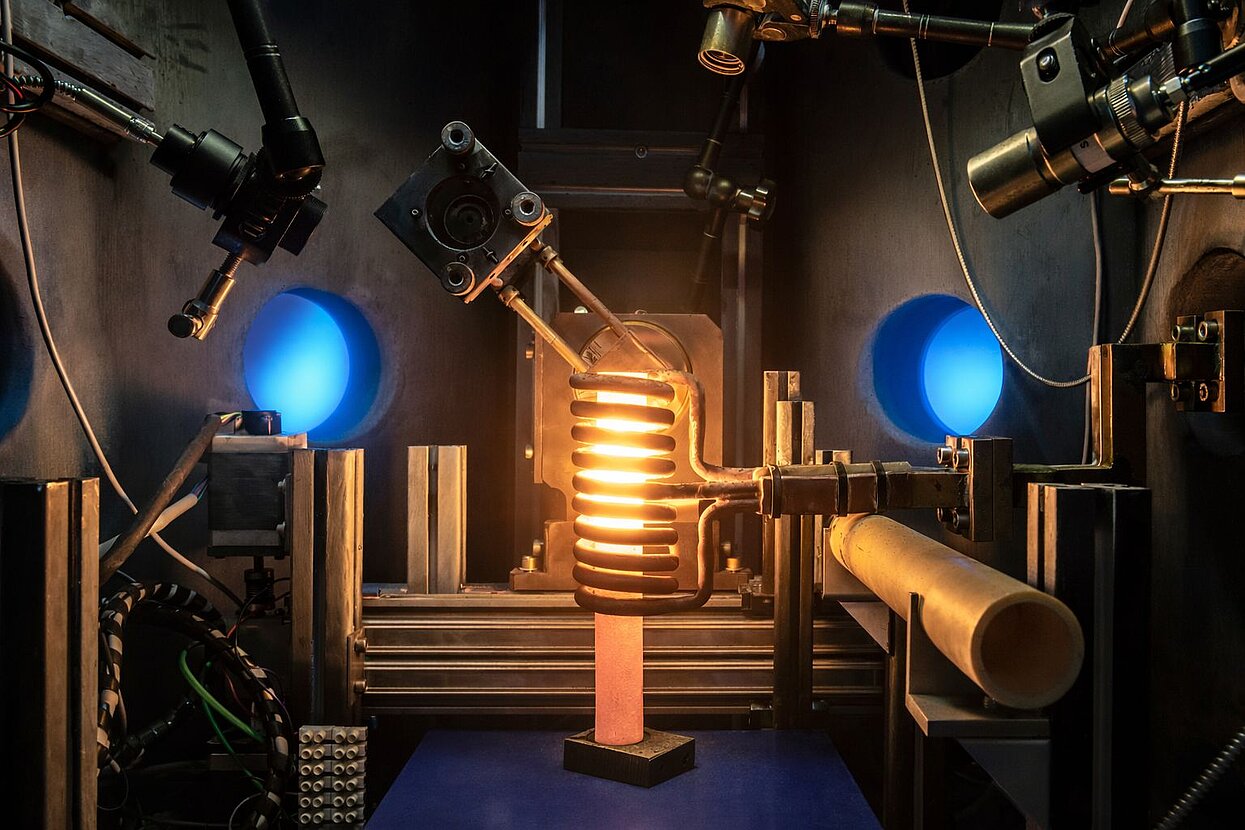
The CAE working group Advanced Thermal Management has an in-depth understanding in the areas of thermophysical characterization, modelling and material development. This forms the necessary basis for innovative and efficient thermal management of processes and products. The experimental equipment for high-precision and traceable characterization of thermal and thermo-optical properties in a wider parameter range (e.g. temperature range from 15 K to 3000 K, gas pressure range from 10-3 hPa to 100 MPa) is only available to this extent and quality in very few research groups, even on an international scale. Overall, a high level of internationally recognized expertise is available in the field of thermophysics, which is complemented by comprehensive experimental equipment of exceptional quality.
In the field of fusion research, for example, emissivities in the temperature range of 80 K and 120 K were determined from material surfaces for the ITER TOKAMAK. Very low emissivities are required here in order to keep the heat input and the associated thermal load on the components sufficiently low.
The CAE working group Smart Functional Materials has many years of in-depth expertise in the field of chemical synthesis and processing of nano-structured materials, in particular high-performance insulation based on aerogels; the scalability of the materials plays a key role in application-oriented developments.
Products / (services) performances
Determination of thermal and infrared-optical parameters, such as
- thermal conductivity
- Thermal diffusivity
- Specific heat capacity and phase transition enthalpy
- Thermal expansion coefficient
- Emissivity, absorptivity, reflectivity and transmittance
- Extinction coefficient, absorption coefficient, scattering coefficient and albedo
- Radiant thermal conductivity, thermal conduction and thermal radiation
- Refractive index and dielectric function (real part and imaginary part respectively)
- Temperature (non-contact temperature measurement using radiation thermometry and thermography)
Depending on the measured variable, the measurement and parameter range is
- Wavelength from 0.2 µm to 500 µm
- Temperature from 15 K to 3200 K
- Angle from -90º to +90º
- Gas pressure from 10 hPa to 100 MPa
- the measurements are carried out in defined atmospheres (gas pressure and gas type).
Modeling and simulations
Simulation and modeling of heat transport with all transport mechanisms
Modeling of radiation and heat exchange between surfaces
Material development and optimization
Support in the development and optimization of materials, components and systems with outstanding and tailored thermal and infrared-optical properties
Thermal management of processes and products
Analysis and improvement of thermal processes and production methods
Non-contact measurement methods for thermal process control and regulation
Conducting contract research and coordinating and implementing funded research projects
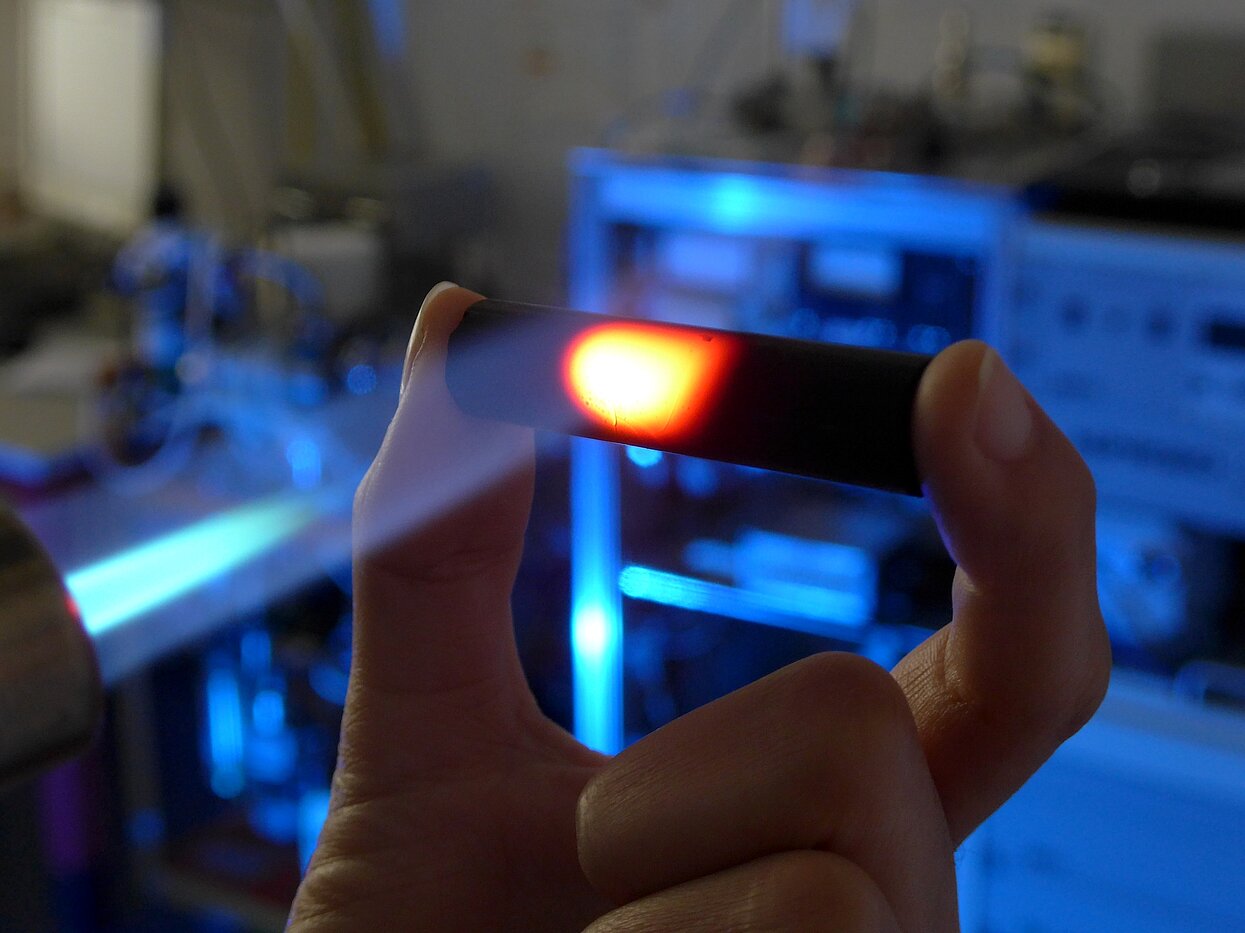
Development of high-performance thermal insulation (up to over 2500 °C) based on carbon aerogels (synthesis, material and structural characterization, optimization for application, scaling)