



Artificial intelligence is transforming products, processes, and value creation. For companies, the question is therefore no longer just what potential AI offers, but how it can be implemented quickly and efficiently.
AI Innovation Day 2026 offers concrete insights into the work of the Augsburg AI Production Network. The program features keynotes, best practices from industry and research, breakout sessions, guided tours, and networking.
The event is aimed at a select group of participants from politics, industry, research, and networks. The focus is on in-depth discussions, concrete project experiences, and new connections among the stakeholders shaping the AI-based production of the future.
Why now?
Artificial intelligence has long been more than just a topic for the future. It is becoming a decisive factor for competitiveness, resilience, and innovation. At the same time, many companies are finding that the transition from an idea or pilot project to robust implementation remains a key challenge.
This is where the AI Innovation Day comes in. The event demonstrates how AI can be brought into industrial application more quickly, what prerequisites are crucial for this, and how strong partnerships between academia, industry, networks, and policymakers can accelerate this transfer. At the same time, the event highlights the expertise, projects, and perspectives that the Augsburg region already brings together in this field today.
Key Topics
- Bringing AI into Practice: Artificial intelligence offers enormous potential for production, processes, and new business models. The crucial question, however, is how technological possibilities can be transformed into concrete industrial applications. The AI Innovation Day highlights the approaches, methods, and partnerships that are essential for this.
- Research & Industry: Innovations emerge where research, development, and industrial practice converge. The event highlights how companies and research partners in the Augsburg AI Production Network are jointly developing solutions and what concrete added value this generates for industrial applications.
- Guidance & Networking: The introduction of AI requires not only technological expertise but also strategic guidance, suitable framework conditions, and strong networks. The AI Innovation Day brings together the relevant stakeholders and creates a space for exchange, new connections, and shared perspectives.
Key Questions
- How can artificial intelligence move more quickly from research to industrial application?
- Which AI projects are already generating concrete benefits for companies today?
- What conditions do companies need for successful implementation?
- How can academia and industry collaborate more sustainably?
- What role do skilled workers, data, and infrastructure play?
- How does the Augsburg AI Production Network strengthen the region as a hub for innovation?
About the Augsburg AI Production Network
The Augsburg AI Production Network is a consortium comprising the University of Augsburg, Augsburg University of Applied Sciences, the Fraunhofer Institute for Foundry, Composite, and Processing Technology IGCV, and the Center for Lightweight Production Technology (ZLP) of the German Aerospace Center (DLR) in Augsburg. Regional industry partners are also involved. The goal is to conduct joint research on AI-based production technologies at the intersection of materials, manufacturing technologies, data-driven modeling, and digital business models.
Here's what you can expect:
- Gain perspective: Get insights into the strategic, political, and technological framework for AI in manufacturing and industry.
- Experience real-world applications: Discover specific projects and best practices resulting from collaboration between industry and research.
- Initiate collaborations: Meet key contacts from politics, industry, academia, and professional networks.
The AI Innovation Day is aimed in particular at:
- Policy makers
- Executive management
- Leaders in production, innovation, and digitalization
- Representatives of technology providers
- Representatives of research institutions
- Stakeholders and partners of the Augsburg AI Production Network
Keynote: Industrial AI: Balancing Innovation and Risk Management
How can the potential of industrial AI be harnessed in a secure and scalable manner? This keynote will highlight successful use cases, the requirements for AI at the industrial level, and the role of AI risk management in ensuring trust, reliability, and compliance.
Workshop: How Is Learning in the Workplace Being Rethought?
How can companies use AI not just as a tool, but as a catalyst for a new culture of learning and knowledge? The Center for Future Production provides practical insights into AI-based educational initiatives with companies and demonstrates how innovative learning formats open up new avenues for knowledge transfer. The focus is on a new project that combines practical, workplace-oriented learning through social video with the knowledge and expertise of the Centre for Future Production, carried out in collaboration with the Augsburg-based EdTech company Ghostthinker GmbH.
Pamina Zwolsky
AI Education Program, Center for Future Production / University of Augsburg
Martina Friedsmann
AI Education Program, Center for Future Production / University of Augsburg
Johannes Metscher
Managing Director & Head of Development, Ghostthinker GmbH
Workshop: AI-Based Security Testing
This presentation demonstrates how local AI models can help identify security issues in digital production systems within IT/OT networks without data leaving the company. The focus is on practical application scenarios as well as the opportunities and limitations of AI-supported security testing.
Prof. Dr. Lothar Braun
IT Security, Department of Computer Science / Augsburg University of Applied Sciences
Workshop: AI in Manufacturing—From Problem to Solution
The use of AI is widely discussed, but how AI can actually be applied in practice is often not entirely clear. We’ll present concrete examples of AI applications at the DLR Center for Lightweight Production Technology and explore where and how AI can be used to benefit your business. Afterward, workshop participants will take the lead: based on your specific questions, we’ll work with you in small groups to develop ideas and approaches for implementation and identify technologies and potential partners for your AI project.
Dr.-Ing. Lars Larsen
Head of ZLP Augsburg, Center for Lightweight Production Technology (ZLP) of the German Aerospace Center (DLR) in Augsburg
Dr. Alfons Schuster
Group Leader at ZLP Augsburg, Center for Lightweight Production Technology (ZLP) of the German Aerospace Center (DLR) in Augsburg
Presentation: From Data Chaos to Scalability: Data Context as the Foundation of Industrial AI
There is often a significant gap between promising AI use cases and the reality on the shop floor: Scalable AI solutions require more than just large amounts of data—context is crucial. Drawing on concrete real-world experience, this presentation will highlight the success factors involved in implementing a semantically consistent database that serves as the foundation for end-to-end digitalization in production.
Lukas Wittmann
Group Leader for IoT and Connected Production, Fraunhofer Institute for Foundry, Composite, and Processing Technology IGCV
Presentation: Hybrid Process Models Meet Frontier AI: Toward Autonomous Process Optimization in Manufacturing Technology
This presentation will explore the possibilities of combining Frontier AI models with specialized data-driven process models to enable largely automated process optimization.
Prof. Dr.-Ing. Philipp Lechner,
, Data-Driven Materials Processing, University of Augsburg
Presentation: Digital Twin of Cooling Processes in an Industrial Setting
Derived from the thermal management of the H2-cooled engine. Focus on MBSE and systems engineering.
Prof. Dr.-Ing. André Baeten
Research Professor of Lightweight Construction and Fiber Composite Technologies, Faculty of Mechanical and Process Engineering, Augsburg University of Applied Sciences
Workshop: AI in Manufacturing—From Problem to Solution
The use of AI is widely discussed, but how AI can actually be applied in practice is often not entirely clear. We’ll present concrete examples of AI applications at the DLR Center for Lightweight Production Technology and explore where and how AI can be used to benefit your business. Afterward, workshop participants will take the lead: based on your specific questions, we’ll work with you in small groups to develop ideas and approaches for implementation and identify technologies and potential partners for your AI project.
Dr.-Ing. Lars Larsen
Head of ZLP Augsburg, Center for Lightweight Production Technology (ZLP) of the German Aerospace Center (DLR) in Augsburg
Dr. Alfons Schuster
Group Leader at ZLP Augsburg, Center for Lightweight Production Technology (ZLP) of the German Aerospace Center (DLR) in Augsburg
Presentation: Extracting Insights from Scattered Data: Verifiable Answers for Production
Test reports, Excel spreadsheets, reports, photos: Most companies already have the knowledge about their own processes and products—it’s just scattered across many locations and in many formats. As a result, even simple questions about a complex production process can quickly become time-consuming. This presentation will demonstrate two ways to answer such questions using AI. The Quick Approach: An assistant searches the original files and provides an immediate answer. The Thorough Approach: With the help of AI, the data is converted into a knowledge graph once. Afterward, every number can be traced back to its source, the same batch is recognized as such across all sources, and experts determine what is considered verified. Only then can correlations be examined—for example, which process settings are linked to which product properties—and documentation such as a digital product passport be created.
Thomas Bjarsch
Department of AI and Digital Engineering, Fraunhofer Institute for Foundry, Composite, and Processing Technology IGCV
"Research Meets Industry"
Under this motto, companies and research partners will work together to showcase what has already been implemented and the insights gained from their collaboration.
TrustME—Toward Certifiable AI in Aviation Manufacturing
How does AI research become a trustworthy application for industrial practice? Research and industry are working together to harness the potential of AI and overcome challenges related to data quality, traceability, and certifiability. The focus is on practical AI systems that meet regulatory requirements such as the EU AI Act and the certification standards of the European Aviation Safety Agency (EASA).
Holger Weber
Research Scientist, Center for Lightweight Production Technology (ZLP) at the German Aerospace Center (DLR) in Augsburg
Martin Frank
AI Manufacturing Engineer, Industrial Robotics & Automation, Airbus Aerostructures GmbH
High Mix, Low Volume, High Value: How Data Analytics Improves Quality in Electronics Manufacturing
Using the joint EBQuoPro project as an example, Rohde & Schwarz and the Augsburg University of Applied Sciences demonstrate the potential that data analytics offers even in a high-mix, low-volume production environment. What matters most is not so much the sheer volume of data as the targeted collection and linking of relevant design, process, and quality parameters. This allows for statistically sound analysis of the relationships between these parameters and enables insights from diverse production processes to be leveraged for future decisions. The duo provides insights into concrete results and experiences from the collaboration between research and industrial practice.
Dr. Bruno Scheffold
Director of Technical Support, Rohde & Schwarz
Prof. Dr. Björn Häckel
Professor of Digital Value Networks, THA
Batch Size 1 Instead of Mass Production: How AI Shapes Sheet Metal Stroke by Stroke
Abstract: In the automotive industry, expensive stamping dies are worthwhile because they produce thousands of identical sheet metal parts. For a production run of just one, this is uneconomical: Each part is shaped by hand, stroke by stroke. But this craft is dying out. Fraunhofer IGCV and Garage Inx demonstrate how artificial intelligence can help here. In a virtual workshop, an AI agent learns the sequence of individual forming steps required to bring a sheet of metal into the desired target shape. The presentation will showcase initial results and outline the path toward automated production for single-unit runs.
Speakers:
Ronald Müller; Managing Director; Garage Inx UG
Sebastian Maier; Senior Scientist – Industrial AI; Fraunhofer IGCV
Predictions in Seconds: AI in the Injection Molding Process
Injection molding is a key industrial manufacturing process used to produce a wide variety of plastic components. Physical simulations are the established method for designing components and molds, but they typically require several hours of computation time. AI-supported models, on the other hand, can make predictions within seconds, enabling the rapid evaluation of many variants—especially in early development phases.
Prof. Dr. Nils Meyer
Data-Driven Product Engineering and Design, University of Augsburg
Dr. Jan-Martin Kaiser
Head of the Component Design, Reliability, and Validation Polymers Research Group, Robert Bosch GmbH
Basic Models for Practical Use Instead of “Higher, Faster, Further”: Multimodal AI from Bavaria for Reliable Applications
Since May 2026, as part of the Bavarian AI Foundation Model Initiative funded by the StMWK, more than 80 scientists and developers at Bavarian universities and colleges have been developing open AI foundation models. These models are intended to enable concrete applications in science, public administration, and industry—particularly in robotics and healthcare. In this process, text, images, and video are linked with other modalities such as haptic data, radar, time series, and omics data. The modular approach is designed to allow for targeted adaptation to specific requirements.
Dr.-Ing. Jan David Smeddinck
, Executive Director of the Bavarian AI Foundation Model Initiative, Ludwig Maximilian University of Munich
Keynote: The Future of AI Robotics
The convergence of artificial intelligence and physical robotics, combined with software platforms, makes it possible to simplify access to intelligent automation and scale industrial deployments. This keynote will explain how Intrinsic’s platform provides essential tools, infrastructure, robotic capabilities, and native ROS interoperability to bridge the gap between the flexibility of a makerspace and commercial, industry-ready deployments.
By building a collaborative developer ecosystem through open-source contributions, regional partner projects, and turnkey reference solutions, developers are empowered to efficiently create and deploy highly complex and variable robotic applications. Participants will learn how foundation models and a shared, open software base accelerate AI adoption and scale intelligent automation across the entire robotics market.
Guided Tours
Guided tours will take place from 3:30 p.m. to 4:30 p.m. to conclude AI Innovation Day. You can choose from the “Halle 43” AI Experience Room at the University of Augsburg, a joint tour of the DLR ZLP in Augsburg and the Fraunhofer IGCV, and the Recycling Atelier Augsburg at the Augsburg University of Applied Sciences. Separate registration is required for the guided tours; each person may select only one tour.
“Halle 43,” the DLR ZLP in Augsburg, and the Fraunhofer IGCV are all within a few minutes’ walk of each other. A shuttle bus is available to the Augsburg University of Applied Sciences’ Recycling Atelier.
Venue – Augsburg Technology Center
The Augsburg Technology Center is the main venue for AI Innovation Day 2026. This is where the opening ceremony, keynote speeches, technical discussions, and networking will take place. Ample parking is available directly in front of the building or in the immediate vicinity.
Drivers should follow the signs on the B17 from the “Haunstetten Nord” exit; public transportation is within walking distance via tram line 3 to the “Landesamt für Umwelt” stop. Further details on how to get there are available on the Technology Center’s website.
Augsburg Technology Center
Am Technologiezentrum 5
86159 Augsburg
Tour - DLR Center for Lightweight Production Technology and Fraunhofer IGCV
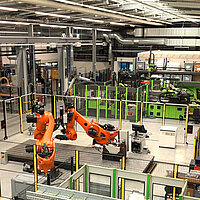
The DLR ZLP Center for Lightweight Production Technology in Augsburg and the Fraunhofer IGCV are jointly participating in the afternoon tour program. The tour provides insights into research, production, and industrial implementation within the Augsburg AI Production Network. Special safety requirements apply to this tour, and separate registration is required.
Guided Tour - "Halle 43" AI Experience Space at the University of Augsburg
In the "Halle 43" AI Experience Center, the University of Augsburg, together with partners from the AI Production Network and various companies, is conducting research on industrial-scale facilitiesspanning 5,300m². During the guided tour, participants gain insights into the University of Augsburg’s current research and application topics.
Guided Tour - Recycling Atelier Augsburg at Augsburg University of Applied Sciences
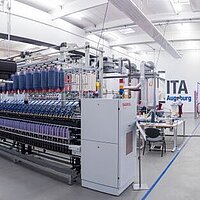
Used textiles are a valuable raw material. The “Recycling Atelier” at Augsburg University of Applied Sciences is the world’s first model factory for mechanical textile recycling and covers the entire textile value chain. During the tour, researchers from the AI Production Network at Augsburg University of Applied Sciences explain how high-quality textile recycling can help many industries solve their raw material challenges.
Thank you very much for your interest in our guided tours. Unfortunately, the registration deadline has already passed.