Circular Construction: From Pilot Project to Economic Standard
Why closed-loop material cycles, urban mining, and reuse are already economically viable today, and what conditions can accelerate this transition
September 24, 2026
Circular construction is considered a key to a resource-efficient, climate-friendly, and sustainable construction industry. Numerous pilot and flagship projects have long demonstrated that circular principles are technically feasible. Nevertheless, the concept has not yet gained widespread acceptance. Frequently cited concerns relate to quality, additional effort, and supposedly higher costs.
Author: Dr. Eva Halsch
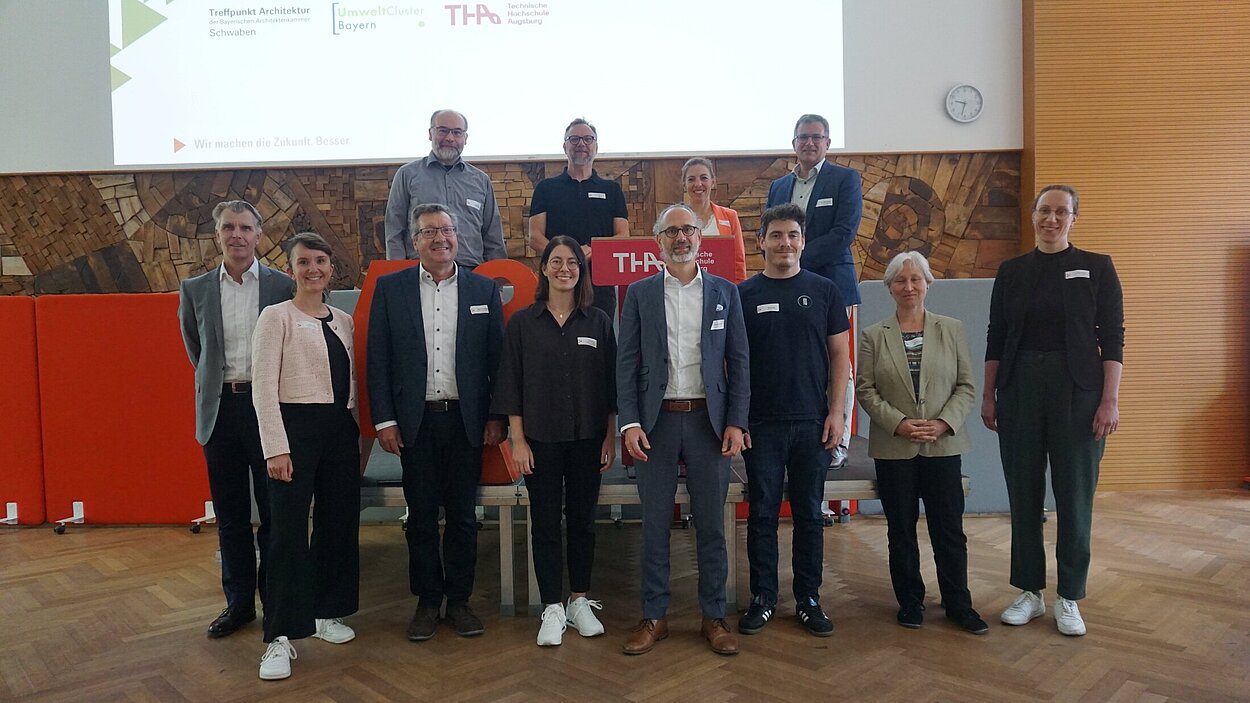
The sixth event of the Augsburg Circular Construction Network took a closer look at these objections on September 22, 2026. Under the title “Circular Construction—Economically Viable?”, experts from the fields of planning, construction, and demolition, as well as from business and public administration, gathered at Augsburg University of Applied Sciences to discuss the opportunities and challenges of a construction method that keeps materials in circulation. Their joint conclusion: Circular construction is already economically and technologically competitive today—and in some areas, it is even superior.
The expert speakers—drawing from the fields of planning, construction, and demolition, as well as business and public administration—agreed: the principle of circularity must and will prevail in the long run. It is already economically and technologically comparable to current construction practices and, in some respects, even superior. The biggest obstacles lie in a lack of information, a lack of practical experience, and a reluctance to move away from established ways of thinking and building. A shift in mindset is needed!
Combining procurement and disposal is the key to cost-effectiveness
Stefan Schmidmeyer, Managing Director of Baustoff Recycling Bayern e.V., provided a summary from the perspective of waste management and recycling companies. In this area, much more is technically feasible and regulated by standards than is commonly believed. For example, excavated soil is not waste, but a raw material from which new building materials can be produced. Demolition material can be reused without hesitation in accordance with the Substitute Building Materials Ordinance, and proven, reliable technologies are available for the removal of hazardous substances. All of this is economically viable. But the key to economic viability lies in considering procurement and disposal together and addressing the resulting material flows early on in the planning phase.
Julia Weißert from the German Sustainable Building Council (DGNB e.V.) provided insight into how circular construction will become the new standard. Circularity is already an important criterion in existing certification systems for sustainable building and a prerequisite for funding and grants. This trend will intensify even further in the future. Both at the EU and federal levels, new regulations and amendments are in the pipeline for the coming years that will further advance this issue. Taxonomy, the Construction Products Regulation, and GWP limits are just a few key terms here. In the future, the question of economic viability will no longer be limited to “How much do I need to invest today?” but will also include “What will my built-in materials be worth tomorrow?”
Thinking of Buildings as Material Storage and Thus Increasing Real Estate Value
Benjamin Sillack, Director of the Center of Excellence for Sustainable Construction, Assets, and Building in Baden-Württemberg, presented a case for a shift in thinking. Approximately 15.5 billion metric tons of building materials are contained in Germany’s buildings—that’s 188 metric tons per capita. Given the sharply rising prices in the building materials market, the question naturally arises as to whether these materials should really be considered waste at the end of their useful life. If buildings were conceived and designed in the future as material repositories, construction costs would no longer be “costs” but rather investments in the built material repository, and circular construction principles would preserve and increase the value of real estate.
The Guide to the Circular Economy in Bavarian Road Construction, presented by Angela Blume of the Bavarian State Building Authority, serves as a true model. The guidelines help road construction stakeholders systematically incorporate the circular economy into planning, bidding, and construction, thereby laying the crucial foundation for avoiding waste, reducing the use of primary raw materials, and minimizing the environmental impact of road construction.
Andrea Heil from EPEA shared a concrete practical example: the new “THE NEW 22” building, a construction project on the grounds of Drees & Sommer’s headquarters in Stuttgart. By 2029, an office building will be completed here based on the “Building Type E” principle and featuring maximum use of urban mining and reuse. The existing building, approximately 40 years old, was used as a raw materials depot and selectively dismantled. Approximately 73% of all materials are being reused in the new building. The cost analysis shows that, despite the expenses associated with demolition, processing, testing, expert reports, and permits, this construction method is no more expensive than demolition and new construction. Looking ahead, it is reasonable to expect that economies of scale and professional B2B platforms such as Madaster Match will further optimize the cost-effectiveness of the “urban mining” principle.
Robert Lotz of Nassauische Heimstätte Wohnungs- und Entwicklungsgesellschaft mbH reaches the same conclusion in his practical example. When adding additional stories to two existing buildings, used building components were utilized. Detailed cost analyses clearly show that for most building components, feasibility and cost-effectiveness are achievable without compromising quality. However, logistics, availability, and the distance over which the parts must be transported are decisive factors.
There is still a great deal of untapped potential in recycling and reuse. Greater transparency regarding where and when surpluses and needs arise could significantly advance the circular economy. High disposal costs can be avoided by finding a user for your residual materials in a timely manner. The SITE DEPOT Community was created for this purpose—an open, free platform presented by Moritz Kern of N1 Circular GmbH.
Circular construction has long been more than just a vision
Examples from recycling, public construction, urban mining, and reuse show that technical solutions exist, many processes are supported by standards, and they are economically viable. It is crucial to consider the topics of procurement, planning, demolition, reuse, and disposal collectively from the very beginning.
For circular construction to become the new standard, what is needed above all is better information about available materials, more practical experience, and reliable structures for exchange, logistics, and marketing. Digital platforms, guidelines, and concrete reference projects can provide important impetus in this regard. Likewise, the regulatory framework will further accelerate this development: requirements stemming from taxonomy, the Construction Products Regulation, and new guidelines on the environmental impacts of buildings will further increase the importance of circularity.
The central question going forward will therefore no longer be merely what investment is required today. It will also be crucial to consider what value the materials used in construction will still have tomorrow. Those who design buildings as material repositories, recognize residual materials as raw materials early on, and systematically organize reuse can conserve resources, reduce disposal costs, and secure the long-term value of real estate.
Circular construction, therefore, does not first need to become economically viable—it is already economically feasible today. What is still missing is the consistent shift from individual flagship projects to widespread implementation. This requires not so much new arguments as the courage to change established ways of thinking and building.
This was already the sixth event in the series, organized under the leadership of A3 Regio Augsburg Wirtschaft GmbH and with support from Bayern Innovativ and other partners. We would like to thank the host, Augsburg University of Applied Sciences.
Contact: