
When Is a Market Mature? Four Signs from the M&A Industry
October 7, 2026
The sky lights up, New Year’s Eve fireworks soar: At the end of the year, the transition to a new era is impossible to miss. With new markets, it’s different: There’s no “Day X” when suddenly the champagne corks pop and it’s clear that the technology is now market-ready or that an industry is launching immediately. There is no market launch announced with a grand event; rather, it is a gradual process. But when is a market ready, and when should industry partners enter it? A look at the fusion industry provides valuable indicators to guide you.
For decades, scientists and companies worldwide have been working to turn fusion technology into a viable energy source. But while early discussions centered on whether “the technology really works,” the tone has shifted in recent years. Questions such as “Who can build fusion plants?” or “What other partners are needed in the supply chain?” now dominate the agendas of companies and numerous industry meetings. The technology is gradually taking center stage in the market. We’ll show you which signals to watch for.
#1 - The Milestones
A new technology does not become market-ready with a single breakthrough. Experiments answer open questions and thereby eliminate risks for potential partners and investors. These stakeholders therefore focus heavily on specific milestones achieved by the scientific community and companies. In the case of fusion, these included, for example:
- 2021 – MIT and Commonwealth Fusion Systems demonstrate a high-temperature superconducting magnet for more compact fusion devices.
- 2022 – At the National Ignition Facility, more fusion energy is released for the first time than the laser energy striking the target.
- 2023 – Wendelstein 7-X maintains a stable plasma for several minutes.
- 2023 – 69 megajoules: JET sets a record using deuterium-tritium fuel.
- 2025 – New W7-X record: Wendelstein 7-X improves its best performance in long plasma discharges.
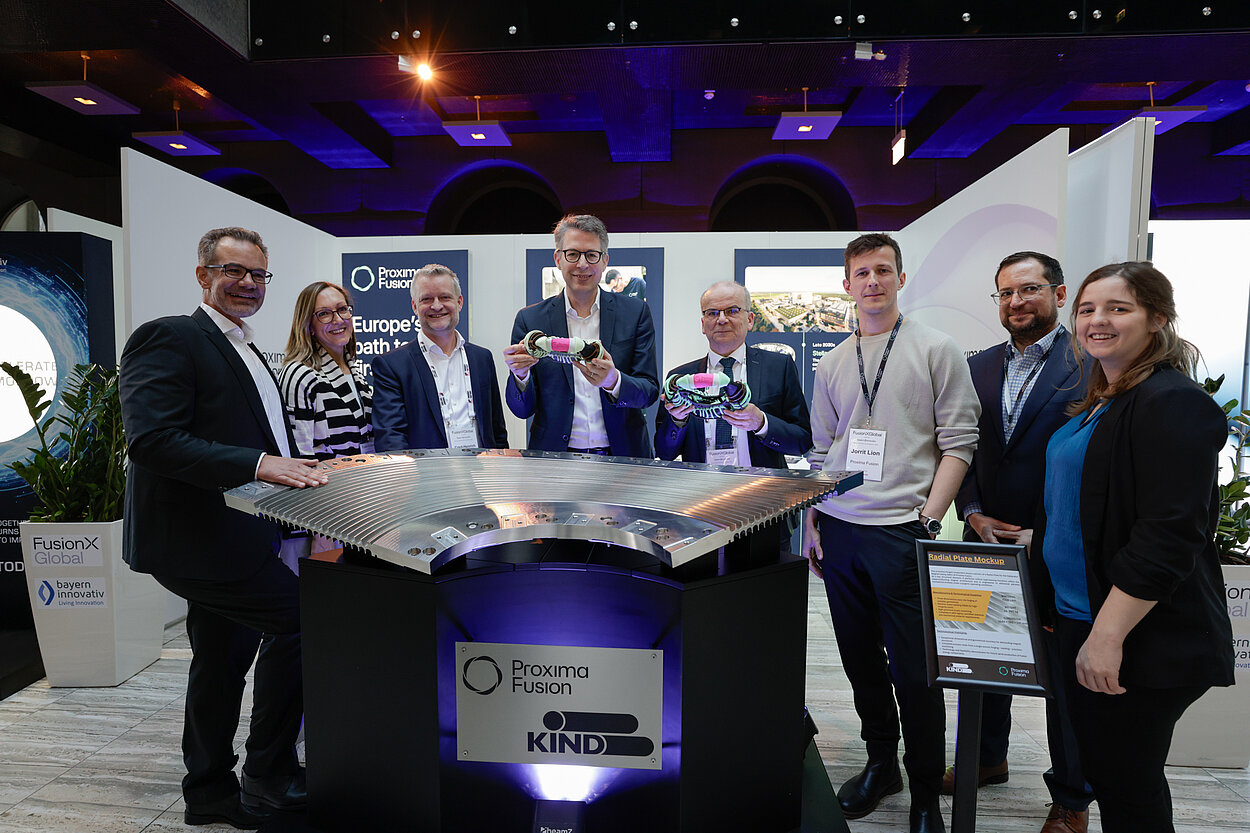
At the FusionX:Global conference in Munich, a long-time investor described the NIF breakthrough as the moment when fusion literally became “fashionable.” The findings from Wendelstein 7-X also played a significant role in reducing the research risk for potential partners, as several people at the conference confirmed.
The first sign: A market is drawing nearer when scientific milestones reduce concrete risks and thus pave the way for the next step in development for industry and capital.
#2 - Interest
A new market isn’t just defined by technical advances. It’s also defined by who is willing to commit money, personnel, and resources long before the finished product even exists. And this is precisely where there has been significant movement in the fusion landscape recently.
In 2026, the Bavarian startup Proxima Fusion introduced the Alpha Alliance: Around 50 industrial companies now aim to bring the Alpha demonstrator to life and are pooling their expertise and collective know-how to do so.
This growing interest is largely driven by policymakers. The Free State of Bavaria has also agreed with the startup and other partners on a development roadmap for the project, including funding. At the federal level, fusion is anchored in Germany’s High-Tech Agenda; three new fusion hubs will receive approximately 125 million euros in funding from the Federal Ministry of Research, Technology, and Space (BMFTR) in an initial phase in 2026. This positions Germany as a strong supporter of fusion technology in the international arena.
These developments are also attracting private capital. According to “The Global Fusion Industry,” a 2026 report by the Fusion Industry Association, $4.48 billion flowed into fusion companies worldwide within a twelve-month period. That is 69 percent more than in the previous year. Consequently, this emerging market is also drawing global players such as Microsoft and Google into the fray; they, too, are becoming involved in the industry and, in some cases, have even entered into off-take agreements.
The second sign: A market gains substance when attention translates into concrete partnerships, investments, and purchasing relationships.
#3 - Efforts to Scale
In an emerging market, mindsets also change. A prototype may require a single component. An industry needs thousands of them—all of consistent quality, at predictable costs, and delivered on time. Only in this way can a market ultimately become industrialized and mature.
In fusion, these are sometimes very unassuming components: valves, seals, sensors, pumps, or measurement systems are needed and must meet the specific requirements of a fusion power plant. When discussions on these topics—for example, at trade conferences or in public media coverage—become more frequent, this is a clear signal. This applies to industrial companies as well.
Now it is crucial to stop waiting for further breakthroughs and the completed fusion power plant. This is a clear signal to find one’s place in the market. Many companies do not even come from the fusion sector; there are plenty of “new entrants” from adjacent markets—especially when it comes to power plant construction.
The third signal: A market becomes industrially viable when technical challenges give rise to concrete specifications, procurement needs, and scalable supply chains.
#4 - Industrial Projects
At some point, a technology finally leaves the lab for good. And with that come entirely new challenges. Suddenly, the technology needs land and permits. Roads and power lines. Cooling systems, turbines, and electrical systems. People to build, finance, maintain, and later operate the facilities.
This is precisely why engineering firms and energy providers become important early on: they manage risks that a pure-play technology company has hardly had to deal with until now. Even the location itself thus becomes part of the path to market readiness.
Recently, experts at FusionX discussed key site advantages that would be necessary for the construction or repurposing of a reactor. These included, for example, existing grid connections, cooling infrastructure, or access roads—features that former fossil fuel power plant sites in particular can offer. Charlie Baynes-Reid of Type One Energy raised another point: Technical progress can only be translated into actual power plants if critical components are reliably available and approval processes are not left to be resolved at the very end.
The fourth sign: A market is maturing when the discussion no longer stops at the product itself, but also takes into account location, infrastructure, partners, regulation, and financing.
Conclusion: Market readiness begins earlier than the power plant
The merger does not yet provide a specific date regarding market readiness. However, it shows what companies can look for to identify impending market readiness. This includes milestones that reduce risks. Market participants who are already establishing a presence in the industry and making investments. Roadmaps that take locations, supply chains, and demand into account.
Industry conferences remain a key indicator for assessing market readiness. There, you can learn about the current status, plans, and next steps from all the key players in the emerging market.
If you’re specifically interested in fusion technology, you should mark your calendar for February 2027. That’s when the international ecosystem of this future-oriented industry will gather right in the heart of Munich. So when around 700 stakeholders from research, industry, politics, and the investment community meet to discuss the next steps toward market readiness, your question shouldn’t be “when will fusion be market-ready?” Rather: Is this the last chance to still become part of this market?
More information: https://www.bayern-innovativ.de/events-termine/detail/fusionx-global-2027/