
Brownfield vs. greenfield in the context of quality control
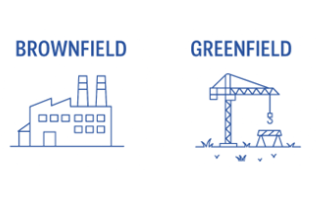
There are two basic scenarios in industrial production: Greenfield - the planning and construction of a production plant on a "greenfield site", where the layout, machinery, material flow and IT systems can be optimally coordinated from the outset, and Brownfield - the integration of new technologies into an existing production environment. For small and medium-sized enterprises (SMEs) in particular, the brown-field approach is often the only realistic option, as it requires less investment, reduces risk and makes it possible to maintain ongoing production without long downtimes.
In the context of quality control, this means that modern vision systems are not integrated into a newly planned factory, but are implemented in existing lines, machinery and IT structures. The aim is smart quality control, i.e. intelligent, automated quality inspection that reduces error rates, delivers objective and reproducible measurement results and at the same time creates a solid data basis for the continuous improvement process (CIP).
From the initial state to the target image
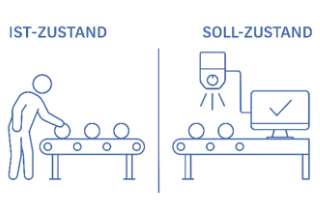
SMEs often start from a situation in which quality assurance is still heavily dependent on manual visual inspections. This means that results are not always reproducible, documentation is incomplete and process problems are identified with a delay. The target picture looks different: A vision system is firmly integrated into the production flow, inspects parts fully automatically in real time, stores relevant measurement data centrally and provides immediate feedback to upstream processes.
Such a change not only results in a measurable reduction in scrap and rework rates, but can also improve customer satisfaction and make it easier to meet the requirements of international standards such as ISO 9001 (quality management) or IATF 16949 (quality management for the automotive industry).
Possible applications in the brownfield environment
Vision systems can be retrofitted in various ways: directly on existing machines, as an additional inspection station on existing conveyor lines or as an end-of-line inspection. They can even perform redundant visual inspections in order to double-check critical production steps. In some cases, they are combined with measuring systems such as laser scanners to check geometric dimensions and surface quality in a single step.
Which solution fits best depends on the spatial conditions, the inspection characteristics and the existing infrastructure. Standards such as VDI/VDE/VDMA 2632 provide valuable guidance here by clearly defining how requirements should be formulated and systems approved.
The path to successful implementation
The introduction of a vision system in the brownfield is a multi-stage process that begins with a thorough analysis. The existing quality assurance is recorded in detail: Which errors occur most frequently? At which stations do they occur? How high are the reject and complaint rates? At the same time, technical framework conditions such as lighting, cycle times and space conditions are evaluated.
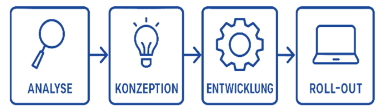
This is followed by a feasibility test in which, among other things, the measuring system's capability is tested. A so-called Gage R&R study (Repeatability & Reproducibility) analyzes whether the planned system delivers consistent results under real conditions. If problems such as vibrations or insufficient illumination become apparent, these can be rectified before the actual implementation.
The core of the planning is the functional specification, which is based on a structured specification sheet. It defines the features to be tested, the tolerances, the required testing speed and the interfaces to control systems or higher-level IT systems such as MES (Manufacturing Execution System) or ERP (Enterprise Resource Planning).
Once a suitable provider has been selected, a pilot installation follows. Ideally, this takes place directly in ongoing production on a representative line. Here, real parts are tested, error patterns are collected and - if artificial intelligence is used - trained according to an established process model such as CRISP-DM (Cross Industry Standard Process for Data Mining). After successful acceptance, in which the system has to prove its performance under production conditions, the solution can be rolled out to other lines step by step.
Economic consideration and benefits
For SMEs, the economic benefit is a decisive factor. The investment in a vision system usually pays off through a combination of reduced scrap and rework costs, avoided complaints, shorter inspection times and increased customer satisfaction. Many companies achieve a return on investment (ROI) within 12 to 24 months.
What is particularly valuable is that the collected quality data serves as a long-term basis for process optimization and thus enables additional efficiency gains.
Practical example: CNC production in the brownfield
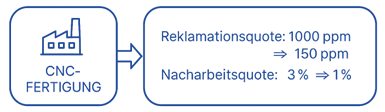
A medium-sized supplier of precision parts used to carry out manual inspections at the end of each production line. The complaint rate was around 1,000 ppm (parts per million - defective parts per million parts produced); the rework rate was around three percent.
After a detailed analysis of the main types of error - predominantly dimensional deviations, burr formation and surface scratches - a measuring system analysis was carried out. This showed that vibrations impaired the measuring accuracy. The basis for reliable image acquisition was created by installing vibration-damping mounts and optimized lighting.
The target defined in the specifications - a minimum detection rate of 99.5% with a maximum misclassification rate of 0.3% - was already achieved in pilot operation. The system was integrated into six lines within nine months. The complaint rate fell to around 150 ppm and rework to less than one percent. Production downtime for the installation amounted to less than one day per line.
The target defined in the specifications - a minimum detection rate of 99.5% with a maximum misclassification rate of 0.3% - was already achieved in pilot operation. The system was integrated into six lines within nine months. The complaint rate fell to around 150 ppm and rework to less than one percent. Production downtime for the installation amounted to less than one day per line.

Outlook and invitation to exchange ideas
Retrofitting modern vision systems in the brownfield is more than just a technical investment - it is a strategic step towards ensuring quality, efficiency and competitiveness. This not only makes companies stronger, but also more resilient to market fluctuations, skills shortages and increasing customer demands.
If you as a reader are interested in this topic or are thinking about how you can make your production fit for the future, we invite you to get in touch with us. We will find the right contact person from our network for every company. Collaboration and open exchange are the key to remaining strong, competitive and resilient together.