
New paths in medicine: virtual worlds as a therapeutic approach
How VR glasses can influence stress, anxiety and pain
11.05.2026
Imagine you are sitting in a treatment room. You are tense and perhaps in pain. Situations like this are part of everyday life for many people, whether during examinations, treatments or minor procedures.
Then you put on VR glasses. The environment changes and so does your focus. External stimuli fade into the background and the tension eases.
Virtual reality is already being researched intensively and is being used in the first medical applications in various treatment situations and for different patient groups.
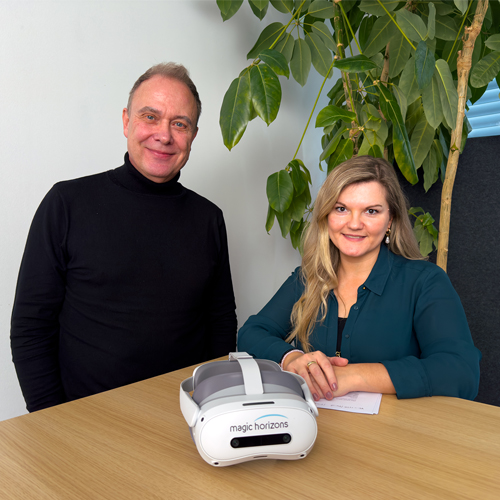
Dr. Tanja Jovanovic talks to Martin Koppehele, CEO of Magic Horizons GmbH, about exactly how this works and where the technology is already being used in practice.
What does the term "immersive technologies" actually mean? Can you also tell us a little more about virtual reality?
Martin Koppehele: "Immersive" means that an experience is so intense that it completely takes over our perception. In the case of virtual reality, the virtual stimuli specifically influence processing in the brain and direct attention, thought flow and subjective experience. This opens up many possibilities: You can, to put it casually, trick the brain to a certain extent, place it in a completely new environment and thus achieve certain targeted effects.
At Magic Horizons, you develop just such applications. How do you go about this specifically? How is a VR application designed so that it can influence pain?
Martin Koppehele: In principle, we first test which applications trigger which triggers in the brain. To do this, we work closely with various universities around the world, in Germany with Humboldt-Universität zu Berlin and Charité Universitätsmedizin Berlin, for example, and internationally with King's College London and the University of Southern California.
Trigger points, i.e. what is stored and anchored in the brain, are crucial here. We make targeted use of these effects.
A simple example: When I go out into nature, for example into a forest, certain things automatically happen in my body. The brain realizes: you are now in the forest, the air is good there, so your breathing becomes deeper, we have internalized that. So I automatically start a deeper breathing reflex, abdominal breathing kicks in, I take in more oxygen and my pulse rate drops, the body relaxes.
Something similar happens when I put on the VR glasses. Our brain is made to believe that we are in this environment and then this machinery starts automatically.
Such triggers can be set using different factors, such as visual environments, colors and patterns, but also in combination with audio, for example natural sounds or special frequencies.
These stimuli can be used in a targeted manner, for example to reduce pain, which is closely linked to the individual stress level. The less stress is experienced, the less pain is often felt.
In this way, virtual reality applications can have a positive influence on various clinical pictures. To ensure that this works reproducibly, the applications are tested and scientifically evaluated together with university partners.
Are there any reliable studies or concrete figures on this? Can you say something about this?
Martin Koppehele: Yes, there are various studies. Some are still in progress and have not yet been published, but there are already many published results, particularly on the topics of pain and stress reduction. Relevant studies can be found in databases such as PubMed.
One effect that is repeatedly observed is the reduction of anxiety. This effect occurs consistently and is reproducible. At the same time, it is often accompanied by a reduction in the perception of pain.
Studies show that the personal perception of pain can generally be reduced by up to 60 percent. Acute stress and feelings of anxiety can also be reduced by over 90 percent in many cases.
These are very high figures that show how effective these approaches can be. At the same time, the number of studies in this area continues to increase.

This also shows that it is a growing field, precisely because there is a demonstrable effect. You just described that sound and image design play an important role and specifically address stimuli to which the body reacts. At the same time, every patient is different. Are there individual solutions here or are they more standardized approaches?
Martin Koppehele: We try to design our platform in such a way that there are suitable applications for every patient, every age and every type of application.
We achieve this through a wide range of content. The platform currently comprises 126 applications. These range from nature experiences, guided meditations and dream journeys to fairytale worlds, fantasy journeys or interactive applications with gamification elements that are particularly suitable for certain treatment contexts.
This diversity makes it highly likely that every person will find an application that works well for them. In some areas, we can now even say quite precisely which applications work particularly well for the majority of people.
Based on our data, we make appropriate recommendations to clinics and doctors. At the same time, it remains important to take individual factors into account.
For example, treatments such as diving with dolphins are frequently used and can help to reduce pain. However, this scenario is not suitable for people who are afraid of being under water. Accordingly, alternative offers are needed so that everyone can find themselves.
There is always a demand for complete personalization. Theoretically, this is possible. I could also switch between applications or combine them with each other. In practice, however, this depends heavily on what data is available about the patients.
Another exciting topic is the question of how good the internet connection or network quality is. Many of these applications are based on data-intensive online services, so these factors play an important role.
This brings us to a topic that I wanted to address: What does it actually need to be used in hospitals - and what is currently making it more difficult? You have already mentioned this: Technology, costs, but also the lack of staff experience in dealing with new applications?
Martin Koppehele: You have to make a distinction here. In theory, the issue of costs is not a central problem - I'll come back to that later.
What we offer our customers are completely offline-capable systems. This means that no integration into the existing IT is necessary and no Internet access is required. The applications run directly on the VR glasses.
They are also controlled externally via a tablet. Practitioners can see what the patient sees in real time and fully control the application. All of this works without an internet connection or external connection.
This is important because this is where the hurdles often lie: Data protection issues, uncertainties with the server connection or complex IT processes. Many of these challenges can be avoided with the standalone approach.
Another point is possible reservations on the part of staff. This is initially a question of communication. Every new tool that comes into a clinic or medical facility initially costs time. You have to familiarize yourself with it first, even if our system is already pre-installed.
You switch it on and within around 52 seconds the patient is already in the application. So we're not talking about a huge amount of time. Nevertheless, a certain routine is required when using the system, for example when putting on the glasses or when dealing with issues such as cleaning and disinfection.
That's why we offer appropriate training for medical staff. It is crucial that there is a fundamental willingness to integrate new technologies into everyday working life. If this is not actively supported, it can be difficult to integrate additional applications in a meaningful way in everyday life.
However, if processes are clearly communicated and supported, it is clear that their use is very successful.
The third issue is the costs in the overall picture. If you look at the return on investment, clinics can even save costs depending on the treatment area.
At present, however, it is often still not possible to bill health insurance companies for such applications as standard treatment. This makes refinancing more difficult, even if the systems are already economically viable for the clinics in many cases.
For which clinical pictures do you generally see the greatest benefit?
Martin Koppehele: Above all, wherever pain plays a role. I'm mainly talking about situations in which the applications are already in use today, particularly for acute pain.
For example, we see them being used in emergency rooms, for blood sampling, when inserting catheters or for examinations that are only carried out under local anesthesia. In such cases, additional sedation or painkillers are often not required.
This is particularly relevant in pediatric oncology, for example. Here, patients are often already heavily medicated, so additional sedation should be avoided as far as possible. In such cases, anxiety, stress and pain can be significantly reduced through the use of virtual reality.
One use case that is becoming increasingly important, both in Germany and internationally, is the induction of anesthesia.
The targeted reduction of anxiety puts the body in a more relaxed state. As anesthesia is usually induced with propofol, the required dose can be reduced if patients feel less anxious and are more relaxed.
In practice, this means that side effects can also be reduced - for example with regard to circulatory reactions, wake-up times or the length of stay after operations.
There is already reliable study material in this area that shows that these effects can be significantly reduced. This is an example of an application in which hospitals can also make significant cost savings.
I would like to come back to your experience in the field of neurotechnology. You have brought a new technology into a highly regulated environment such as the healthcare sector. What experiences have you had? And what tips would you give to other companies that would also like to establish a technology in this environment?
Martin Koppehele: I think the most important thing is first of all to be clear: Where are my specific fields of application and what do I want to achieve in the first place? This leads to many further steps.
The healthcare sector is a highly regulated environment. In our case, the platform is a CE-certified medical device for clinical use. This is a fundamental requirement when applications are used in a clinical context, for example by doctors. It must be ensured that the application functions reliably and that the promised effect actually occurs.
Claims are a key issue in the medical field. If I say that my application reduces pain, this is a medical promise that I can only make if it is a medical product. This is also about the necessary legal certainty.
And otherwise, if you have a good idea: I've been an entrepreneur all my life, founded several companies with my brother and you just have to do things and try them out. Despite the highly regulated areas, you shouldn't let this put you off. There are always points that even we, as experienced founders, didn't have fully in mind when we started. Working with health insurance companies and all the formalities involved are particularly complex.
In hindsight, it's almost a good thing that we didn't know everything in detail. Otherwise we might have hesitated at one point or another. This way, you approach things with more euphoria and ultimately need a healthy mix of both.
If you only focus on what you can't do, you won't even get started. That's why it's important to think about it: What is my path and which claim do I want to pursue and then implement this consistently.
We have seen other companies that are active in this area but have failed because they neglected the scientific background. Then it often remains with pilot projects. Clinics test the application, carry out a study and use your software or device, but the step into everyday use is not successful.
I assume that the Health Innovation Network also supported you in overcoming these hurdles. How important was this collaboration for you?
Martin Koppehele: We actually only came across your network late on, at a time when we had already gone through many of these processes.
If we had had contact earlier, a lot of things would certainly have been easier because we would have had direct contacts and sources of information.
We now benefit greatly from the network and value the exchange of ideas, both with other companies and with partners from similar sectors. This exchange is particularly valuable in such a young field.
We still need a lot of cooperation and close collaboration between those involved. Networks play a central role in this.
At the same time, we hope that others can also benefit from our experience.
I would like to take a look into the future with you: What might medicine look like when digital and virtual technologies are used as naturally as medicines?
Martin Koppehele: It would be healthier for the population. At the same time, costs could be saved and many journeys reduced. Unnecessary suffering could also be avoided because processes often still take too long.
Technologies such as virtual or mixed reality offer great potential, particularly in the area of mental healthcare. We are currently working with virtual reality, but technological development is continuing so that mixed reality applications will also play a greater role in the future.
For many patients, this could mean that long waiting times can be shortened and treatments can be carried out in a more targeted manner.
The bottom line is that such technologies would help to improve care and significantly reduce costs in the healthcare system.
We've moved on from the topic of pain and stress. Can you tell us which technologies help you personally to slow down?
Martin Koppehele: I actually use our technology. Perhaps it's also worth explaining how my brother and I came to found the company in the first place. We come from the field of immersive media, i.e. from the audio sector not only in stereo, but also multi-channel sound installations, and in the visual sector from the production of shows for planetariums, i.e. projections in large domes.
In principle, these are all precursors to what is happening in virtual reality today. We initially used VR as a production tool to save time when developing these shows and to simulate scenarios virtually rather than physically on location.
We discovered this for ourselves and realized that you can immerse yourself very well in these worlds that we produce anyway. I actually perceived it as a kind of "escape".
This personal experience gave rise to the idea of developing a product that not only serves as entertainment, but also offers real added value and can be put to good use.
That's why I still use it myself today. If I have the opportunity, I naturally prefer to go out into nature - there's no substitute for fresh air and exercise.
But when that's not possible, I still enjoy immersing myself in our worlds.
The interview was conducted by Dr. Tanja Jovanovic, Head of Marketing & Innovation and Member of the Management Board, Bayern Innovativ GmbH, Nuremberg.
Your contact


