

Admittedly, it doesn't look particularly elegant as I stand in the room and wave my arms wildly in the air - but it feels very futuristic. Still and every time I enter a virtual room with VR glasses. I navigate through the menu with my gaze, give voice commands and feel a bit like the crew of the Starship Enterprise. In the series from the late 1980s, the crew had a 'holodeck' on the ship. A device that creates 3D simulations of real or imaginary environments by projecting holograms. In this simulation, Captain Picard and co were able to interact freely and move around as if they were in a real environment.
My VR glasses are still light years away from this, and yet what was only science fiction on television around 40 years ago has now become reality: VR goggles are available for computer games, for watching movies and also in medicine and technology - for example, when it comes to using simulations for training purposes. Who would have thought this possible in 1987, when Star Trek first hit the screen? I take the device off my head, return "back to my living room" and ask myself: can supposed reveries inspire us to new ideas?
Innovation between dream and reality
According to a report by the Asimov Institute, utopian thinking has already laid the foundations for many major technological innovations, such as the World Wide Web and the smartphone. By imagining a better world, we find ways to build it. Even if the "holodeck" from Star Trek and my VR glasses don't have much in common technologically, the basic idea is the same. Both create a deceptively real space that can be freely designed to experience and see things without them actually being physically present. With our current possibilities, we have therefore achieved the purpose of the holodeck - just implemented differently. So why not take a look at "fantasies" more often, keep dreaming - and create something tangible new inspired by them? Especially as there is a lot of sound knowledge in many of these supposedly crazy ideas.

A well-known example is the future thriller Minority Report from 2002, which tells of a world in the year 2054 - and depicts technologies that were later actually implemented. You know the images: Tom Cruise controls a computer with his hands in the air. These scenes are still world-famous today. Years after the film, gesture interfaces were tested and implemented in real life. Minority Report also shows personalized advertising on digital screens everywhere. In other words, advertising tailored to the person seeing it. Today, this is commonplace on social media, on the web and on smart televisions. It was no coincidence that these ideas were able to predict our current technology so accurately back then: in 1999, director Steven Spielberg commissioned a "think tank" of scientists, technology experts and sci-fi authors, including Canadian writer Douglas Coupland. For three days, this group brainstormed about future technologies and social trends. Many ideas from this think tank made it into the screenplay - and a number of them hit the bull's eye of the real future. Spielberg used utopia as a tool to develop tangible future scenarios and thus inspired others.
Star director Stanley Kubrick also relied on this mixture of imagination and engineering. For 2001: A Space Odyssey (1968), he worked closely with sci-fi author Arthur C. Clarke to show visionary yet plausible future technologies. You probably know HAL, the intelligent computer that seems remarkably similar to our "Alexas" today. And Kubrick's long-cherished project A.I. is about artificial intelligence and robotic children. The film deals with ethical questions about the relationship between humans and "artificial" but intelligent products. What was a thought experiment at the time has become reality in the age of ChatGPT and co.
Archetypes, utopias and the collective head cinema
So there is more in-depth knowledge in films and stories than we would like to believe at first glance - and they inspire our minds in a completely different way than a report or a study would. Because while studies "explain" something to us, stories allow us to experience the content. Anyone who doubted the value of their own existence in Blade Runner with Rick Deckard learned a lot about human-machine ethics - and perhaps shed a tear or two.
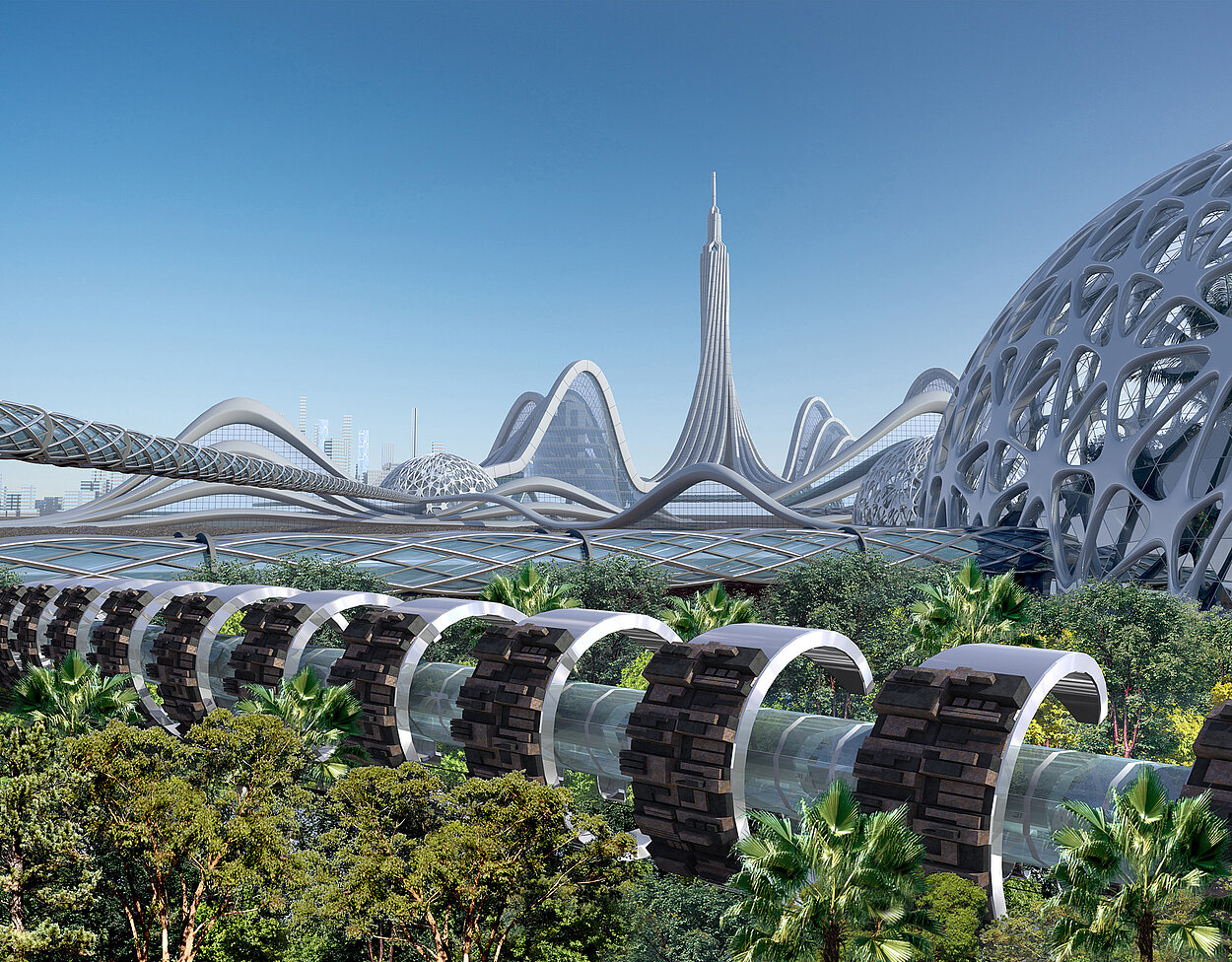
Fairy tales, books and films make use of timeless archetypes and narratives. The battle between good and evil, the heroic figure facing a seemingly impossible task. These are all age-old patterns that lie dormant in our collective unconscious and thus inspire us. A mythical example: since Plato, people have been telling stories about Atlantis, the sunken advanced civilization. This primal utopia of a better (or warningly sunken) world has inspired generations - be it in medieval ideas of paradise or modern underwater city projects. The steampunk genre, which combines Victorian aesthetics with imaginary technology, has a similar effect: zeppelins, cogwheels and steam power are woven into a retro dream of the future. It's no wonder that designers and inventors are inspired to build brass-look computer housings or wearables in the style of old pocket watches - the line between fan fiction and product design is playfully blurred.
More recent movements such as solarpunk go one step further: this international art and literature movement creates optimistic future worlds in which high-tech and nature are in harmony. Colorful cities full of solar cells, urban gardening and decentralized energy - a conscious alternative to gloomy cyberpunk dystopias. Such positive utopias function like mood boards for our reality: they "actively work towards realizing a sustainable future" by first boldly imagining what it could look like. The situation is similar with classic literary utopias. The French futurologist Sandrine Roudaut emphasizes that "the internet, women's suffrage, social security... all great innovations were first utopias. The utopias of today are the self-evident things of tomorrow." Oscar Wilde put it another way: "Progress is only the realization of utopias."
Interestingly, in addition to utopias, dystopias also serve their purpose in the world of innovation. Stories of bad outcomes - whether Orwell's 1984, Terminator's AI horror scenario or the environmental apocalypse - act as negative projection surfaces. They remind us "not like this" and motivate inventors to develop better alternatives. In AI research, for example, experts are currently discussing ethical guard rails in order to avoid slipping down dystopian paths. But it is precisely here that we see once again that those who only want to prevent the bad often remain stuck within existing walls of thought. Constructive imagination is needed to create something truly new. Futurists therefore advocate "utopian thinking" - thinking in spaces of possibility. This attitude - boundless, optimistic, but not naive - needs to be cultivated in companies.
Dreaming and doing: Four methods for innovation
To achieve this, we should encourage imagination without losing our grip on reality. Many companies rely on structured creative methods. One prominent example is design thinking. Here, your team goes through a process with several phases. Particularly in the first stages, it is explicitly stated: "Encourage wild ideas", also encourages weird, wild ideas. Why? Because crazy approaches often lead to the biggest creative leaps - they force us to "really think without the usual restrictions". Here, participants are given tasks such as "What would Superman do in your place?" - and this is where fantastic stories come into play. Use worlds away from our everyday lives, let the team dream and develop ideas here, as I said: "Wild ideas" are welcome. Later in the process, these ideas are then methodically brought "into reality", checked for feasibility and adapted.

Another method of strategic idea generation is "dragon dreaming". The name suggests it: Here, space is systematically given to dreaming . Dragon dreaming is also divided into several phases: Dreaming, Planning, Doing, Celebrating. First, all participants dream together - they mentally design the best of all worlds for their project. Nothing is impossible in this round of dreaming. Then concrete plans are made, tasks are distributed and successes are celebrated at the end. This playful method removes ingrained mental blocks. It creates a safe space in which even far-fetched ideas can be expressed before reality takes over again. This creates collective visions that arouse enough enthusiasm for everyone to pull together. This "painting towards utopia" is not a luxury, but a strategic creative tool. It ensures that goals are not just formulated incrementally ("a little better than now"), but in a ground-breaking way.
Unlike design thinking or dragon dreaming, the future workshop method starts with the hard reality. Here, the participants start with a criticism phase and collect factual points of criticism: Where do we stand, what are the weaknesses, risks? The second step in the process is the free generation of ideas. The participants are allowed to freely express imaginative "spinning stuff" about what a perfect future could look like, as if there were no limits. Nothing is forbidden, no objections of "yes, but" interfere. Only then does it move on to the realization phase, where concrete next steps are derived from the spun ideas. This approach, once conceived for citizen participation in the 1980s, is now also used in companies and administrations. It shows impressively that structured dreaming is not a nice-to-have, but can lead directly to realizable innovation.
Finally, there is the scenario technique. It originates from strategic planning and is used to create alternative visions of the future on the basis of facts. Instead of simply updating a forecast, several scenarios are developed - e.g. an optimistic, a pessimistic and a surprise scenario - and what they would mean for the company is examined. This method has long been established in politics and business. Running through what-ifs helps to think flexibly and prepare for the unforeseen. Basically, scenario planning is nothing more than well-founded dreaming: you create projection spaces (such as "What would our market look like if a completely new technology X came along?") and derive realistic decisions from them. A well-known example: In the 1970s, the rapid rise in oil prices hit the industry hard. The Shell company was prepared for this - it had already taken such a scenario into account in its planning and was prepared for it.
The trick for companies is to create space for visions without losing their grip on the ground. So: encourage employees to put their heads in the clouds - in the form of innovation workshops, independent projects or simply an open culture of ideas. And then check together: Which of these dreams can be realized with current or foreseeable skills? Perhaps not immediately 1:1, but in first steps. The philosopher Ernst Bloch spoke of "concrete utopianism" - a hope that does not take refuge in the indefinite, but becomes a guiding principle for action . In the same way, fantastic dreams of the future can also serve as target images for the company to work towards.
Read more:
Technologies of tomorrow: Trend report on the "trend city"
How to innovate - promoting creativity in companies
How to innovate - from the problem to the solution with design thinking
Sources:
These Star Trek technologies already exist today
Inside Minority Report's 'Idea Summit,' Visionaries Saw the Future | WIRED
Toutes les grandes innovations ont d'abord été des utopies | Germe
On Utopian Thinking - The Asimov Institute
Scenario technique | INNOVATIONSPROZESSE.com
From Illusions to Reality: 'Peer Gynt's' Journey of Self-Discovery | by Salim Akhtar | Medium