
Innovation pioneers: building bridges between ideas and implementation
Halgard Stolte on entrepreneurial spirit, artificial intelligence and the power of innovation beyond the metropolitan areas
26.05.2026
Halgard Stolte has worked internationally, built up companies and broken new ground time and again. She planned at BMW in Canada, looked after dealers in Munich, was responsible for the Škoda budget at Grey Advertising and founded her own company in Prague just a few years after the fall of the Berlin Wall. From there, she later managed packaging design projects for well-known brands in 36 European countries, while also studying economic history at the London School of Economics.
Today, she works where Bavaria, Thuringia and the Czech Republic meet: in the border triangle in the middle of the Franconian Forest. She has set new impulses in the region, for example with co-working and co-living ideas in rural areas, with local international IT expertise and with her company, ArtFlex Software GmbH. Funded by the Bavarian start-up program BayTOU and supported by Bayern Innovativ, the company now develops AI solutions for SMEs from its base in Hof.
What makes her approach special is that Halgard Stolte goes where others often don't initially expect potential. She connects regions, people and ideas and brings what she has learned internationally to Upper Franconia in a very concrete way.
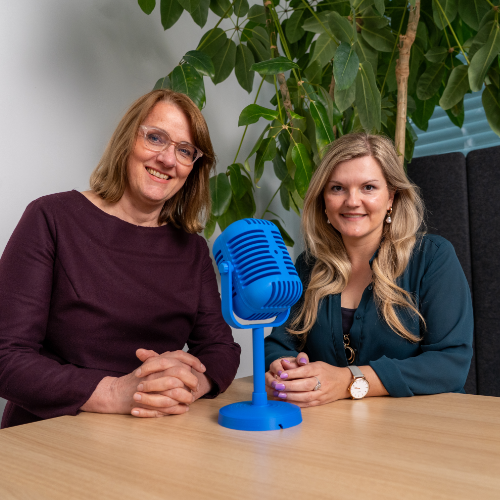
In this interview, we talk about her unusual life path, about courage, networks and innovation, and about the question of why the future is not only created in the big cities, but also in the countryside.
Why did you deliberately choose the border triangle?
Halgard Stolte: After around 20 years in Prague, where we had set up our design company, I felt the need to move closer to home again. But I didn't want to be too far away from Prague because I still had many personal and professional connections there.
What's more, my husband is Czech. It was therefore clear to us that the new center of our lives should not be too far away from the Czech Republic. About 15 years ago, we decided to move to this region.
One of the reasons I chose Thuringia back then was because, as an East German, the people there often have a different relationship to the Czech Republic than many West Germans. In the end, we ended up right on the border rather by chance, which turned out to be ideal.
This meant that I was able to work in Upper Franconia with my company based in Hof, while our home is in Thuringia. Nothing has changed to this day.
How important are relationships and mutual understanding for your work?
Halgard Stolte: They play a very important role. I originally come from the service sector. Although I also worked in sales network planning and marketing at BMW, when I was self-employed I was mainly involved in customer projects.
In the service sector in particular, it's all about really understanding the customer's problems and finding suitable solutions. For me, this is the central relationship aspect of my work.
When I talk to customers, the first thing I do is listen carefully: What is the actual problem? What is really needed? Only then is it a matter of addressing and solving these issues in a targeted manner.
In the past, this was mainly the case with branding and communication in advertising agencies. Today, it happens on the IT side: we develop software with which we solve very specific problems.
How do you approach innovations and new topics?
Halgard Stolte: Essentially, it's always about understanding the customer's needs precisely. We then use this to develop a concept and a suitable solution scenario. Software is a very good tool for this because it can be used to solve specific problems in a targeted manner.
How exciting are the developments in artificial intelligence for you?
Halgard Stolte: Extremely exciting. A lot has changed in the last year in particular. Initially, the focus was on simple chat applications, but today it's much more than that: it's about data management, business processes and the question of how AI can be meaningfully integrated into existing processes. Development has expanded incredibly in a short space of time.
How do you stay on top of these rapid developments?
Halgard Stolte: Our environment helps us in particular. Our company is based at Einstein1 in Hof, the start-up center right next to Hof University of Applied Sciences. The Institute for Information Systems there is a strong partner that supports us in many areas.
Thanks to the close cooperation with the university and partners such as Prof. Dr. René Peinl, we are in constant professional contact. This not only keeps us informed about new developments, but also puts us at the heart of the action.
The network is also an important factor for me. In the IT cluster, on whose board I am active, we experience every day how valuable the exchange with other companies is. Formats such as the AI Walk or the IT Forum with Hof University of Applied Sciences provide additional impetus - most recently on topics such as cloud sovereignty. It is precisely this continuous contact that helps enormously to keep pace with the dynamics.
You come across as a very curious person with a strong sense for networks and relationships. Your career path is all the more exciting: you studied administrative science but never worked in administration. How did that come about?
Halgard Stolte: The plan was actually different at first. After my boyfriend at the time moved to Munich to work at Siemens, I applied to the Bavarian State Administration. However, I was told that my degree in administrative sciences at the University of Constance would not be recognized for the Bavarian civil service.
But my studies in Constance were very formative for me, both professionally and personally. It was an innovative degree program with an exceptionally inspiring environment. That made the rejection all the more surprising for me at the time.
This turn of events then led me to BMW. Although I hadn't studied business administration, I applied there - and was accepted. After an assessment center lasting several days and an interview with the Board of Management, I was hired as the first female trainee at BMW AG. Looking back, that was definitely a special step.
In retrospect, would you have preferred the other path?
Halgard Stolte: No, not really. Originally, I wanted to work in an international environment, perhaps also in European institutions. Through BMW, this was fulfilled in a different way.
I was able to work for BMW in Paris in the sales department and later for several years in Canada. This gave me very valuable international experience that I probably wouldn't have had on the path I had originally planned.
So something very positive came out of a setback in the end?
Halgard Stolte: Yes, that's exactly how you could put it. What initially seemed like a rejection has, in retrospect, opened many new doors for me.
You often go where others might not initially expect great potential. Does that also apply to the border triangle?
Halgard Stolte: I wouldn't put it like that directly. The move around 15 years ago was initially primarily a personal decision, not an economic one. At that time, we still had our company in Prague and the plan was actually to continue working there and commute between the locations.
It was only when I got to know the region better that I really became aware of its economic potential. The most surprising thing for me was how diverse the environment is.
Cities such as Jena, Erfurt, Nuremberg, Bayreuth and Bamberg are easily accessible from there. At the same time, there are many strong medium-sized companies and internationally successful hidden champions in the region. That's what makes the border triangle and Upper Franconia so interesting for me today.
What does the region need to become even more innovative?
Halgard Stolte: In my opinion, the region has a lot of potential: strong companies, good scientific institutions and an exciting innovation landscape overall. But what needs to be strengthened is the transfer to the economy.
There are many sensible funding programs, but a large proportion of these funds flow into state institutions, such as universities, new chairs or technology centers. That is important. At the same time, however, I see that local companies, especially IT and software companies, are not yet benefiting enough from this.
I would like to see more specific support for companies in the field of artificial intelligence in particular. After all, in the current economic situation, many SMEs cannot simply finance innovations from their own resources. At the same time, it is often regional software companies that could develop and implement precisely these innovations together with the business community. Technology centers implement many projects directly with local companies instead of involving the existing IT expertise of the local software industry. As a regional IT cluster, we could do much more for companies if this funding were also effective for software companies and industry at the same time.
What specifically would have to change?
Halgard Stolte: We need more courage to transfer. In other words, more ways to link research, funding and entrepreneurial implementation more closely together. If state funding is used, it should ultimately also be effective in the economy.
At the moment, software companies often have to make advance payments: they develop new solutions, bear the risk and only then hope for interest from the market. Understandably, many companies only ask when a product is already finished. However, this means a high financial risk for the developers.
This is why innovation in the region not only needs good ideas, but also a willingness to take risks, courage and reliable financing. I am pursuing this path myself, for example through funding projects together with Hof University of Applied Sciences. But it's not easy, especially because as a software company you have to make a lot of upfront investments.
Where do you find the courage to take this risk anyway?
Halgard Stolte: This courage often comes from a specific problem that needs to be solved. In our case, a company from industry was an important impetus: a foam producer facing a very practical challenge. They use cutting machines that have hardly been digitized to date. At the same time, there is a shortage of skilled workers and experienced employees who have spent years learning how to correctly assess materials and cuts as they gradually retire.
This gave rise to the idea for a new project. Together, we developed a ZIM application, which we worked on for almost a year. The aim is a digital solution for the 3D nesting of cutting machines, i.e. the intelligent, most efficient planning of blanks. With the help of AI, this system can improve over time and use materials more efficiently in an automated process.
The exciting thing about it is that the solution is not just relevant for a single application. In principle, it can also be transferred to other industries and materials and could even be offered more widely as a licensed product in the future.
What drives you?
Halgard Stolte: It always starts with a specific need. If I can see that there is a real problem and that a viable solution can be developed from it, then that convinces me. This is precisely what gives me the energy to really drive a project like this forward.
At the same time, this example very clearly shows a fundamental problem: many industry partners find such developments very interesting, but expect the software side to initially make the upfront investment itself. Only when the solution is ready does the willingness to use it increase.
This is precisely the challenge that many software companies face.
Your father was an innovator himself and founded a network back in 1979 that still supports medical students today. You are also a member of the board there. How did that come about?
Halgard Stolte: The program was and is one of the most successful exchange programs of the German Academic Exchange Service. Together with three professors who went through the program themselves, I campaigned for it to be continued.
When my father died, there was a risk that the funding program would not be continued. We therefore restructured the existing association, reorganized it and further developed the programme together with the German Academic Exchange Service. It was important to us to maintain this valuable network.
Today, almost 800 professors have emerged from this network who are active worldwide, including at many German university hospitals. This shows the impact this network has had over the decades.
What is particularly important to you?
Halgard Stolte: Essentially, it's about bringing young people abroad so that they can gain experience and new perspectives. That's exactly what was important to my father, because it had a huge impact on his own life.
I very much share this conviction. A stay abroad broadens your perspective, both personally and professionally. You experience a different country, a different way of working and see your own job from a new perspective.
Looking at your path from the outside, there seems to be a common thread running through it: Your father built bridges to North America, you more to Eastern Europe. Is that by chance or by design?
Halgard Stolte: That was more by chance. A lot of things came about as a result of my career. When I got to a point at BMW where it was no longer natural for me to continue, the next step for me was a job that others didn't want to take on: Marketing for Škoda in Prague.
That was an opportunity for me to take the next step professionally. I later joined an advertising agency there that was looking for someone with automotive experience. That's how this path developed - not as a master plan, but out of concrete situations.
What gives you personal energy - and what has slowed you down?
Halgard Stolte: Above all, people, exchanges and networks give me energy. It's incredibly important for me to talk to others, share ideas and think ahead together. This is exactly where I draw a lot of strength from.
I find the exchange in my networks, for example in the IT cluster, with great companions like Katharina Kroll and Hans-Uli Gruber, particularly valuable. The collaboration with the university also gives me a lot of encouragement, especially when we receive such dedicated support in projects. There are also strong women's networks, regular discussions and formats such as the IHK committees, which I really enjoy being part of. Such encounters inspire me and give me new energy.
And what was difficult?
Halgard Stolte: The experience in Nordhalben was painful for me. There, I had the idea of bringing new impetus to the region with a digital center, with co-working, co-living, digital jobs and new forms of living and working together in the countryside.
My idea was to attract digital specialists and creative people to the region and thus also build up new expertise locally. For me, this also included cultural impulses, such as modern art or new event formats. However, this idea was not as well received locally as I had hoped.
That was disappointing because I saw it as a real opportunity for rural areas. At the same time, this shows exactly how challenging innovation can be: An idea is only viable if people accept it.
What do you take away from this?
Halgard Stolte: For me, the question of how we can create equal living conditions in rural areas remains exciting. I am convinced that the future is not just in the cities. You can also live very well in the countryside and achieve many things there that you would otherwise associate with urban life.
The region already offers a lot today: culture, exciting events and strong initiatives. It is therefore clear to me that rural areas have a future. This realization in particular came as a surprise to me and has now become a real conviction.
Looking back, is there anything you would do differently? And what would it take for more people to make the move from the big city to the region?
Halgard Stolte: In my view, the key point is jobs. People are generally willing to come and live in the region. I also experience this with our residential project in the vicarage in Nordhalben, but it often fails due to a lack of suitable career prospects.
Once the livelihood is secured, many other things become easier. The conditions in the region are often very good: available childcare places, affordable housing and the possibility of still being able to afford property. That's why I believe that the topic of housing needs to be more closely linked to the topic of work.
For me, it would be important to build even more targeted bridges here, i.e. to bring people, jobs and housing opportunities together more effectively. This is a major lever if more people are to find their way to the region.
What skills will be particularly important for SMEs in the coming years?
Halgard Stolte: I wouldn't want to speak in general terms for the entire SME sector, because the challenges vary greatly depending on the industry. Energy-intensive industries such as glass or automotive are currently under a lot of pressure.
What is crucial in my view, however, is flexibility and a willingness to take risks. Thinking in terms of security alone does not help in a time of change. Companies must be prepared to constantly reposition themselves, react to change and break new ground.
In my view, there are other important skills too: Openness, curiosity and strong personal relationships. Without exchange, trust and support from others, you often don't get anywhere. Networks are therefore not a side issue, but a real success factor.
The interview was conducted by Dr. Tanja Jovanovic, Head of Marketing & Innovation and Member of the Management Board, Bayern Innovativ GmbH, Nuremberg.


