
The milking robot tracks milk volume and conductivity to monitor udder health. The collar records feeding and rumination times, while a bolus tracks temperature and activity. This is supplemented by data from milk yield testing, feeding, fertility, animal health, and barn climate. What is often missing is the connection between them.
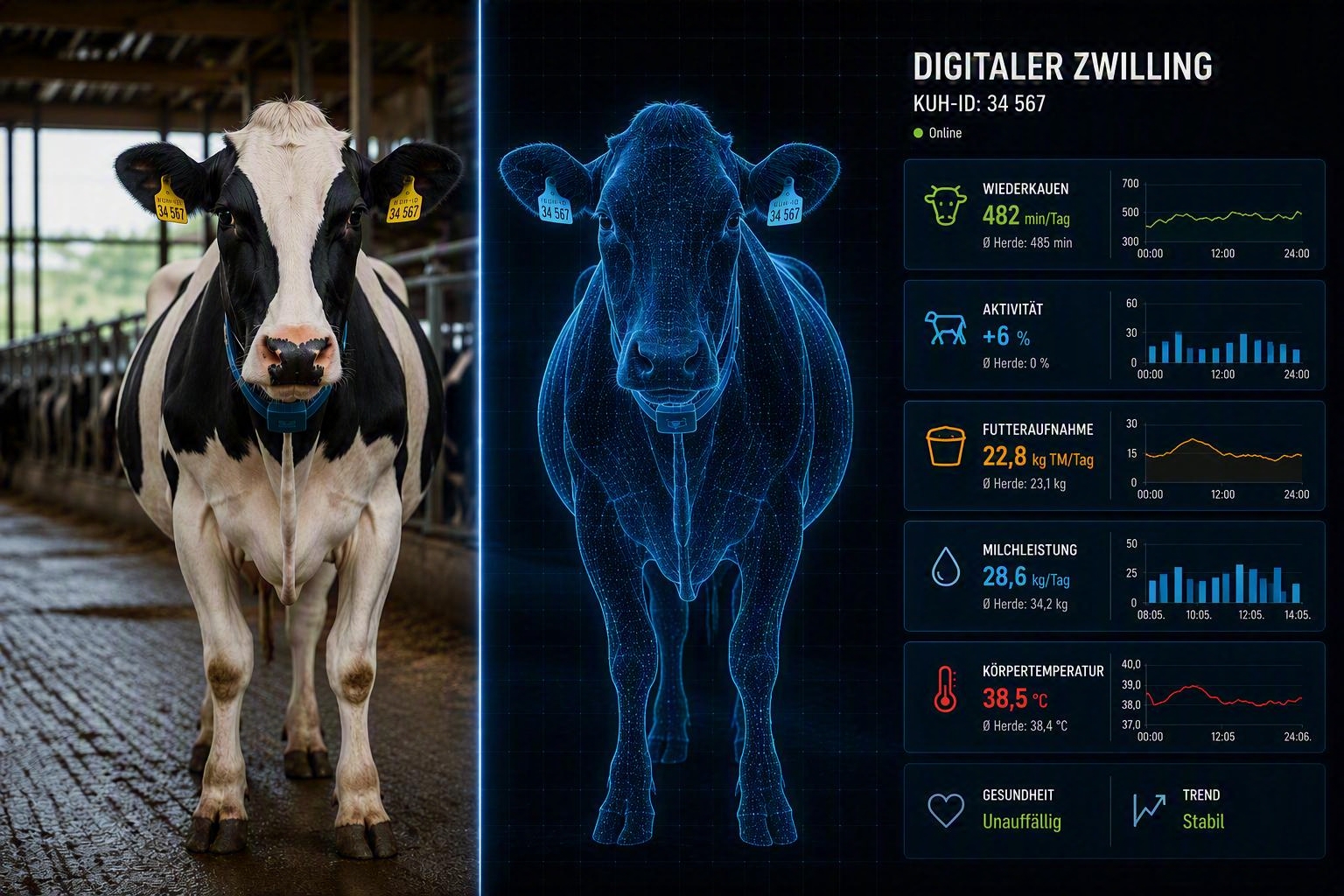

This is precisely where one of the next major steps in digitalization lies. After all, a single measurement is often just one piece of the puzzle. Only when information from various sources is brought together does a picture emerge that actually provides farmers with additional insight. The question, therefore, is less and less: “Which sensor measures what?” and more: “Which data can be meaningfully combined, and what additional value does this create?”
When individual signals don't reveal anything yet
Diseases rarely announce themselves with a single, clear sign; everyday life in the barn is full of natural fluctuations. A shortened rumination time alone can have many causes. However, when combined with changes in activity, reduced feed intake, or abnormalities in milk production, a different picture emerges. Individual observations form a pattern, and this is precisely where AI can demonstrate its strength.
A recent study on subacute ruminal acidosis (SARA) demonstrates just how valuable this additional information can be. Researchers analyzed a combination of factors, including rumination time, activity, water intake, rumen temperature, milk yield, and milk composition. With 95 percent accuracy, the best machine-learning model was able to distinguish between healthy days and days affected by SARA in cows. This does not replace a veterinary diagnosis. However, it illustrates the principle: where a single value remains ambiguous, multiple data sources can collectively provide a clearer warning signal.
What Bavaria's Research Community Is Currently Working On
Research in Bavaria focuses precisely on this intersection between scientific potential and on-farm practice. In the DigiMilchPro research project, the Bavarian State Institute for Agriculture (LfL), Weihenstephan-Triesdorf University of Applied Sciences, Ludwig Maximilian University of Munich, and Osnabrück University of Applied Sciences are investigating how digital technologies, AI, and networked data management can support dairy farms in their day-to-day operations. One focus is on the health monitoring of dairy cows. Among other things, the project is testing AI-supported methods for the early detection of lameness and heat stress. Further studies focus on digitally supported pasture management, such as virtual pasture fences or concepts for pasture grazing on farms with automated milking systems.
Interview
Project coordinators Dr. Isabella Lorenzini and Maria Schneider explain the opportunities offered by linking different data sources, as well as the challenges that still remain.
Why is linking different data sources becoming an increasingly important focus of research?
Operations managers who invest in digital technologies are primarily seeking greater visibility and a reduced workload. The lack of interoperability or connectivity between systems and devices—which still exists in some cases—poses an obstacle in this regard; on the one hand, it leads to frustration and overwhelm among users, and on the other, it prevents the full potential of these technologies from being realized. Through research, we can demonstrate in a neutral environment the potential benefits of connecting systems and integrating data. Many people are not yet aware of the added value these integrations can provide and may not yet perceive them as relevant—we can change that through targeted research.
What insights have you already gained by combining sensor, camera, and management data?
Based on research projects at the LfL, we know that combining different types of data on animal performance, behavior, and physiology gives us an advantage in health monitoring. The more information about an animal I can combine in statistical models, the more accurate the assessment of its health status becomes. So it’s worth staying on top of these issues and encouraging manufacturers to network with other manufacturers and offer open interfaces. This benefits not only farm managers but, above all, the animals themselves.
Why is the early detection of lameness so difficult, and how can AI help?
Hoof diseases—and consequently lameness—are a multifactorial problem. This means that various factors play a role (feeding, housing, genetics, etc.), and many aspects of the animals’ behavior and physiology also change as a result of lameness. Added to this is the fact that every animal is a little different and reacts differently to an episode of lameness. The same is true for milk production: it doesn’t simply drop as soon as an animal becomes visibly lame, but often changes gradually, weeks or even months before any visible change in the animal’s gait. These factors mean that statistical modeling of hoof health data cannot always follow the same pattern, and a wide variety of data is needed to draw accurate conclusions.
How can AI filter out, from the vast amount of available data, precisely the indicators that are truly relevant to day-to-day barn operations?
AI can identify patterns and anomalies in large datasets and derive relevant indicators or alerts for day-to-day barn operations. This requires a comprehensive, high-quality data set from which the AI can learn. In this way, it supports farmers in reviewing and processing large amounts of data and summarizes relevant information, for example, in the form of notifications within the herd management program. The AI serves as a decision-making aid—the evaluation of the insights and the resulting management decisions remain the responsibility of the farmer.



More Than Just Health Monitoring
When feeding, milk yield, behavior, and health information are considered together, it becomes possible to assess resource use in a more nuanced way. A liter of milk is then no longer viewed in isolation as a measure of performance, but can be evaluated in the context of feed costs, animal condition, and management practices. Recent reviews identify potential here for more precise feeding, more efficient production management, and a more targeted use of working time.
Environmental factors can also be incorporated into this data picture. In a recent study conducted on three dairy farms, barn temperature and humidity, weather data, ammonia and carbon dioxide levels, as well as various manure parameters were consolidated into an IoT system. Among other things, the linked data made it possible to estimate heat stress and the nitrogen content of the manure. This example demonstrates that data integration can combine animal, production, and environmental monitoring, thereby revealing correlations that remain hidden in separate systems.
The Digital Representation of the Cow
The concept of the digital twin takes this a step further. The idea behind it is to create a digital representation of an animal or a production process and to continuously update this model with the latest data. Such a “digital twin” is intended not only to describe what is happening at any given moment, but also, in the long term, to help estimate how an animal or a process might develop under changing conditions.
A recent review article on precision feeding of dairy cows shows just how challenging this is: Digital twins require continuous, high-quality data streams as well as robust models. Many applications are still in the research and development phase. The digital twin is therefore less a new device for the barn and more the most logical next step in data networking.
Not more data, but better connections
The dairy barn of the future is unlikely to suffer from a lack of data. The greater challenge will be to identify reliable correlations from a growing number of measurement values and to process them in a way that fits into existing workflows.
The yardstick: Does the technology help identify changes earlier, allocate resources more effectively, and make more informed decisions? If so, then data collection truly becomes knowledge.
The foundation of any data network: data collection
In the video series “KNeDL on a Discovery Tour,” the Almesbach State Estate demonstrates just how diverse the data set already is.
Boerman, J. P. et al. (2025): Data processing techniques to improve data integration from dairy farms. JDS Communications 6(3), 339–344. DOI: 10.3168/jdsc.2024-0723.
Cabrera, V. E. et al. (2025): Data Integration and Analytics in the Dairy Industry: Challenges and Pathways Forward. Animals 15(3), 329. DOI: 10.3390/ani15030329.
Grigė, S. et al. (2026): Machine learning-based detection of subacute ruminal acidosis in early-lactation dairy cows using multi-sensor behavioral, physiological, and milk production data. Scientific Reports 16, 24624. DOI: 10.1038/s41598-026-55162-z.
Sharma, S. et al. (2026): Invited review: Milking the data for value-driven dairy farming. Journal of Dairy Science 109(4), 3137–3157. DOI: 10.3168/jds.2025-27011.
Rosa, E., Rincón, L., & Merino, P. (2026): Development and validation of an integrated IoT system for monitoring barn environment, gas concentrations, and slurry management on dairy cattle farms. Internet of Things 37, 101914. DOI: 10.1016/j.iot.2026.101914.
Rao, S. & Neethirajan, S. (2025): Computational Architectures for Precision Dairy Nutrition Digital Twins: A Technical Review and Implementation Framework. Sensors 25(16), 4899. DOI: 10.3390/s25164899.
This article is part of the new AI section in LKV Magazine and regularly explores exciting topics related to artificial intelligence in agriculture. As a network of experts, we collaborate with LKV to help shape these articles and contribute insights on current developments, applications, and perspectives.
Our goal: to provide practical information, offer guidance, and highlight the potential of AI for agriculture.
Contact us

