Review
Vertical Farming—Everything Under One Roof
16. March 2022
10:00 - 16:00
 AdobeStock/rostov777,
Climate change, the need to ensure a sustainable food supply, and the demand for regional products are driving the search for increasingly innovative and efficient methods of food production. Join us in taking a look into the future and discover new approaches and concepts for food production and niche agriculture.
Vertical Farming—Everything Under One Roof
Climate change, the need to ensure a sustainable food supply, and the demand for regional products are driving the search for increasingly innovative and efficient methods of food production.
What would cultivation systems look like that operate independently of external environmental conditions within closed-loop systems? Whether in a high-rise building, a hall, a container, or a cabinet.
Join us in taking a look into the future and discover new approaches and concepts for food production and niche agriculture. You can expect insights into cutting-edge technologies, exciting ideas from science, business, and the field, an exhibition, a pitch event featuring startups in the vertical farming sector, and interactive discussions with experts.
Welcome!
The event will be moderated by:
Christian Metz, Head of the Bavarian Digital Agriculture Competence Network, Bayern Innovativ GmbH, Munich
Claudia Luksch, Managing Director, Hans Eisenmann Forum for Agricultural Sciences, TUM
Roman Werner, Managing Director, FACIT—Food & Agro Center for Innovation and Technology, TUM
Vertical Farming—How Does It Actually Work?
Overview and Opportunities of Vertical Farming
Prof. Dr. Senthold Asseng, Scientific Director, Hans Eisenmann Forum for Agricultural Sciences, TUM
Europe—Wake Up! Vertical Farming in Europe—Current Status, Challenges, and Potential
Nicole Thorpe, Owner, Cultinova, Munich & UK
How Can Vertical Farming Be Put into Practice Right Now?
Jochen Haubner, Haubner Gemüsebau – SalaJoe
Vertical Farming—The Agriculture of the Future? Exchange and Discussion
Prof. Dr. Heike Mempel, Weihenstephan-Triesdorf University of Applied Sciences
Andreas Schmitt, Bavarian State Institute for Viticulture and Horticulture
Anton Huber, Advisor for Grains and Oilseeds, Bavarian Farmers’ Association
Alexander S. Gerfer, CTO, Würth Elektronik eiSos GmbH & Co. KG
Summary and Award Ceremony
Christian Metz, Head of the Bavarian Digital Agriculture Competence Network, Bayern Innovativ GmbH, Munich
Claudia Luksch, Managing Director, Hans Eisenmann Forum for Agricultural Sciences, TUM
Roman Werner, Managing Director, FACIT – Food & Agro Center for Innovation and Technology, TUM
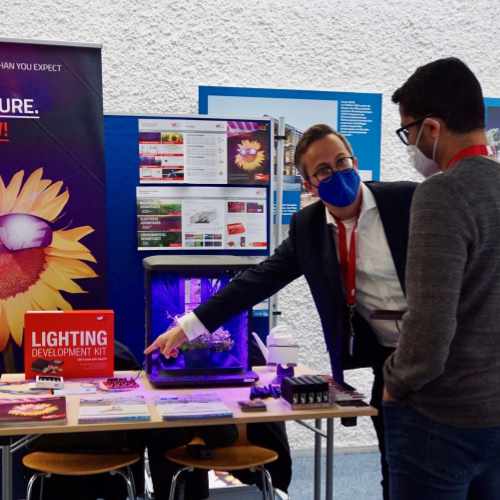
The following companies have registered for the exhibition:
Boll & Kirch Filterbau GmbH
Cultinova
DH Licht GmbH
Digitalplan Bayern 2030
Digital Root
Food & Energy Campus Groß-Gerau GmbH
geo-konzept GmbH
HAI TEC AM - INNOVATIONS
Infarm Indoor Urban Farming BV
Kalera GmbH
MABEWO AG
Organifarms GmbH
VePa Vertical Parking
Vertical Farm Tech GmbH
Würth Elektronik
Dear Startups,
At our event , “Vertical Farming—Everything Under One Roof,” experts from diverse backgrounds will come together to present the topic of vertical farming in detail. This field is a hot topic in the agricultural industry and still presents numerous exciting challenges—a perfect “playground” for startups!
Our event is therefore a platform for presenting your idea. This not only helps with networking afterward but also with validating your business model and assessing market opportunities. Have you come up with an exciting idea for a new technology and/or business model? Then you’ve come to the right place!
In a 5-minute pitch, you can make a compelling case for your idea. The winner will receive a customized, all-inclusive startup coaching package. And the best part is: you don’t have to worry about a thing—we’ll organize everything for you. You’ll get:
- Access to the TUM and UnternehmerTUM startup ecosystem
- Education & venturing opportunities through TUM’s Start-up Services and UnternehmerTUM ( pitch training, startup consulting, etc.)
- The opportunity to prototype at the TUM Venture Lab
- A €500 prototyping grant from UnternehmerTUM
- Advice from Gründerlotse Bayern on funding and financing opportunities for your projects
- Expert support with questions regarding intellectual property rights from the Bavarian Patent Center
- Exclusive guidance, inspiration, and coaching from the Technology and Innovation Management Team at Bayern Innovativ


New Ideas and Approaches to Crop Production
Vertical Farming – A Glimpse into the Future
How can we use innovative production systems to provide the growing global population with healthy, nutrient-rich, and sustainably produced food? This question was the focus of the event “Vertical Farming – Everything Under One Roof,” organized by Bayern Innovativ in collaboration with the Hans Eisenmann Forum (HEF) at the Technical University of Munich (TUM), the TUM Food & Agro Center for Innovation, and TUM Venture Labs. The conclusion was that vertical farming has enormous potential, but there is still much work to be done.
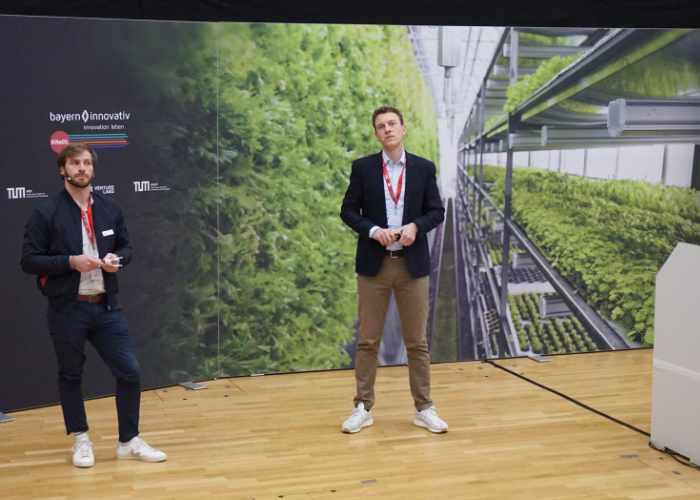
Ninety people attended in person and 200 watched online as experts from research, industry, startups, and the field provided updates on the current state of vertical farming and discussed its potential. Christian Metz, head of the Bavarian Digital Agriculture Competence Network at Bayern Innovativ, is convinced of the new method’s merits: “By growing plants on stacked levels within a high-rise building, a hall, or even just a container, available space is used as efficiently as possible. At the same time, vertical farming enables production that is decoupled from external climatic influences. And there are many other advantages—but, to be honest, also challenges, as our event showed.”
Call for Collaboration Between Science and Practice
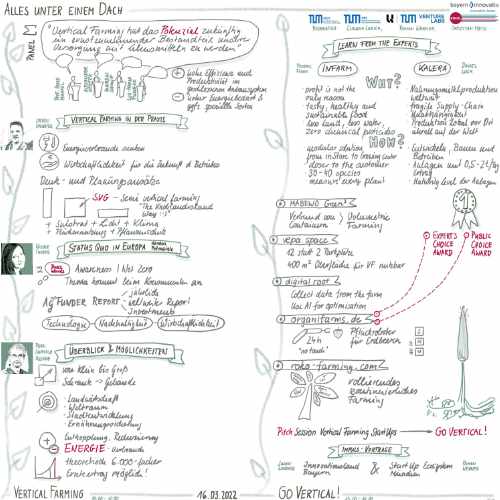
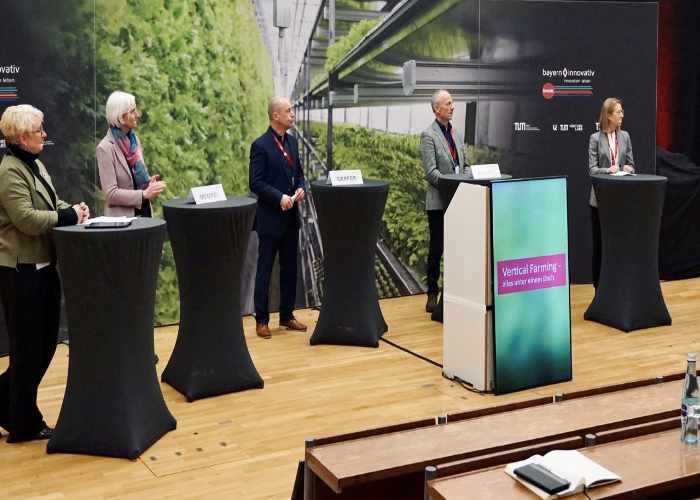
The panel discussion with experts from research, industry, and professional associations highlighted the prerequisites for successful market establishment. For example, Prof. Heike Mempel from Weihenstephan-Triesdorf University of Applied Sciences called for a large-scale demonstration project that would be open to collaboration between research and industry. Andreas Schmitt from the Bavarian State Institute for Viticulture and Horticulture (LWG) explained that practice-oriented research could be a key driving force for vegetable-growing operations that are economically oriented. Currently, he noted, vertical farming is too far removed from practitioners. Lisa Puschak of the Bavarian Farmers’ Association also emphasized that the success of a cultivation system lies in its economic viability for the farms. Vertical farming will only succeed in practice through strong cooperation between research and a willingness to innovate in agriculture. Alexander Gerfer of Würth Elektronik eiSos emphasized that vertical farming must be applicable in practice, noting that science must fill the gaps that still exist in its implementation.
Industry Success Stories – Vertical Farming on a Large Scale
Vertical farming has already made its mark inthe industry, as demonstrated by two internationally successful companies. Infarm – Indoor Farming GmbH is already showcasing its indoor farms in German retail stores. At the point of sale, customers can watch as the food grows and thrives. Dr. Pádraic Flood, Team Lead for Crop Genetics, highlighted advances in plant breeding as a key factor for success. Plants that provide protein and carbohydrates are particularly important for feeding the world’s population. The challenge here is to find new plant diversity for vertical farming. In its search, infarm is also drawing on traditional, nearly forgotten crops, such as the tuberous flat pea, which provides both protein and carbohydrates but can also be used as a salad.
Daniel Lock, Vice President of Business Development, introduced Kalera GmbH, which acquired the Munich-based startup &ever in late 2021 and is one of the world’s leading companies in the field of vertical farming. Kalera specializes in the production of “leafy greens,” such as spinach, arugula, watercress, and cilantro. Each facility produces between half a metric ton and four metric tons of produce daily. Fully automated production facilities up to 20 meters high are located in Kuwait, among other places, and will soon be operational in Singapore as well.
Vertical Farming Competition – “Berry” Takes Home the Prize
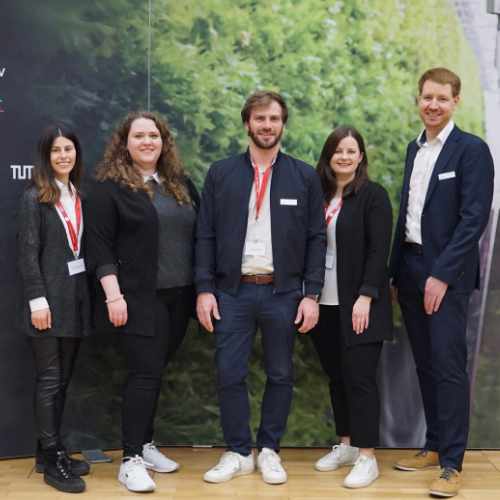
At the event, five startups presented their ideas in the field of vertical farming and competed against each other in a pitch. They demonstrated the enormous range of applications for vertical farming: from the use of robots for fruit harvesting (www.organifarms.de), to fully automated systems (www.roko-farming.de), modular facilities using expandable container construction (www.mabewo.com), to a vertical parking tower with a green facade (www.vepa.space). The Expert Choice Award was presented by the event’s speakers, and the Public Choice Award was voted on by all attendees. Following a compelling presentation, the Konstanz-based startup Organifarms won both awards. The company, which operates in the field of robotics, was founded in 2019 and offers the “Berry” harvesting robot for strawberry harvesting, along with the user interface and corresponding cloud solution. Founder Hannah Brown accepted both awards.