
- Bayern Innovativ
- Services
- Health
- Health partner network
- Interview: Circular economy in medical technology
Interview: Circular economy in medical technology
What needs to be done? - Shaping the circular economy in the healthcare sector together
13.11.2023
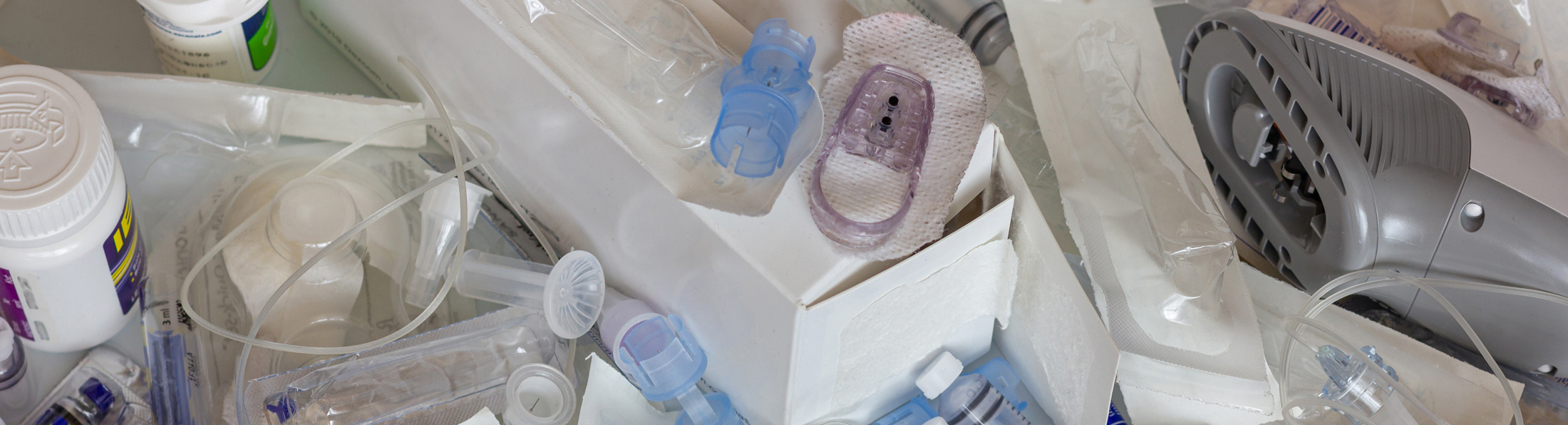
A lot of waste is generated in the healthcare sector due to the large proportion of disposable products used. In Germany alone, the healthcare sector accounts for 5.2 percent of GermanCO2 emissions. In order to minimize carbon dioxide emissions, use raw materials sustainably and thus protect the environment, many industries have adopted the concept of the circular economy.
In the following interview, you can find out what contribution the circular economy can make to environmental protection in the healthcare sector and whether this is even feasible despite the numerous regulations in the healthcare sector. We asked Dr. Eva Schichl from the Environmental Technology Cluster Bavaria and Stefanie Brauer from Bayern Innovativ in the field of healthcare, who are working together on the MeDiCircle cross-cluster project.
You are currently carrying out a project on the topic of the circular economy in medical technology. Eva, could you explain what the circular economy means in concrete terms?
Dr. Eva Schichl: Our economic system currently tends to follow a very linear logic, which means that we extract raw materials from nature, manufacture products, sometimes use the products for a very short period of time and then dispose of them again. In a circular economy, the aim is to ensure that raw materials can be permanently recycled, i.e. that hardly any raw materials need to be extracted from nature and can then be used again and again in cycles. However, this does not just mean recycling at the end of a product's life, which we in Germany generally understand as the circular economy, but rather starting much earlier. To this end, the 10 R strategies were developed from the famous 3 Rs - Reduce, Reuse, Recycle - to help make products more recyclable overall.
The first group of R-strategies is about making products recyclable in the first place, i.e. making the use of products and their manufacture smarter and completely rethinking them as early as the design phase. This has an influence, for example, on the choice of materials, the way in which materials are combined and the fact that components can be joined together again in a separable way.
The next group of R strategies is concerned with increasing the service life and the components of a product. This ranges from the reuse of the product - in the classic sense of second-hand - to the reuse of individual components of old products to manufacture new products.
Finally, there are the strategies that are needed to close cycles completely, but which lead to the greatest loss of value in products and materials. These are recycling and recovery, i.e. the recovery of energy from incineration.
Stefanie, can you explain what this means for the healthcare sector in concrete terms?
Stefanie Brauer: A lot of disposable products are used in clinics and doctors' surgeries. These include disposable gloves and masks, for example, but disposable tweezers and even disposable endoscopes are also used. The products are all made from very high-quality materials, are often only used for a very short time and often end up in the waste and from there in incineration. In most cases, the high-quality materials are lost. The question arises as to why this is the case.
Two very big issues are hygiene and regulation.
Here is an example: When you are in hospital and the doctor examines you with a metal spatula because of a sore throat, she pushes your tongue down with it so that she can see your tonsils. Let's assume that this metal spatula is a reusable product which, after being used for a few seconds, is returned to the reprocessing unit. This reprocessing is a cleaning process, usually autoclaving with subsequent packaging of the spatula. The process is very time-consuming, labor-intensive and must be documented in great detail. Soup is then served for lunch, which is brought to the hospital bed with a spoon. The spoon touches the mouth and tongue in the same way as the spatula did before. However, unlike the spatula, the dishes are placed in the canteen dishwasher and cleaned for the next use.
This example shows that we make a distinction between "how" things are used and "what" we use.
There is an urgent need to shift from selling products to selling services, as this linear business model is difficult to implement in the circular economy.
What were your first steps in the project? How did you proceed?
Dr. Eva Schichl: When the project was launched in January, we first gained an overview of existing approaches in the MedTech sector and the regulatory framework. The framework conditions are very complex, because not only do the high requirements from the MedTech industry come together, but also others from the Closed Substance Cycle Waste Management Act, EU regulations, the Commercial Waste Ordinance and so on. In addition, disposal is a municipal matter and is therefore regulated differently from region to region. We visualized the complexity of this process along the product life cycle of medical devices and plotted a floor-to-ceiling wallpaper for our first event, which we then used to find starting points for circular changes.
For our event, we invited experts from manufacturing, supply and disposal to roundtables. The main participants were medical device manufacturers, healthcare providers, hospitals or organizations representing hospitals, as well as medical device disposal companies and hospital waste disposal companies. Using the plotted process, we verified the life cycle with these experts and worked out approaches for cycles.
We then used the participants' examples and worked on very specific challenges and developed specific ideas for closing loops.
Stefanie Brauer: However, we not only worked with the experts, but also with Friedrich-Alexander-Universität Erlangen-Nürnberg (FAU) as a scientific partner. Together with a master's student from FAU, we created a survey to identify the challenges for a functioning circular economy on the part of manufacturers, users and disposal companies. We would like to publish the results of the survey and the findings from the roundtables in a study with recommendations for action derived from them. In addition, we intend to continue to provide a framework for this fruitful dialog between the various stakeholder groups in order to continue to exchange ideas on the topic.
Where do you see the greatest challenges in putting these recommendations for action into practice?
Stefanie Brauer: As the survey has not yet been fully evaluated, at this stage I can mainly only address the points that we identified in the discussions in the roundtables. One major aspect was the issue of hygiene. Hospitals and doctors' surgeries are faced with the big question of who bears the liability when it comes to disposable and reusable products. The law stipulates that the manufacturer or reprocessor is liable. This means that when a clinic or practice reprocesses a product, it practically becomes the manufacturer and is fully liable for the product that is no longer new. Clinics must decide whether they wish to assume responsibility. This is one of the reasons why more and more reprocessing centers at clinics are being closed or downsized.
Dr. Eva Schichl: From the perspective of medical technology manufacturers, one of the biggest challenges is probably transforming business models. Most business models are based on the linear principle of producing items and selling them in large quantities at a profit. There is an urgent need to shift from selling products to selling services, as this linear business model is difficult to implement in the circular economy. By selling the use of a product, the company has a completely different view of its products and wants to make them usable for as many customers as possible for as long as possible. This makes the products more durable, easier to repair and refurbish.
However, this poses major challenges for the entire industry, as it requires the entire system to be adapted. For example, clinics will then have completely different liquidity flows, which in turn means that the billing modalities of health insurance companies will have to be adapted. This is precisely why we want to bring all stakeholders in this sector together in the project, so that we can tackle this complex transformation systemically and in coordination with everyone involved.
The key to circular transformation is to start and continue in small steps, despite the many major challenges.
Are there already examples of successful approaches to circular medical devices?
Stefanie Brauer: The first approaches to the 10 R strategies have been taken by manufacturers, users and disposal companies. Among users, for example, there have always been classic reusable products, which have always been part of a circular economy. Although usage is declining, we can focus more on reusing products.
The company Röchling , a plastics processor, for example, has created a change within its product range by redesigning a trocar. The number of materials and components used has been reduced and the plastics previously used have been converted to bio-based plastics. This makes recycling easier and raw materials are no longer used unnecessarily.
Repairing high-priced products in particular is quite common. This is not only done by the manufacturer's service department, which carries out maintenance and the like, but there are also companies that specialize in this area. The Austrian company Mides , for example, specializes in the repair of ultrasonic probes. During the repair process, the company also provides the hospital with a replacement product so that the device can be used almost continuously.
Another example from remanufacturing. The Medical Device Regulation (MDR) gives EU member states the freedom to decide whether to allow the reprocessing of single-use devices in their respective countries, which Germany allows. On this basis, the Berlin-based company Vanguard has been able to reprocess cardiac catheters, for example, for many years. These are normally classic disposable products, but reprocessing extends their service life by two to three times and a reprocessed cardiac catheter also has a financial advantage, as it is cheaper than a new one.
Dr. Eva Schichl: Some medical devices are only available as disposable versions. We need to find ways of at least recycling them. This is currently not guaranteed, as electrical devices often end up in traditional hospital waste and are therefore incinerated instead of being recycled as electronic waste. In general, the lack of digitalization in the waste and recycling industry, which would provide the necessary transparency and measurability, is often a problem.
There are good examples and new start-ups, such as Resourcify from Hamburg, which have initiated initial pilot projects to sort individual electronic medical devices from the hospital waste stream so that they can then be recycled. This is technically feasible, but due to regulatory requirements, special permits are needed from local authorities, which are not currently being granted.
Circular transformation requires courage and a willingness to change at all levels, because the challenges are as individual and diverse as the product categories.
What needs to be done to ultimately establish a successful and functioning circular economy?
Stefanie Brauer: You can see that something can also be achieved through the efforts of individuals. However, it is crucial to start and continue in small steps, despite the many major challenges.
Dr. Eva Schichl: However, it is not just the task of individuals, but of the entire network. The complexity makes it clear that it is necessary to cooperate and take a systemic approach. Our task is to bring the players together and provide them with tools, ideas and best practices, but also to present concrete methods on how to work on ideas within a company and develop new solutions in this area.
Stefanie Brauer: Another important aspect is the topic of digitalization. Particularly if you want to work together within the industry or even across industries, you should be prepared to share data, as industry solutions are likely to be required in many cases. Digital product passports are also helpful, for example, if a clinic is moving towards sustainability and needs information to decide which product is better and more sustainable for them. On the other hand, it will be clearer for manufacturers which measures are effective for making better decisions and increasing their market advantage. They can then say that they have successfully implemented changes that are paying off.
The interview was conducted by Dr. Petra Blumenroth, Project Manager Technology I Frugal Innovation at Bayern Innovativ GmbH.
Networking, leveraging synergy effects and exchanging experiences are important. Every first Friday of the month, the Alliance for Sustainable Medical Technology holds a series of events to discuss best practices and thematic inputs.
Listen to the full interview as a podcast:
Audio file length: 00:19:20 (hh:mm:ss)
Length of the audio file: 00:19:20 (hh:mm::ss)
Circular economy in medical technology - is it feasible? (06.11.2023)
In Germany, the healthcare industry is now responsible for 5.2% of global CO2 emissions. This underlines the growing importance of concepts such as the circular economy, sustainability and recycling, which are also becoming increasingly important in the healthcare sector.
Dr. Petra Blumenroth talks to Eva Schichl from the Umwelttechnologie-Cluster Bayern e.V. support association and Stefanie Brauer, who is involved in sustainability at Bayern Innovativ in the health sector, about the contribution the circular economy can make to protecting the environment and whether this is even feasible despite the numerous regulations in the healthcare sector.