Accessibility

 Language
Transfer succeeds together: the strength of the transfer community
In knowledge and technology transfer, information alone is often not enough. Experience, classification and exchange with the right people are crucial
We know that there is potential for transfer work in numerous experiences that usually arise in the background and rarely become visible. This
insight emerged from many conversations during our work on the topic of transfer. This recurring observation was the starting point for taking a closer look at
.
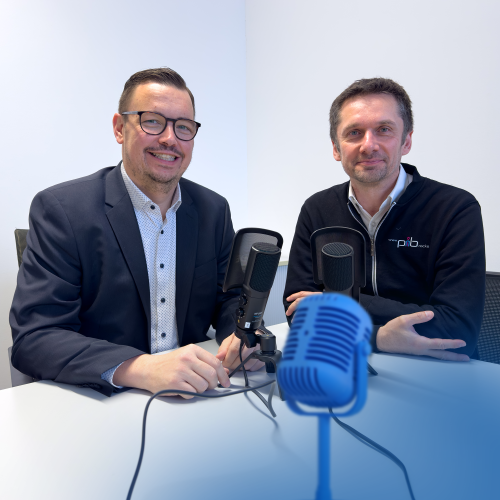
For concrete insights, we spoke to Andrea Janssen, a transfer intermediary who can not only describe transfer in theory, but also lives it
every day. This resulted in exciting insights into how transfer actually works, where peer resonance is lacking and why contact with like-minded people is often
crucial.
What is complex about transfer work in everyday life and why exchange is important for this

"No company would google 'transfer intermediary'."
Andrea Janssen, who supports many transfer projects in her work as a project manager in innovation management, says this sentence with a
wink. And yet it hits the nail on the head. Transfer work is usually quiet.
Andrea Janssen: "Transfer work rarely begins where a need is already clearly formulated on the table.
It often begins much earlier: with listening, classifying, finding out what companies actually need and where there are points of contact
. Finding suitable companies, making needs tangible, documenting discussions so that colleagues can continue to work on them
. Much of this happens in the background. This is precisely what makes transfer work more complex than it often appears from the outside.
Much of our work does not begin with a ready-made request from the company.
It usually starts with first finding out what is really needed.
In addition, much of this work is not easy to look up. Which companies really match an offer? Where is there a
specific need? What needs to be recorded to ensure that a contact doesn't fizzle out, but rather remains viable?"
Andrea therefore describes her everyday life not as a linear process, but as a constant search, check and connection.
Andrea Janssen: "And anyone who accompanies many topics in parallel knows how valuable it is to get feedback quickly, to know a
suitable contact or to hear about an experience that saves time and opens up new paths.
The problem has often not been a lack of information. It was a lack of readily available, experience-based classification.
Transfer actors meet again and again at events or in individual projects, but this exchange often remains situational. What is often
missing is the opportunity to stay in contact between these moments and benefit from each other without having to start from scratch
every time."
Studies, tools and best practices are available in large numbers today. But availability does not automatically mean applicability. Anyone who reads, saves and informs
receives knowledge, but not necessarily the assessment that will help in a specific situation.
Andrea Janssen: "In practice, it's not only what we know that counts, but also how we classify this knowledge and under what conditions we apply it
. The really helpful answers often don't come from reading another article, but from talking to people who have already experienced
similar situations."
Transfer is context-dependent. Every organization has its own structures. Every cooperation follows its own dynamic. Every region has
special features that cannot simply be transferred. This is why documented knowledge alone is often not enough.
This is an often underestimated strength in transfer: the experience of the community itself.
Andrea Janssen: "Over the years, an enormous amount of practical knowledge has been built up in projects, collaborations and discussions. This knowledge is highly relevant, but it
usually remains dispersed: it lies in personal networks, in individual project experiences and in situational conversations between
colleagues. The intermediaries could benefit even more from each other. When exchanges take place and topics are seen by other
intermediaries, points of contact often arise that were previously not even on the radar."
Experience-based knowledge is available, but not easily accessible. For example, many transfer intermediaries work on similar challenges without
benefiting from each other, although this could be a great added value.
Our conclusion: What is needed is a space in which experiential knowledge is accessible
There are numerous digital exchange and information spaces today. They enable visibility, reach and initial contacts, and also provide valuable impetus for knowledge and
technology transfer. At the same time, many of these platforms follow a logic of attention and continuous
activity. The rapidly growing number of content interactions and new functions shows that use and resonance are increasingly at the heart of
.1
For transfer intermediaries who work with complex, context-dependent issues, this is only part of the solution. After all, not everything that is visible
or quickly shareable is actually helpful in everyday work. At the same time, information density is constantly growing: studies show an increasing digital
overload, in which communication overload and a lack of focus time make the actual work more difficult. 2,3
What this reveals is not so much a lack of channels or information, but the lack of a shared space for context and
specific transfer exchange.
A space that is constant.
In which there is also room for immature thoughts, questions can be asked before they are fully formulated and experiences can be shared,
which often remain invisible in open platforms. This kind of protected exchange can be particularly crucial in transfer: it connects people
with similar tasks, enables honest peer feedback and makes the knowledge already available in the community usable - as a
contribution to shared learning.
...not as a product, but as an infrastructure for relevant exchange
Based on these ideas, a new platform for knowledge and technology transfer is currently being created. Not as another feed and not as
an end in itself. But rather as a place where experiences, questions and perspectives from the community can come together.
The aim is to create points of contact more easily and continuously in future. This is because many transfer intermediaries are working on very similar
challenges without yet having a common point of reference. People meet at events, in projects or via
existing networks, exchange ideas and then often continue to work within their own structures. Much still depends on chance: the
right meeting, the right contact or the right moment. The platform is not intended to replace this exchange, but to give it more
continuity. It should make visible what is already there: practical knowledge that can directly help others in the transfer. It is intended to bring
people together who might otherwise never have met. And it should help to create a stronger common understanding of transfer from many individual
experiences. Because we don't have to create the most important resource in transfer. In
many cases, it is already there. We just need to connect them better.
Hardly anyone would google transfer intermediaries. Not because their work is unimportant, but because it often takes place between the systems
and is difficult to grasp from the outside. This makes it all the more important to have a space in which this role does not have to be explained or marketed, but in
which those who have been fulfilling it for a long time can be found. A space in which transfer intermediaries can see each other, share experiences and
learn from each other. After all, anyone who creates connections on a daily basis also needs places where connections are created.
Your thoughts and questions on the topic are always welcome - we look forward to exchanging ideas with you.
Your contact