
FC Isar Robotics: Developing Tomorrow's Robotics Through Soccer
November 23, 2026
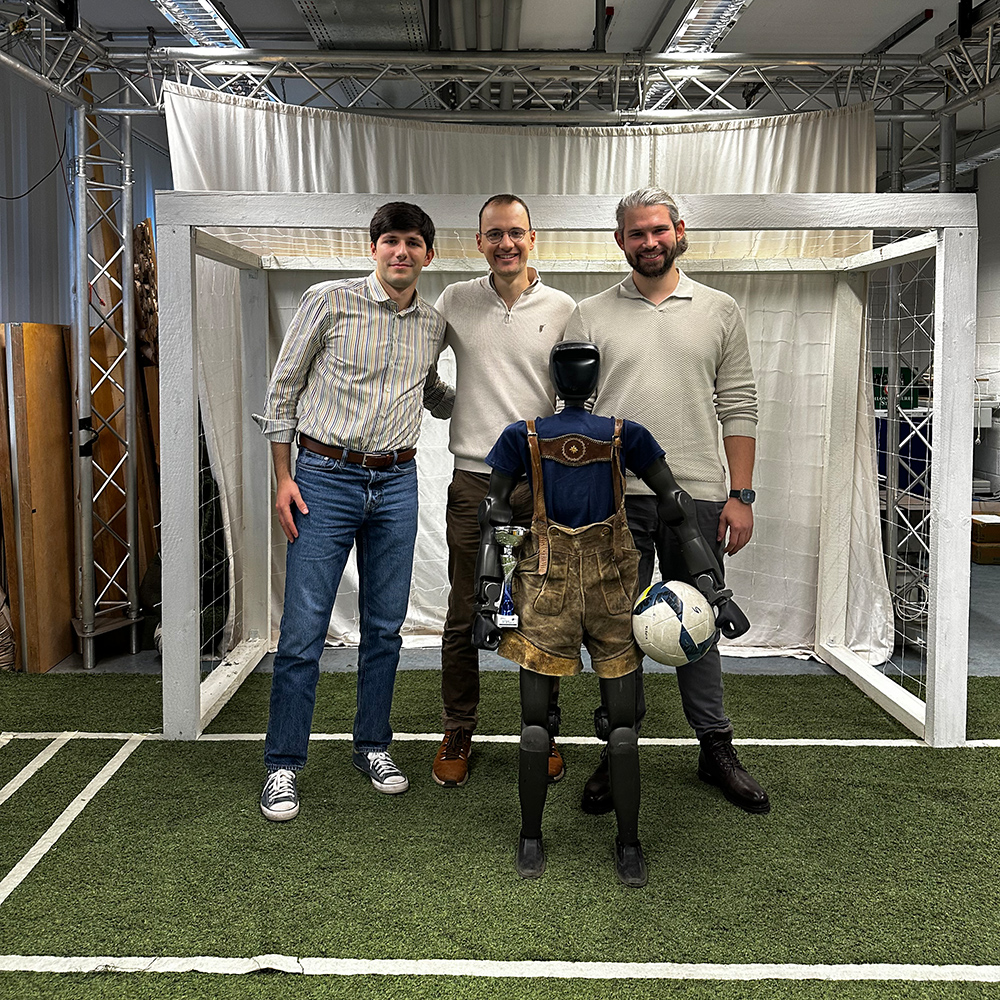
Robots that play soccer on their own, recognize complex situations, and make intelligent decisions: that’s exactly what the student team FC Isar Robotics is working on. In this interview, developers Paul Völker (co-founder and team lead) and Marko Prohaska (founding team member) discuss their technological ambitions, the challenges of physical AI, and the potential of their research for industrial applications.
What do you hope to achieve with FC Isar Robotics, and why is soccer the perfect development environment for that?
Isar Robotics: Our approach is to give students the opportunity to work with robotics. In doing so, we cover many areas that also have applications in industry. Soccer is particularly exciting because it’s a playful application in a competitive environment. We bring together different areas of research and make robotics visually understandable even to people who don’t work in this field themselves. In the short term, we want to become soccer world champions. In the long term, we’d like to create a testing ground for Physical AI, whose developments can also be applied to other areas of application.
How do you integrate perception, motion control, and decision-making into a functioning overall system?
Isar Robotics: First, the robot must recognize where the ball, its teammates, and the opponents are located. Then it must understand where it is positioned on the field and what is currently happening. This information is passed on to our behavior module, which decides how the robot should act. The Motion Team ultimately translates these decisions into movements, which we train using reinforcement learning. These three areas form the foundation of our system and can also be applied to industrial applications. In a factory, for example, a robot must detect where a tool is located, make a decision, and then execute that decision.
What is already working well in the simulation, and where do you think the biggest challenges lie for real-world movement?
Isar Robotics: We distinguish between two types of simulation: on the one hand, we simulate gameplay behavior; on the other hand, we train specific movements such as running or kicking a ball. The simulation of gameplay behavior is already working very well. This allowed us to identify and correct errors before we even set foot on a large playing field. The biggest challenge lies in training complex movement sequences. This requires enormous computing power and, in some cases, tens of thousands of training iterations. Our first self-trained walking policy already works, but it’s still very stiff.
What opportunities for collaboration does your company offer?
Isar Robotics: We are generally very open to collaborations with companies in the robotics sector. Sensors and camera systems, for example, are of particular interest. We can serve as an initial testing ground, putting new technologies through their paces under real-world conditions and demonstrating their applications. At the same time, international competitions provide a platform to showcase these technologies, whether it’s the RoboCup World Championship or the Beijing Humanoid Games, which attract millions of viewers annually. It’s also conceivable to adapt our software models for industrial applications. Here, however, we must assess the possibilities on a case-by-case basis. Furthermore, we’re an attractive partner for companies seeking highly qualified young talent. In our most recent recruitment round, we received 300 applications and accepted the top six candidates.
How do you organize knowledge exchange, and what role does collaboration with research institutions and companies play?
Isar Robotics: Research is a top priority for us. We hold weekly scientific reviews where we discuss current publications. Developments in robotics are advancing so rapidly that sometimes a new paper is published the very next day, and we can apply its findings immediately. A major advantage is our interdisciplinary team drawing from mathematics, mechanical engineering, computer science, and AI. We’re very dynamic and willing to completely overhaul our models when better approaches emerge. This allows us to respond quickly to new scientific findings and work at the cutting edge of technology.
What are you planning as your next major technological milestone?
Isar Robotics: Our goal is to have the best software at the 2027 RoboCup World Championship in Nuremberg. Currently, many processes are still strictly pre-programmed. For example, a forward looks for the ball and shoots. We want the robots to independently decide which strategy is best in a given game situation. Instead of anticipating and programming every situation, our AI should make the right decisions on its own. We believe this will enable us to win the RoboCup in Nuremberg as well.


