Accessibility

 Language
Join us on a journey to people, ideas and technologies that are revolutionizing Bavarian agriculture. Along the way, we will visit digitalized fields, marvel at autonomous agricultural robots and take a look inside smart barns. All to answer the one burning question: What will the agriculture of tomorrow look like?
Technology and Support Center (TFZ)
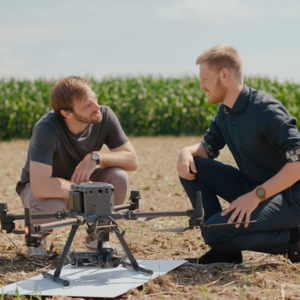
In the EWIS2 project, the Technology and Support Centre (TFZ) is breaking new ground: drones capture fields from the air, artificial intelligence recognizes weeds and creates precise application maps. This can be used to control autonomous robots or precise plant protection. The goal: fewer pesticides, lower erosion risks and greater sustainability. "What will sustainable crop protection look like tomorrow?"
Bavarian State Institute for Agriculture in Ruhstorf a. d. Rott
Climate change, energy costs, environmental protection - agriculture is facing major challenges. Does the solution lie in digitalization?
The Bavarian State Institute for Agriculture is showing how it can be done: In its "Future Crop Farming" project, it is testing high-precision sensors, satellite-based monitoring and autonomous field robots - with the aim of making the entire cultivation process more efficient, resource-saving and sustainable.
Take a look into the future with us!
Agricultural robotics
Thanks to digitalization, agricultural robots are taking over repetitive tasks and giving farmers more freedom. Beat Vinzent and Stefan Kopfinger show how field robotics are replacing human labor and also reducing soil compaction. Discover how autonomous robots increase efficiency and biodiversity.
Soil protection
Heavy rain, drought, storms - climate change is hitting agriculture hard. Florian Ebertseder shows how we use sensors, drones and the ABAG software to analyze and, above all, minimize soil erosion. Mulching and undersowing protect the soil, improve water absorption and promote biodiversity.
Plant protection
Klaus Gehring demonstrates two concepts in the Future Crop Farming project: on the one hand, the minimal use of pesticides and mechanical weed control versus the targeted, sparing use of chemical agents. What makes which method particularly effective?
Bavarian state estate Almesbach near Weiden i.d. Oberpfalz
Thanks to the use of state-of-the-art technologies, we are experiencing a transformation that is taking the well-being of our animals to a new level and reducing the workload of farmers. From fitness watches for cows and AR glasses to milking robots and high-tech in the calf barn. Stay informed and discover innovations that focus on animal welfare!

The cow's smart home
From smart sensors to automated processes: Helmut Bamler, deputy manager of the Bavarian State Farm Almesbach, offers an exclusive insight into the networked barn and shows how automation and health monitoring can achieve a new level of animal welfare and make farmers' work more efficient.
More comfort with the milking robot
More and more farms are opting for automatic milking with milking robots. In Almesbach, too, automatic milking is already part of the daily routine, a big step towards efficiency and convenience. Hanna Market, specialist teacher at Staatsgut Almesbach, explains what data the milking robot documents, which in turn allows conclusions to be drawn about the animal's state of health and thus enables early action to be taken.
Keeping an eye on the animal with AR glasses
Augmented reality is finding its way into agriculture. At the Bavarian State Farm Almesbach, AR glasses make it possible to link the digital and physical worlds. While the farmer looks at the cow, all important data about the animal can be called up in real time and processed directly. This includes, for example, behavioral patterns when eating, walking and lying down, body temperature or rumination behavior.
High-tech in calf rearing
At the Almesbach state farm, the principle is "Healthy calves today are healthy cows tomorrow!" Various drinking techniques, such as the automatic calf feeder, are tested in practice. Jasmin Gietl, herd manager at Staatsgut Almesbach, will show how modern technology can be used to retrieve animal-related data, such as the amount of feed consumed, at any time. This enables problems to be identified as quickly as possible and immediate countermeasures to be taken.
Your contact