Accessibility

 Language
Nuclear fusion on the way to industry: new prospects for the German economy
Opportunities of nuclear fusion for SMEs
27.04.2026
Energy is a key planning factor for companies - and at the same time often one of the biggest uncertainties. Fluctuating prices and uncertain availability repeatedly highlight the extent to which production, investment and innovation depend on it. With nuclear fusion, the focus is shifting to a technology that addresses precisely this issue: an energy source that can be provided in a stable, scalable and climate-neutral manner over the long term. In the future, energy could become less of an uncertainty factor and more of a predictable basis.
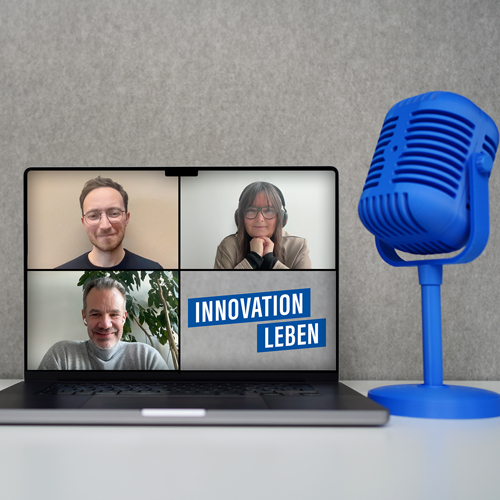
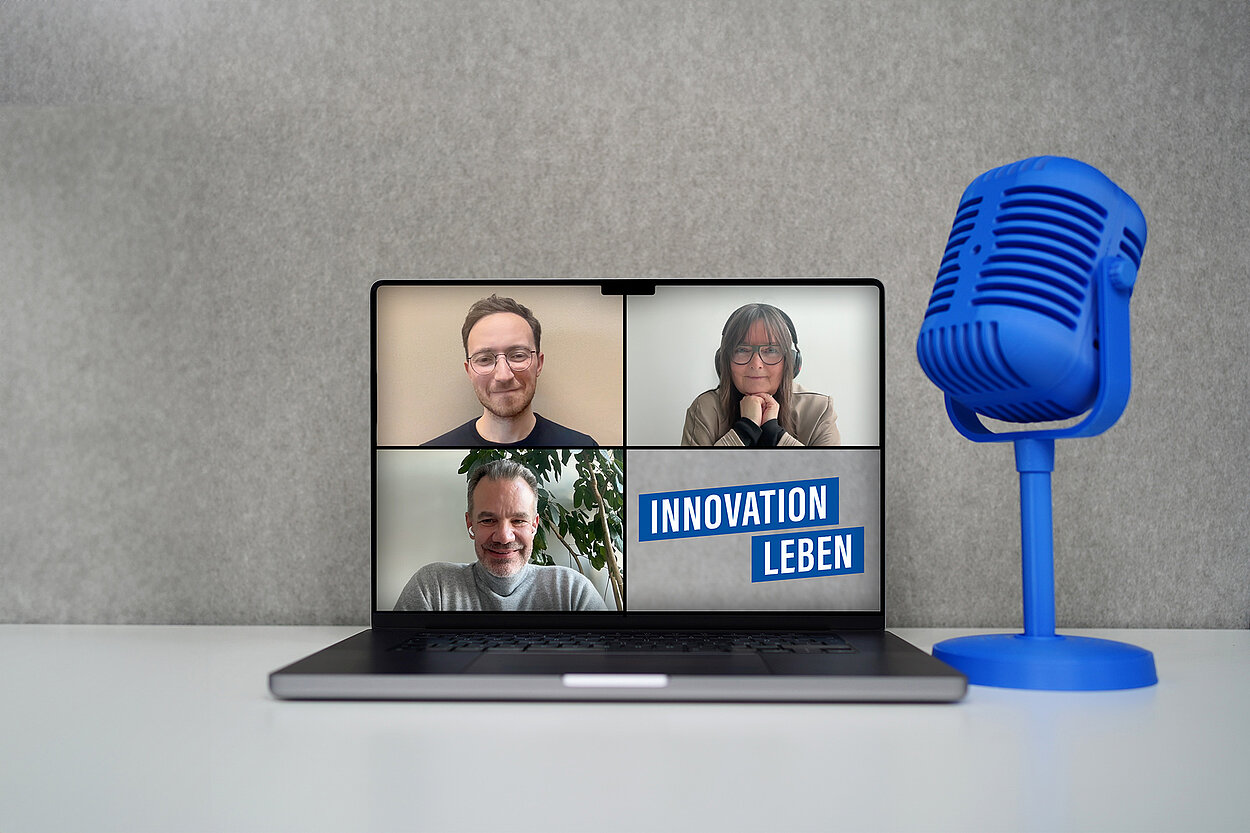
Today, the technology is no longer just a research topic. Initial projects show that development is increasingly moving towards application. One of the leading start-ups in the field of nuclear fusion comes from Bavaria: Proxima Fusion. In our Innovation Leben podcast, Barbara Groll talks to Francesco Sciortino, CEO and co-founder of Proxima Fusion, and Dr Rainer Seßner, CEO of Bayern Innovativ, about the current state of the technology and the next steps on the road to industrialization.
Mr. Sciortino, many people confuse nuclear fusion and nuclear fission. What is the crucial difference?
Francesco Sciortino: I would say that the two are basically opposites. Nuclear fission splits heavy atomic nuclei and can get out of control through chain reactions.
Nuclear fusion, on the other hand, is completely different. It fuses light nuclei and is inherently self-limiting and safe. In addition, nuclear fusion does not produce long-lived radioactive waste and there is no risk of a nuclear meltdown.
What was your motivation for founding the company? And when did the moment come when you thought: Now we can really do it?
Francesco Sciortino: That was in 2022. At the time, I was a scientist at the Max Planck Institute for Plasma Physics in Garching near Munich and was in close contact with colleagues, including in Greifswald, where the Wendelstein 7-X is located.
We met with other colleagues from MIT in Boston and Google X California and realized that a new publication was of crucial importance to us. It showed that we can fundamentally rethink the numerical optimization of stellarators - and thus also the possibility of developing nuclear fusion towards commercialization.
This was not so clear in 2022, but we saw this opportunity and decided to go down this path.
At the same time, Wendelstein 7-X was incredibly successful. This machine was built up over fifteen years and achieved all its goals in 2022. That was outstanding for us, so we said: if we can do it, it has to be in Germany.
We founded the company in 2023. Today, we have almost 150 employees between Munich, Zurich and Oxford and work closely with the Max Planck Institute for Plasma Physics on high-temperature superconductors, magnets and stellarator optimization.
Dr. Seßner, Bayern Innovativ was involved at a very early stage. Why?
Dr. Rainer Seßner: As a think tank and transfer organization, we monitor trends in science and industry very closely. We analyze and evaluate them and often look at technological developments before the hype cycle, but of course also during it. We prioritize and derive measures.
In the case of fusion, it became clear that after decades of research, the so-called "fusion constant" - i.e. the assumption that it will still take around 30 years until a functioning power plant is ready - is increasingly disappearing. Our analyses show that the time is now ripe to take the next step, to drive forward the industrialization of this technology in parallel with ongoing research and to actively shape the transfer from science to industry.
Today, we are talking about much shorter periods of time until commercialization than in previous decades. The scientific maturity of the technology is now very high. The open technological challenges need solutions that now come from engineering sciences and high-tech companies. At the same time, there is a great need for new energy sources to supplement renewable energies.
It is now crucial to build an ecosystem of science and companies, to shape the transfer of knowledge and technology and to develop these value chains together with industry from the outset.
It is also important to note that fusion will not be a short-term quick win for the supplying companies, but a possible mainstay in one or two decades. It is therefore important to build up expertise in these deep-tech topics at an early stage and then hopefully be successful as a hidden champion - this is exactly what we are working on.
Proxima Fusion was and is a prime example of this for us. Another reason why now is the right time: numerous start-ups are emerging, particularly here in Bavaria, but also in other federal states, that are taking up precisely these technological advances. Proxima Fusion is one of these examples - a company from Munich that has reached precisely this level of maturity and now needs to move from science to industrialization.
You brought the "FusionX:Global" congress to Bavaria, the world's leading investor conference on fusion technology, which took place for the first time in Europe, even in Munich. Why is this conference so important?
Dr. Rainer Seßner: First of all, a big thank you to Francesco Sciortino. He gave the initial impetus and suggested bringing the conference to Europe, to Germany and to Munich. We took up this impulse and implemented it.
At the same time, we developed the investor conference further and added the topic of industrialization. This enabled us to bring the entire international community to Bavaria - investors, large companies, small and medium-sized enterprises and start-ups that are active in this field or are potential suppliers.
This has created an ecosystem that, on the one hand, demonstrates Bavaria's international appeal as a deep-tech location and, on the other, makes it clear that the time is ripe to transfer the technology to industrial implementation.
The resulting momentum was enormous and was also confirmed internationally by the media coverage. All in all, it was a tremendous success.
Mr. Sciortino, as part of "Fusion Global", you signed a letter of intent to build two reactors - the "Alpha" demonstrator and the "Stellaris" power plant. Why two reactors?
Francesco Sciortino: It's not really two reactors. You could say that we are first building a demonstrator and then a power plant. The "Alpha" demonstrator is being built in Garching, the "Stellaris" power plant is the next step.
There is already an existing nuclear fission power plant on the site of the planned power plant, which is no longer in operation but has a very good infrastructure. It is crucial for us to move forward as quickly as possible. Using this existing infrastructure is therefore a great advantage.
We signed the corresponding declaration of intent together with the Free State of Bavaria, the Max Planck Institute for Plasma Physics and RWE. This was a strong signal for investors and the international fusion community.
What is important here is that it is not just about a single company, but about an entire ecosystem that is currently being formed. In this context, we have also announced the "Alpha Alliance" - a consortium of predominantly European companies from our supply chain. The aim is to build the demonstrator together.
"Alpha" is a major project with an investment volume of around two billion euros. We cannot realize this alone. That's why partnerships are crucial - with the Bavarian State Government, the Max Planck Institute for Plasma Physics, RWE and other companies working together in the Alpha Alliance. Bringing all this together in the same week around "Fusion Global" was incredible.
If you now build this demonstrator: What does it have to prove so that the "Stellaris" reactor can subsequently be realized?
Francesco Sciortino: Alpha is the last stellarator we have to build before we can realize a power plant. The aim is to demonstrate a net energy gain.
In concrete terms, this means that we feed around 30 megawatts into the machine to heat the plasma - i.e. the hydrogen. The plasma then has to give back more energy, including from nuclear fusion itself. This is precisely the crucial demonstration.
Alpha is not yet a power plant, but a research infrastructure. That is why we are working closely with the Max Planck Institute for Plasma Physics. It is important for us to show that we as a company are able to develop and implement such a facility - and at the same time set up industrial production, especially for the powerful magnets.
After construction, we want to achieve our goals and use the facility for research together with the Max Planck Institute. It should play a leading role there for many years to come. Proxima Fusion and the Max Planck Institute are pursuing different but complementary goals - and can drive this development forward together.
Stellaris is the next step and differs fundamentally from Alpha. While Alpha serves as a demonstrator, Stellaris is a power plant. We have published a paper for it, which is available on the Internet.
For Stellaris, we have developed a complete design concept in which physical and engineering aspects have been brought together for the first time. This is the first time in human history that we have a concept that works on paper - and that's exactly what we need to build now.
Among other things, we need a demonstration of the new magnet technology based on high-temperature superconductors. We want to develop, manufacture and test this over the next 18 months. This is a European project that brings together Munich, Zurich and Paris.
At the same time, we are building Alpha to demonstrate that we as a company can bring such a project to a successful conclusion.
Alpha is scheduled to go into operation in the early 2030s. By the end of the 2030s, we want to have built Stellaris and put it into operation.
And what are the biggest technological challenges at the moment?
Francesco Sciortino: The first major challenge is the magnets. These have to be significantly more powerful than previous systems, such as the Wendelstein 7-X. The basis for this are new technologies based on high-temperature superconductors.
The challenge lies in combining these materials in such a way that a functioning magnet is created that achieves field strengths of around 20 Tesla. That is a very high magnetic field intensity. At the same time, we are talking about energy quantities of around 100 megajoules that have to be introduced into the magnet. That is really difficult. So the magnet is the first challenge.
The second is operation and maintenance. While an experiment can also function with interruptions, a power plant must run reliably for a large part of the time - around 80 to 90 percent - in order to be economical. This requires robust materials and solutions that enable long-term operation.
Our Stellaris design is based exclusively on materials that already exist today. This is important because we can build Stellaris with today's materials. This means that it is not a "fantasy story".
The third challenge is tritium generation. Tritium is a rare hydrogen isotope that does not occur naturally in sufficient quantities and therefore has to be produced in the reactor itself. The relevant technologies are still under development and need to be tested further.
The whole world is working on this - and so are we. The focus is on magnets, materials for maintenance and operation as well as tritium breeder technology.
Dr. Seßner, what role do Bavaria and Europe play in international comparison? Are we competitive with the USA and Asia?
Dr. Rainer Seßner: Yes, we are. Bavaria and Europe play an important role in international nuclear fusion research. Scientifically, we are - as so often - in the top league.
The crucial thing now is to translate this strength into economic added value. The level of competition is very high. However, Bavaria has its own master plan and is one of the world's leading locations for stellarator technology.
As is so often the case, the central challenge lies in the speed of transfer from science to commercial implementation, i.e. industrialization, as well as in the necessary willingness to invest.
The planned demonstration reactor here in Bavaria is a huge step. What does this mean strategically for Bavaria?
Dr. Rainer Seßner: With this project, the demonstration reactor, we have the opportunity to establish an industrial value chain.
We can integrate the companies that have the necessary engineering expertise at an early stage and involve our hidden champions, who are strong in different technologies and are building up this industrial value chain.
The great thing is that we are not alone with this project here in Bavaria. Technologies and hubs are also emerging in other federal states that can complement each other.
Overall, it is important to emphasize that this is not a purely Bavarian project. Nuclear fusion is an international topic that can only be implemented in close cooperation.
After all, the planned reactor is not just about research, but a major technology project. Can SMEs in Bavaria benefit from it?
Dr. Rainer Seßner: Yes, absolutely. The construction of a fusion power plant requires materials, precision technology, control systems and special production, but of course also outstanding construction expertise to implement the necessary building infrastructure and the mechanical engineering around it.
This is precisely where the strength of Bavaria's SMEs lies. There are numerous hidden champions who can drive these developments forward. This results in opportunities - for suppliers, mechanical engineering and engineering firms. Because fusion is not just research, it is developing into industry - and Bavaria can be at the forefront here.
For companies, this means new markets, new partnerships and long-term prospects, especially if they get involved at an early stage.
And what about SMEs that have had little contact with high-tech so far? Is now the right time to get to grips with the topic? What opportunities does it offer?
Dr. Rainer Seßner: Of course there are opportunities here too. First of all, it is important to get informed: What is currently happening and what opportunities are there to get involved?
As I said, an entire ecosystem needs to be created. Francesco already described this earlier: Building such a power plant requires numerous disciplines. Companies can therefore examine where they can make a meaningful contribution.
We at Bayern Innovativ know the companies in Bavaria very well and actively approach our networks to involve them and activate the corresponding potential.
So companies can also contact Bayern Innovativ directly for advice on what opportunities are available to them?
Dr. Rainer Seßner: Absolutely. As I said before, fusion is not a short-term business model, but an investment in a long-term perspective.
This is exactly what SMEs are geared towards - not just taking the short-term quick wins, but positioning themselves solidly for the long term.
What happens next? When will we see the first demonstration plant?
Francesco Sciortino: We are currently working on the demonstration of a superconducting magnet. This development is taking place between Munich and Zurich, and the system is being tested in Paris.
This is a major challenge, as many different disciplines and teams are working together.
At the same time, we are already working on the "Alpha" demonstrator. The location has been decided and we are in the planning phase - from the infrastructure to analyzing the supply chains. Construction of the plant is scheduled for the next six to seven years.
We currently have around 150 people at Proxima Fusion. In the coming years, the team will grow significantly - not only at our company, but also at our partners, for example at the Max Planck Institute for Plasma Physics and at other locations, for example in Greifswald and North Rhine-Westphalia.
Overall, this is an important step for Germany, which plays a leading role in stellarator technology. At the same time, we see the project as a European initiative.
And what specific contribution will Bayern Innovativ be making?
Dr. Rainer Seßner: We are already working intensively on building and developing a strong ecosystem - in Bavaria, but also beyond that at a national and international level. In doing so, we are bringing together research, start-ups, suppliers and industry.
At the same time, we are addressing the current challenges of industrialization in a targeted manner, for example through corresponding challenges, workshops and deep dives, in order to solve existing hurdles in a timely manner.
This in turn creates numerous opportunities for specialized companies to contribute their expertise in order to solve the challenges.
Because only together can we make this technology a reality.
When we meet again in ten years' time - what would have to have happened for you to say that the starting signal has been given for the age of fusion energy in Europe, perhaps even in Bavaria?
Dr Rainer Seßner: For me, the decisive factor would be that this ecosystem has become an economically successful industry, or at least that the starting point is there.
This means that the challenges of implementation and industrialization have been solved and companies along the value chain are ready to build fusion power plants worldwide based on the Proxima Fusion model.
Francesco Sciortino: As Dr. Seßner said, this is not a short challenge. For us, it's about building a new industry over the next few years.
To do this, we need to go into production over the next ten years and develop this ecosystem together - not as a single company, but as a collaboration between many players. The supply chain will continue to develop, collaborate and invest together over the next few years.
Our role as Proxima Fusion is to bring together international investors for these projects. To do this, we need the support of the Free State of Bavaria, the German government and investors from all over Europe, the USA and other countries.
In the end, it's speed that counts. We have the right companies, the necessary political support and the financial resources for such a flagship project - now we have to implement it quickly.
Dr. Rainer Seßner: This is exactly what drives me once again: that we can ultimately show how research, politics and entrepreneurship can create a real project for the future - just as Mr. Sciortino has just described.
The interview was conducted by Barbara Groll, Media Relations, Bayern Innovativ GmbH, Nuremberg.
Your contact