Federal government wants to promote CO2 removal technology
German government wants to promote CO₂ removal technologies with funding programs
09.06.2026
Source: E & M powernews
The Federal Ministry for the Environment has started a dialog on technical CO2 removal and announces funding programs for the market ramp-up of corresponding technologies.
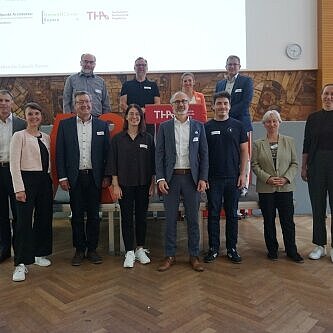
The German government wants to drive forward the development of technologies to remove carbon dioxide from the atmosphere. On June 8, around 180 representatives from science, politics, business and environmental associations discussed this at the conference "CO2 removal from the atmosphere: new opportunities for climate protection and innovation". The topic was the contribution of technical CO2 removal processes to Germany's long-term climate targets.
The event was organized by the Federal Ministry for the Environment, Climate Protection, Nature Conservation and Nuclear Safety (BMUKN). Federal Environment Minister Carsten Schneider (SPD) announced that the Federal Government wanted to create the conditions for a market ramp-up of such technologies. Technical CO2 removal is needed to offset unavoidable residual emissions, for example from agriculture or certain industrial processes.
The processes also offer economic opportunities for German companies. Schneider said: "The ministry plans to provide funding for the development and use of corresponding technologies in the coming years."
According to the requirements of the Federal Climate Protection Act, Germany should be greenhouse gas neutral from 2045. After 2050, the law stipulates that even more greenhouse gases should be removed from the atmosphere than are emitted. Reducing emissions alone is not enough to achieve this. So-called negative emissions must also be built up.
In addition to natural carbon sinks such as forests and soils, the German government is relying on technical and other innovative processes. These include, for example, the direct capture of carbon dioxide from the ambient air with subsequent geological storage. This process is known as Direct Air Carbon Capture and Storage (DACCS). Other approaches include the production of biochar, the mineralization of CO2 and the accelerated weathering of rock.
Long-term strategy coming
The BMUKN is currently working on a long-term strategy for removing CO2 from the atmosphere. The focus is particularly on technical and innovative carbon sinks. The ministry is also planning an investment promotion program and a market incentive program. In addition, a public dialog is to accompany the social debate.
According to the ministry, Germany is already one of the pioneers in Europe for several extraction technologies. This applies in particular to the research and development of DACCS processes, biochar and mineralization technologies. The Federal Government believes that the expansion of these technologies offers opportunities for innovation, employment and exports.
Creating an economic framework
A central topic of the conference was the economic framework for the development of a market for CO2 removal. According to the BMUKN, this requires reliable rules for the certification and tradability of CO2 removals.
The German government is involved at European level in the development of corresponding standards for voluntary carbon markets. It is also supporting the discussion on the possible inclusion of permanent CO2 removals in European emissions trading.
Experts consider the financing of new removal technologies to be one of the greatest challenges. Most of the processes are still at an early stage of development and require high levels of investment. Accordingly, the role of state funding and long-term market incentives was also discussed at the conference.
Background to the conference
Participants at the event included representatives from the German Energy Agency (Dena), the Berlin-based consultancy Stiftung Wissenschaft und Politik (SWP), the German Nature and Biodiversity Conservation Union (Nabu), the Potsdam Institute for Climate Impact Research (PIK) as well as companies and associations from the energy, cement industry and CO2 removal technologies sectors.
According to the BMUKN, the conference has opened a public dialog on the future role of technical CO2 removal processes in German climate policy. The aim is also to discuss how industrial policy opportunities can be exploited while at the same time taking environmental and nature conservation requirements into account.
Author: Susanne Harmsen