A model project for the heating transition
In future, TEWE will supply Erkner with climate-friendly district heating using a hybrid system of large heat pumps and biomethane CHP
10.06.2026
Source: E & M powernews
With two large heat pumps and a biomethane CHP plant, EWE subsidiary TEWE generates renewable heat for Erkner in Brandenburg - and the grid is also relieved.
The Oldenburg-based energy service provider EWE has implemented a model project for the heating transition in Brandenburg: EWE subsidiary TEWE commissioned the new heat generation system in the Erkner Mitte boiler house in September 2025. After just over a year of construction, the combination of large heat pumps and biomethane cogeneration plant supplies climate-neutral district heating for the small town of Erkner (Oder-Spree district in Brandenburg).
"With the plant technology now fully commissioned, we are realizing our goal of making the district heating supply in Erkner more efficient, climate-friendly and future-proof," explains Andreas Saadhoff, Managing Director of TEWE.
Previously, TEWE operated three natural gas-fired combined heat and power plants and a three-part district heating network in Erkner. These were partially modernized and converted.
Following the conversion of the first boiler house, the proportion of renewable energies in the connected heating network is now more than 50 percent. This is partly due to the biomethane fuel for the CHP unit and partly due to the installed heat pumps. Previously, the heat in the Mitte boiler house was generated exclusively with natural gas boilers.
The largest customers include the town of Erkner itself, an educational center and the municipal housing company Erkner (WGE), the largest landlord in the town of 12,000 inhabitants. A detached house, the Protestant daycare center at the church tower, a cinema, gyms, a retirement home and a medical center are also already connected.
CHP and heat pumps powered by electricity
The overall system in Erkner is designed as a hybrid energy system: Heat pumps and CHP react to electricity price signals. If electricity prices are low due to high electricity prices on the market, the heat pumps take over the heat supply; if electricity prices are high, the CHP unit is operated primarily and simultaneously generates revenue through electricity production. In this way, heat production costs can be stabilized, price risks cushioned and the efficiency of the overall system increased. The use of heat storage units provides additional flexibility.
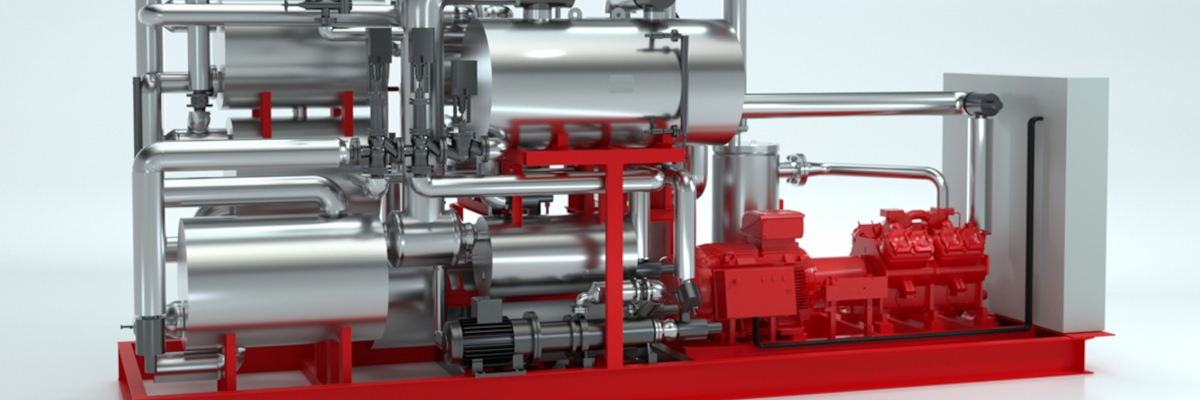
The project was the result of a collaboration between TEWE and the CHP and heat pump manufacturer 2G Energy. The new generation system consists of a biomethane CHP plant for the base load and a two-stage heat pump system. The installed "agenitor 408" CHP system from the manufacturer 2G Energy generates energy with an electrical output of 360 kW and a thermal output of 400 kW. The electricity generated in this way in turn drives the heat pump system with an output of 530 kW. Thanks to intelligent sector coupling, there is no additional load on the electricity grid.
Technology for system operation
In this system concept, the heat pump system consists of a series connection of an air-to-water heat pump from the "afilia air AEK-R290" series and a water-to-water heat pump from the "afilia water R717" series, also from 2G Energy. The system enables water to be heated up to 80 degrees Celsius using environmental heat and the integration of a heat storage tank. According to the manufacturer, only natural substances such as propane and ammonia are used as refrigerants.
The heat pump system runs at around 3,500 full utilization hours per year. The operating hours are based on forecasts and market prices. The total heat quantity of around 10,000 MWh per year is supplied to customers via the district heating network. All of the electricity generated in the CHP plant is fed into the public grid. Since commissioning in June 2025, around 2,400 MWh of electricity has been generated to date.
EWE uses the old gas boilers to cover peak loads. In winter, an existing natural gas boiler also supports the supply. A buffer storage tank from the manufacturer Dehoust with a volume of 2 x 31 cubic meters was also installed to ensure sufficient flexibility.
TEWE invested around 2.5 million euros in the new plant, of which around 600,000 euros came from the federal subsidy for efficient heating networks (BEW). As a TEWE shareholder, EWE was responsible for the planning and construction supervision. Regional partners were deliberately chosen for the implementation. The two other energy centers in Erkner (Buchhorst and Flakensee), which still use natural gas, are also to be gradually converted to climate-friendly technology.
Author: Heidi Roider