
The right moment rarely comes at the push of a button
October 15, 2026
When is the right time to enter a new market? When is it worth investing in a new technology? And when does a good idea become a product or service that can hold its own in the market? For medium-sized manufacturing companies, these are not theoretical questions. They determine whether an idea becomes a project—and whether a project might become a new line of business. The story of Kerling Kunststofftechnik GmbH from Rednitzhembach near Nuremberg shows that the right moment rarely comes with a single decision. More often than not, it develops step by step.
Plastics processing is evolving into a broader range of expertise
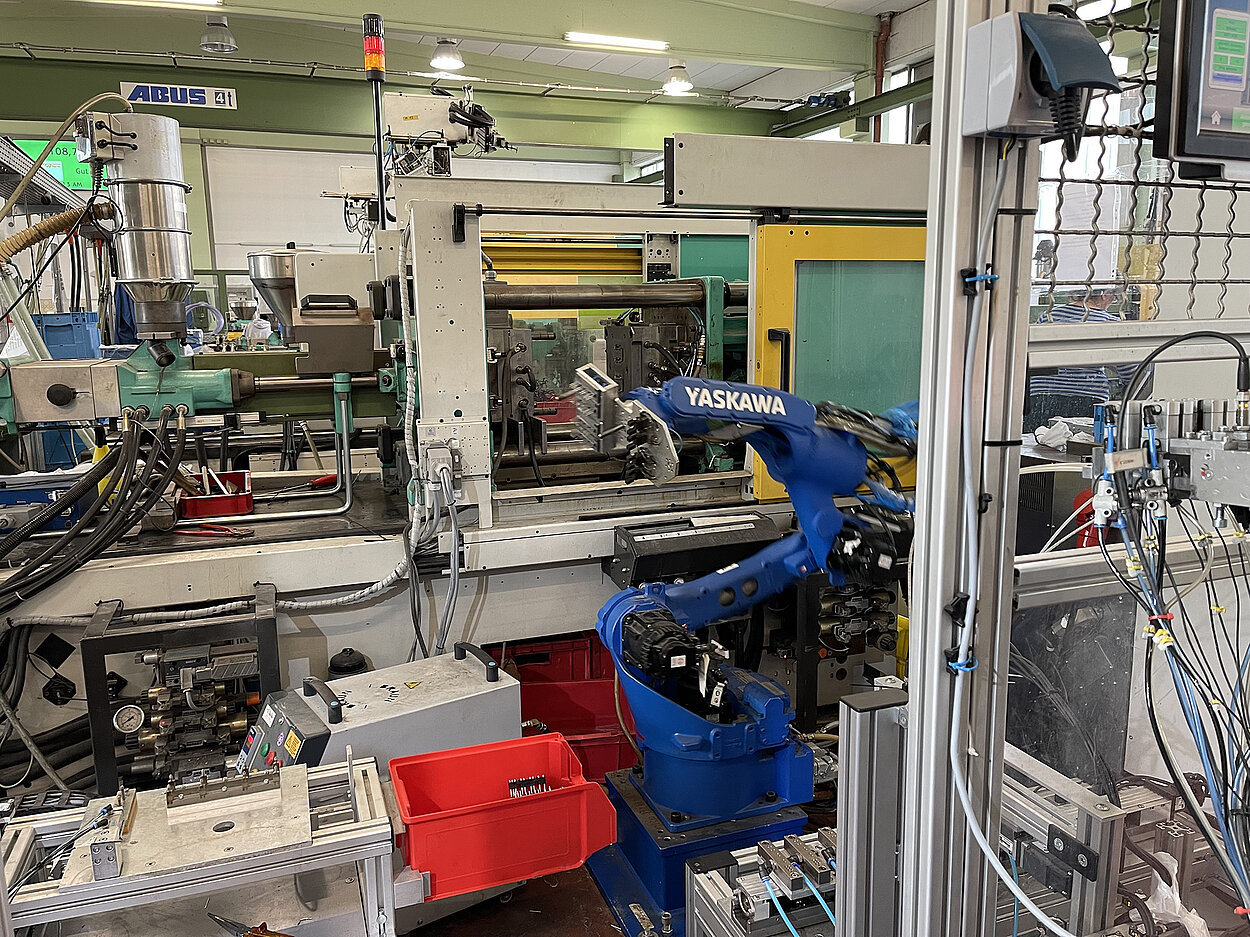
Kerling Kunststofftechnik has more than 50 years of experience in plastics processing. What began as relatively simple injection-molded parts has evolved into sophisticated plastic parts and assemblies for industrial applications. The company’s range of services includes plastics and metal processing, in-house toolmaking, assembly, and quality assurance. Kerling excels particularly in the production of complex hybrid and two-component parts. The company supplies customers in the automotive, electrical engineering, and medical technology industries, among others.
“Transformation has always been part of our history. Markets are changing, and competition is growing. That’s why we must regularly adapt our product portfolio, production, processes, and business models,” reflects Managing Director Thomas Kerling.
His goal is not to throw the existing business model overboard. Rather, the goal is to expand existing capabilities in a targeted manner: What changes are emerging in the market? Which technologies align with our own expertise? Where is an investment worthwhile? And which idea could actually become a new business segment?
In day-to-day production, there’s often little time for such questions. “Smaller companies in particular have few resources to devote to future-oriented topics,” notes transformation consultant Dr. Matthias Werner. “At the same time, they’re heavily dependent on day-to-day operations and changing customer requirements and orders.”
An outside perspective can help filter out the approaches that are a good fit for the company from among the many possibilities. For several years now, Kerling has therefore been holding regular discussions with the transformation and funding advisors at Bayern Innovativ. The focus is on how to expand the company’s own production while simultaneously broadening its skill set. While funding advice cannot replace a business decision, it can help turn a decision into a feasible project.
When an Idea Becomes an Investment
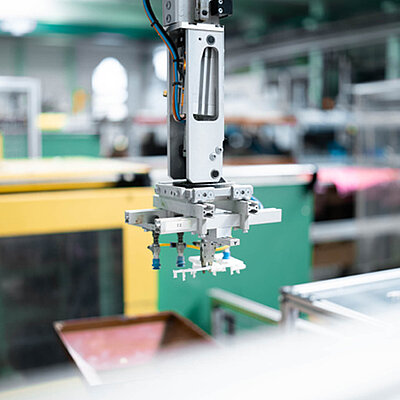
A new service can only be offered if the necessary production capabilities are in place. With funding from the KoPa 35c grant program, Kerling was able to invest in punch presses and automatic bending machines, a vibratory finishing system, and measurement technology for quality assurance.
This not only expanded the company’s machinery fleet; Kerling also built up new expertise in stamping technology and toolmaking. Additionally, the company gained expertise in transfer injection molding and plant engineering. The result: six new jobs and an additional annual revenue of approximately 500,000 euros.
“The Bayern-Innovativ mentors provided us with important guidance on investments and modernization efforts, as well as information on suitable funding programs,” recalls Thomas Kerling.
Not every idea is ready for the market yet
As it expanded production, Kerling sought new technological approaches to tap into applications in the power semiconductor industry. This raised a different question than the one faced by the stamping shop: A technical idea can be promising without yet representing a finished product. A process may be eligible for protection before it goes into mass production. A prototype may work without necessarily leading to a scalable business. In February 2023, patent searches and patent consulting were therefore conducted by experts at the Bavarian Patent Center. Among other things, the focus was on which technical developments could be protected and what needed to be considered before publication or collaboration with third parties.
The two processes, which are now protected, are still under development. They are not yet a finished, market-ready product. But that is precisely the key point: A product does not have to be ready for mass production for it to make sense to address its protection.
Sometimes the right partner is missing
The third challenge for Kerling: How can quality be monitored automatically and reliably before defects carry over into the production process? For a demanding injection molding process, Kerling did not want to develop its own solution and sought a suitable technology partner. Through the Bayern Innovativ matching program “Cooperation Talks: SMEs & Startups,” Kerling connected with PCB Arts GmbH from Fürth in 2024.
Together with the embedded systems specialist, they created an AI-powered machine vision solution for automated quality control. Cameras, lighting, edge computing, and a neural network detect defects in fractions of a second. “In PCB Arts, we’ve found a partner who not only understood our requirements for modern, automated quality control but also translated them into a high-performance solution in no time at all,” says Thomas Kerling.
Three Projects, Three Levels of Maturity
Stamping technology, new processes for power electronics, and quality control: At first glance, these three challenges seem to have little in common.
- Stamping technology: The technology was well-defined. The investment could be planned, funded, and implemented.
- Power electronics: The processes are not yet ready for series production, but are technically concrete enough to apply for intellectual property rights.
- Machine vision: The solution is integrated into the production process and is being further optimized.
The three projects thus provide three different answers to the same question: Are we ready yet? At the same time, however, they reveal a pattern. Market readiness is not a switch that you simply flip to “on” at some point. It can mean that an idea is technically feasible. That a process should be protected. That a prototype works under real-world conditions. That a solution is being used in a customer’s process. Or that a new service can be offered in a repeatable and scalable manner.
What Helps in Making the Decision
The collaboration with Bayern Innovativ demonstrates the contribution an innovation ecosystem can make to the solution:
- Transformation guides help assess the strategic starting point.
- Funding experts outline the available financing options.
- Patent consulting provides clarity on technical developments and intellectual property rights.
- Clusters and networks open up access to new topics and contacts.
- Matching programs connect companies with suitable partners.
The right time isn’t a specific date
So when is a project ready for the next step? Kerling’s experience offers no simple formula for this, but it does show what matters.
A new market becomes interesting when a specific need aligns with a company’s own expertise. An investment becomes tangible when it’s clear what skills and capacities will be needed in the future. Patent consulting becomes relevant when an idea has evolved into a concrete technical development. A partnership makes sense when a real problem meets a suitable external solution.
The right time, therefore, is not the moment when all uncertainties have disappeared. It is the moment when the next steps are clear enough to be addressed in a targeted manner.