The Future of Humanoid Robotics: Technology Meets Design
Human-Robot Interaction: How Trust Is Built
July 7, 2026
In a nursing home in the year 2035, two new humanoid robots are being tested. Both have the same sensors and technical capabilities. They can hold conversations and assist residents with daily tasks. While one of the robots is quickly accepted, many react to the other with skepticism and rejection. Some even deliberately avoid contact. The difference lies not in the technology, but in the way the robots were designed: their body language, voice, movements, and how they approach people. The crucial question, therefore, is not only what a humanoid robot can do, but also how it must be designed so that people trust it.
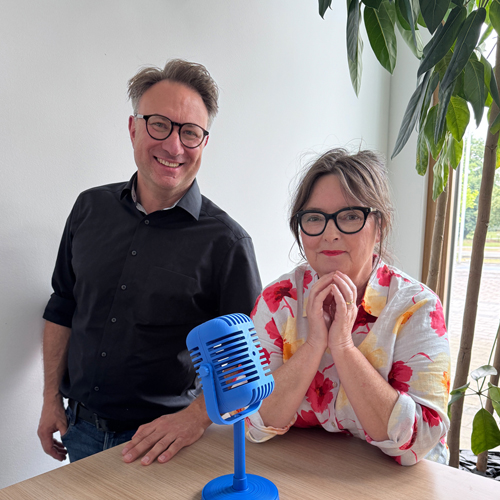
Barbara Groll speaks with Prof. Daniel Nusser, CEO of designflow, about the design of human-machine relationships and the role of creativity in these developments. The discussion also covers how companies can adopt the technology early on and what the future of humanoid robotics might look like.
Is the major challenge of humanoid robotics ultimately less of a purely technical one and more of a design one?
Prof. Daniel Nusser: I wouldn’t want to rule out either one here. Both aspects are important. Beyond that, however, there are other challenges—such as legal issues, liability concerns, and industrialization—that are currently slowing down development.
When we talk about design, it’s about much more than just aesthetics. It also includes ethical questions, which I consider extremely important and where I believe designers have a duty to get involved.
We have to ask ourselves: How autonomous should a humanoid robot actually be? What should it be allowed to do on its own? Should it be allowed to make decisions independently? Should it be allowed to lie, as we already see with large language models today?
When it comes to all these questions, I hope that designers will have a say in the matter.
Do you have an example where design was crucial to the acceptance of a humanoid robot or another technology?
Prof. Daniel Nusser: The development of the personal computer immediately comes to mind. In the early days, when computers were used only in large institutions, universities, or, for example, at the Pentagon, hardly anyone could have imagined how widespread they would eventually become.
At the time, some people assumed that there might be no more than five or ten such computers worldwide—let alone that they would eventually be found in nearly every office and household. Thomas Watson, then CEO of IBM, is said to have remarked that there would never be more than five computers in the world.
He was a bit off the mark there.
Prof. Daniel Nusser: Indeed. Apple then achieved the major breakthrough with the iMac. Suddenly, everything that had previously been housed in gray cases under or on the desk was deliberately combined into a single product available in different colors. Added to that was a user interface that made using the computer significantly more accessible.
All of a sudden, people enjoyed bringing a computer into their homes. That’s a good example of how design does more than just foster acceptance. I now like to talk about the “joy of use.” We don’t just want to accept technologies—we also want to create a positive experience through their use.
Everyone is probably familiar with this: When something isn’t intuitive to use, acceptance drops quickly.
Prof. Daniel Nusser: That’s exactly where we’re at a very interesting point. Another example comes to mind: the computer mouse. I still remember my first computer well—a Commodore 64. Back then, you had to enter cryptic characters and often wait a long time for a program or game to load.
At first, it wasn’t at all obvious that one would ever move a pointer across the screen. That’s why metaphors from the real world—such as the desktop or the trash can—were adopted to make navigation easier.
And even the mouse itself isn’t purely an engineering feat. The idea of developing a device that is oriented toward usage processes and provides ease of use is, ultimately, a classic design task.

But it’s not just about comfort or aesthetics. Ultimately, trust also plays a crucial role, doesn’t it?
Prof. Daniel Nusser: And that’s exactly what makes working on humanoid robots so novel and innovative. We’re used to coffee makers, irons, and washing machines. They sit in the corner and only come to life when we use them.
With humanoid robots, it’s different. They have a constant presence in our environment. Especially when we think of humanoids that will be used in households in the future, entirely new forms of interaction emerge. We’re building relationships with them, but we don’t yet have any experience to draw on.
That’s why many new questions arise: How do we interact with them? How do we call them? When do they become intrusive? When might a sudden movement even cause a brief startle response? Many of these topics have hardly been researched so far, and that is precisely where a major challenge lies.
How do you determine which shapes, movements, voices, or facial expressions are perceived by people as pleasant and trustworthy? Do you test this?
Prof. Daniel Nusser: In professional industrial design, we don’t start with form, color, or sound. Those are more like the results that emerge at the end of a process. First, we look at tasks and processes. It’s no coincidence that our degree program at DIPLOMA University is called “Process and Product Design.” The name itself makes it clear that we derive products from processes and that products, in turn, influence processes.
The central task in design is first and foremost to define the problem: What do we actually want to achieve? Where do we want to go? One could refer to this as human-centered design. In the case of humanoid robotics, however, it’s more about relationship-centered design, because we’re actually building relationships with these systems.
Use-case scenarios, which we develop to be as realistic as possible, help us with this. Artificial intelligence has become a very helpful tool in this regard. Storyboards, which used to take several days to create, can now be produced in just a few hours. The same applies to illustrative videos.
We then draw key insights from these scenarios. Especially when working with students, it’s not just about collecting possible applications—such as a humanoid robot cleaning the bathroom or changing a light bulb. It’s much more important to delve deeply into the usage scenarios. We refer to these as use cases or user journeys. Only by gaining this understanding can we derive insights that will later be incorporated into the design.
Can you give us an example of this?
Prof. Daniel Nusser: A good example is the topic of “idle state.” One of our students explored the question of what a humanoid robot actually does when it’s not in use—for example, while it’s charging.
This led to some very interesting scenarios. In one case, there was an AI rendering of a kitchen in which the charging station happened to look like a toilet bowl. We had to chuckle at that ourselves. But that’s exactly the point: you first have to visualize and think through such situations. Where is the robot actually located when it’s not in use? Is it visible in the room? Is it hidden in a closet or behind a curtain? These questions become particularly relevant in smaller apartments.
First, you have to engage intensively with these topics, develop different scenarios, and explore them in depth. Only then do new insights emerge that are later incorporated into the design. And then technology and design must work closely together to develop truly meaningful solutions.
Is there a big difference in industrial manufacturing?
Prof. Daniel Nusser: Of course there’s a big difference. Different requirements apply in industrial manufacturing. In my view, it may not even be that important there for a robot to actually appear humanoid or human-like.
Rather, other aspects take center stage, such as the strength, precision, or efficiency it must deliver. We’re familiar with numerous systems in industry that, strictly speaking, aren’t humanoids at all. They often look completely different and are designed more for their function than to mimic a human model.
The primary concern there is ensuring that certain tasks can be performed reliably.
But design plays a role there too, doesn’t it? Just under different circumstances.
Prof. Daniel Nusser: Of course, design plays an important role here as well. For me, design is neither purely aesthetic nor purely functional. Design shapes culture, our environment, and ultimately the way we act.
Especially in industry, ergonomic aspects and usability issues play a key role. Of course, aesthetics are part of it, too. But it’s not just about something looking good. Design can and must achieve much more than that.
As a designer, I must first ask myself: What is actually behind this product? And that applies not only to humanoid robots, but to every product we design. What is it meant to embody? What does it stand for?
This brings us to semantic questions. Should a humanoid robot appear light on its feet? Powerful? Childlike or adult-like? Highly professional, technological, or exceptionally precise? We ask ourselves these kinds of questions before we even think about form, color, or audio.
Does audio also fall under this category?
Prof. Daniel Nusser: Sound is also an important aspect. However, there are specialists—such as sound designers—who deal specifically with these kinds of issues.
What I’ll definitely take away from this is that trust is also created through design.
Daniel Nusser: Trust is built through design. Our job is to design trust.
Is creativity also a decisive factor in the acceptance of humanoid systems?
Prof. Daniel Nusser: Absolutely. Creativity is a decisive factor here. That’s why I advocate giving it sufficient space both in companies and at universities. It can’t be all about efficiency. Creativity needs freedom to develop.
Of course, there’s a difference between professional creativity and the kind of creativity that simply arises in the moment and doesn’t necessarily pursue a specific goal.
How can creativity be systematically embedded in a technical environment?
Prof. Daniel Nusser: First of all, it’s important that leadership—especially in companies—adopts the right mindset. Without that commitment, it won’t work. You can’t force creativity onto a company that’s actually oriented quite differently and focuses exclusively on efficiency. Although, in the end, creativity often leads us back to more efficient solutions. Creativity needs room to breathe first and foremost.
It’s just as important that everyone communicates with one another. Creativity doesn’t arise solely in design; it’s also technology-driven. When I, as a designer, have an idea, I have to at least consider its functionality.
In creative processes, we usually proceed in two steps. First, we consciously set aside technical constraints. I give my students this freedom as well. They’re allowed to develop and experiment with ideas first, without judging them right away. It’s important that we don’t judge too soon, but rather make thoughts visible and visualize ideas. For me, this still includes drawing as a key building block—even in the age of AI.
Only in the next step do we evaluate, sort, and structure. Then we examine ideas based on specific criteria and steer them in a direction that can be pursued further. Only then do we assess them in terms of usability, cost-effectiveness, and practicality.
What conditions must small and medium-sized enterprises meet to understand such technologies early on and put them to use?
Prof. Daniel Nusser: I’m not just thinking of medium-sized companies here, but also small and medium-sized enterprises or startups that are founded, for example, at universities.
What we’re currently witnessing is a democratization of innovation. Thanks to technologies such as 3D printing, easy access to information, artificial intelligence, and crowdfunding, it’s now possible to develop prototypes much faster and work in ways that are completely different from how we did 25 years ago. As a student, I could only have dreamed of this.
That’s why I want to encourage these groups in particular to take action. Innovation doesn’t always have to come from large corporations, nor does it have to be a major technological revolution right away. Often, smaller aspects, individual workflows, or specialized solutions that can be improved through new technologies are enough.
There are enormous opportunities in this area, especially for smaller companies and startups.
Have you personally had any experience with our funding programs?
Prof. Daniel Nusser: Absolutely. Through my own design firm, I support innovation and development projects from the initial idea all the way to the start of series production. Over the past few years, I’ve repeatedly been approached by companies that have used the Bavarian Innovation Voucher. This allowed them to secure funding for a large portion of their development and design work and to implement new ideas much more easily.
Now let’s fast-forward ten years into the future. What does your vision of a truly human-centered humanoid robot look like—in both a positive and a negative sense?
Prof. Daniel Nusser: In the best-case scenario—as I hope it will be—humanoids will primarily relieve us of unpleasant or stressful tasks. This will give us more time for the things that really matter to us: social interactions, spending time in nature, meeting with friends, traveling, or even creative pursuits.
Of course, there are also dystopian scenarios that I hope will never come to pass. The idea that humanoid robots could one day dominate us isn’t entirely far-fetched. Such considerations are certainly based on real-world developments and show that we humans must handle this technology responsibly.
I don’t necessarily believe that we’ll stick with a strictly human-like form indefinitely. Perhaps in the future, we’ll be accompanied by very different, creatively designed systems.
There are many dog lovers. Maybe things will go in that direction?
Prof. Daniel Nusser: Yes, for example. One possibility would be forms that convey a sense of lightness, like a butterfly. There are many exciting visions and possibilities here for how this technology could develop in a positive way.
If you could give a humanoid robot a single human trait, what would it be? Thinking, feeling, or perhaps even doubt?
Prof. Daniel Nusser: I would say: healthy skepticism.
The reason for this is that thinking—depending on how you define it—already takes place to some extent today or will take place in the future. The topic of emotions is also complex and would have to be considered very carefully.
However, a healthy dose of skepticism regarding what a system does—and also in its interactions with us humans—could certainly be beneficial to this development.
The interview was conducted by Barbara Groll, Media Relations, Bayern Innovativ GmbH, Nuremberg