
Rethinking Engineering and Production: Successfully Implementing Transformation Processes Through Competency Management
August 3, 2026
How can manufacturing companies develop their employees and organizations in such a way that new technologies are not only introduced but also used effectively? This question was the focus of the webinar “Rethinking Engineering and Production: Successfully Implementing Transformation Processes Through Competency Management.” The webinar on July 31, 2026, marked the conclusion of the “Production of the Future” focus area in the “Transformation. In Dialogue.” series.
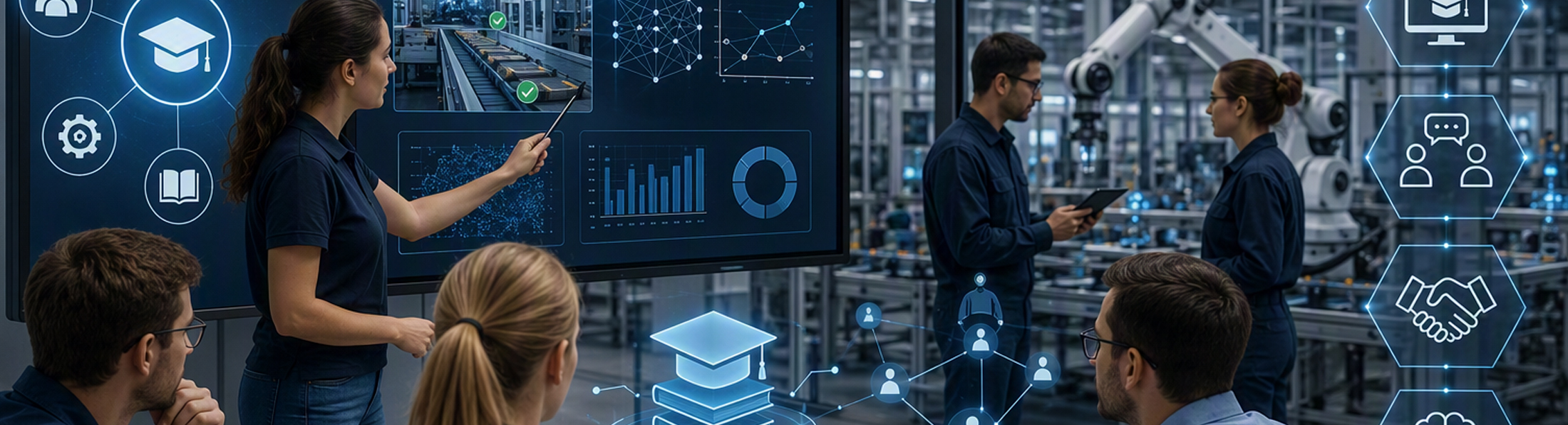

The focus was on two perspectives: building AI expertise in manufacturing companies and the ability to flexibly tap into engineering expertise through platform-based work models. The presentations showed that successful transformation does not depend solely on technical solutions. Rather, what is crucial is whether companies secure knowledge, develop skills, and establish new forms of collaboration.
AI Expertise as a Foundation
Dr. Marietta Menner from the Center for Future Production at the University of Augsburg highlighted how artificial intelligence will transform vocational education and numerous apprenticeship programs. AI not only supports existing tasks but can also influence entire job profiles—and thus the content and structure of apprenticeship programs.
This shifts the focus from the mere transfer of knowledge to the development of professional competence. Trainees must be able to apply what they have learned to new situations, select appropriate tools, and critically evaluate the results of AI.

"AI literacy means more than just knowing how to use tools. What matters most are critical thinking, independent decision-making, problem-solving, and the ability to evaluate AI results from a technical perspective."
Dr. Marietta Menner
Head of AI Education and Board Member, Center for Production of the Future at the University of Augsburg
From their perspective, five areas of competence are particularly important: critical thinking and judgment, AI literacy, problem-solving skills, learning skills, and digital literacy. AI literacy, therefore, does not mean being able to use as many applications as possible. Rather, it is about recognizing meaningful applications, understanding limitations, and ensuring that the responsibility for decisions remains with humans.
The New Role of Educators
However, the use of artificial intelligence is also changing the role of educators. They no longer merely impart knowledge and provide solutions; instead, they increasingly support learning processes as coaches and mentors.
This learning support is particularly important because, for many learners, AI is associated with uncertainty and fears about the future. Instructors can help learners contextualize results, identify mistakes, and develop confidence in their own professional competence. The central principle is this: AI is a tool—the professional remains the expert in their own field.
The Center for Future Production therefore focuses on action-oriented learning formats. As part of a supplementary AI certificate program, program organizers combine e-learning, hands-on training days, and tasks relevant to everyday workplace situations. An escape game teaches fundamental concepts while also promoting interaction among participants. In addition, the program covers machine learning, generative AI, and ethical issues.
Learning by Doing
This approach was particularly evident in the computer vision module. Trainees first create their own dataset by, for example, photographing screws, nuts, and nails. They label the images and train a model to distinguish the objects from one another.
In doing so, they experience firsthand just how much the quality of an AI model depends on the data used. Blurry images, one-sided perspectives, repetitive backgrounds, or incorrect labels can significantly degrade the results. As a result, learners not only understand how a model is trained but also why data quality and critical evaluation are indispensable.
The model is then transferred to a robotic arm. This creates a direct link between data generation, training, software, and industrial application. Learning is thus understood not as the isolated acquisition of knowledge, but as a process in which participants take action themselves, make decisions, and verify results.
Sustainable Transfer
A key challenge is to permanently transfer what has been learned into everyday workplace practice. The MOCA research project aims to support this transfer through an interactive learning app and social learning. Trainees will be able to implement their own small-scale use cases within their companies and learn from one another in the process.
Transfer to vocational schools is also planned. Initial pilot projects show that the browser-based computer vision module is well-suited for teaching the fundamentals of artificial intelligence in a practical way. In combination with an e-learning course and an ethics module, this could result in a scalable educational offering. Advanced certificate modules could then be more closely aligned with specific applications in production.
Engineering Competence on Demand
Tatiana Weiss, Managing Director of WiredWhite GmbH, presented the second perspective of the webinar. Her “Engineering Expertise on Demand” approach addresses the shortage of skilled workers, demographic change, and the growing importance of project-based work.
Many manufacturing companies often do not need new permanent full-time positions, but rather temporary or specialized expertise for specific projects. A digital platform can help identify suitable engineers and integrate them into projects.
The model connects a network of qualified professionals with continuing education opportunities, knowledge management, and digital tools for project work. Companies can post project opportunities, review profiles based on skills, and directly reach out to suitable professionals. Chat and meeting features, Kanban boards, task management, and time tracking support the subsequent collaboration.
Flexibility for Companies and Professionals
For small and medium-sized enterprises, such a model offers the opportunity to assemble project teams based on budget and required skills. If additional expertise is needed during the course of a project, another specialist can be brought on board at short notice.
The centralized digital work environment also simplifies onboarding and increases transparency. Project information, tasks, and communication histories are consolidated in one place. In addition, cloud computing can enable project-based access to specific engineering software without requiring each specialist to have their own license.

New opportunities are also emerging for engineers. They can work on a project basis for multiple companies, work remotely, and build their own engineering portfolio. Technical publications, webinars, and project experience help showcase their expertise and complement a traditional resume.
AI as a Knowledge Interface
Another component of the platform model is an AI assistant based on Retrieval-Augmented Generation, or RAG for short. It specifically accesses company-specific documents and data, thereby making knowledge accessible more quickly.
This approach is particularly relevant for knowledge retention. When experienced specialists leave the company, documented knowledge can remain available. This requires structured, up-to-date, and appropriately protected data. An AI assistant can then serve as a digital knowledge interface and, for example, support new employees as they get started.
Common Success Factors
The two articles highlight different but closely related ways in which companies can strengthen their ability to transform. The Center for Future Production focuses on building expertise within vocational training. WiredWhite’s platform approach creates flexible access to external engineering expertise and combines this with digital collaboration and knowledge management.
Common to both approaches is the recognition that technology alone does not drive transformation. Companies need people who can understand new tools, evaluate them critically, and apply them effectively. At the same time, structures must be created in which knowledge is shared, competencies are strategically integrated, and learning processes are incorporated into everyday work.
Conclusion
The webinar made it clear: competency management is becoming a key driver for the future of production and engineering. Companies must not only select new technologies but also create the conditions necessary for their successful use.
This includes practical AI training, critical thinking, continuous professional development, and new forms of collaboration. E-learning and hands-on learning modules can prepare trainees for the use of AI. Platform-based work models enable companies to flexibly tap into the engineering skills they need. AI-supported knowledge management can help preserve experiential knowledge over the long term.
The key challenge is to integrate these elements—skills development, technological advancement, and flexible work models. This approach ensures that transformation is not only faster but also more sustainable and people-centered.