
Rethinking Engineering and Production—How AI Can Be Used to Targetedly Improve Quality and Productivity
July 28, 2026
Artificial intelligence is considered one of the most important future technologies for industrial production. But how can its potential be harnessed in practice? Which applications are already creating measurable added value today? And what requirements must companies meet to successfully implement AI?
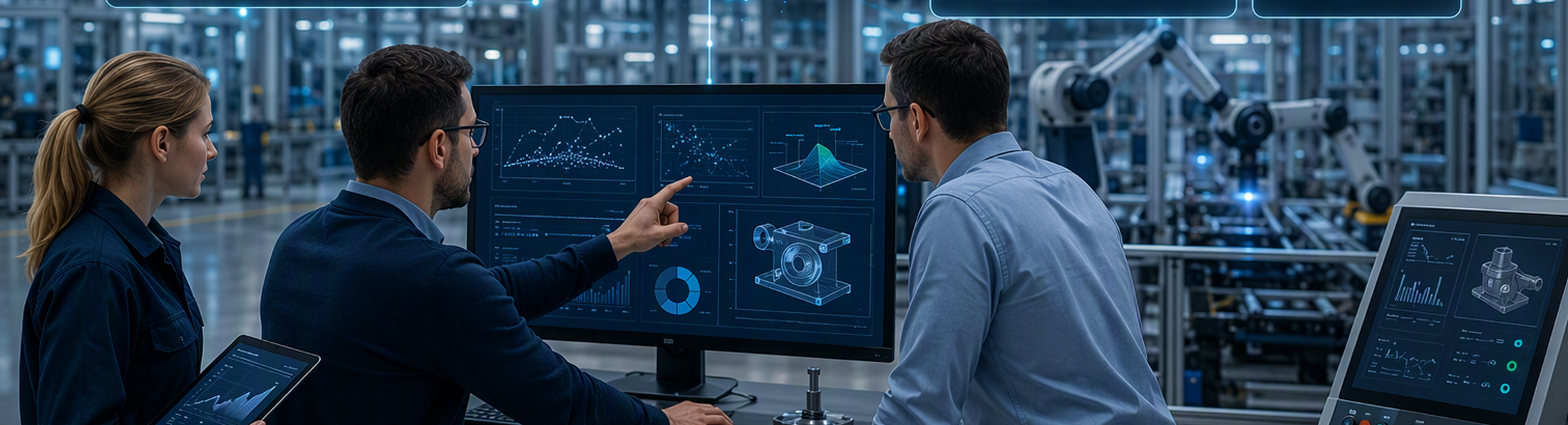

These questions were the focus of the third webinar in our “Transformation” series, titled “Rethinking Engineering and Production.” In dialogue, with a focus on production. The speakers, Sebastian Maier from the Fraunhofer Institute for Foundry, Composite, and Processing Technology (IGCV) and Frank Thurner, Managing Director of Contech Software & Engineering GmbH, used practical examples to demonstrate how AI is transforming product development, process planning, and quality assurance. It became clear that economic benefits do not arise from the technology alone, but rather from the interplay of engineering expertise, data quality, and intelligent models.
More Than Just Chatbots and Language Models
When people talk about artificial intelligence, many still think first and foremost of ChatGPT or other generative AI systems. In industrial practice, however, the range of applications extends much further.
Sebastian Maier demonstrated that even traditional machine learning methods generate significant economic benefits. They help detect anomalies in production processes early on, predict quality characteristics, or automatically identify defects. At the same time, a new generation of intelligent systems is emerging in the form of AI agents. In the future, they will be able to analyze requirements, generate product variants, assess their manufacturability, and even calculate expected production costs. As a result, AI is evolving from an analytical tool into an active supporter in the development and engineering process.
From Requirement to Finished Component
The potential of AI is particularly evident in the areas of product development and process planning. In the future, AI agents could not only generate CAD models but also simultaneously take into account physical relationships, manufacturing constraints, and economic factors.
This is likely to fundamentally change the traditional workflow, in which a product is first developed and then assessed for manufacturability. Instead, an iterative process could emerge in which design, manufacturability, and costs are jointly optimized early in the development phases.
Digital twins and simulation environments play a central role in this process. They make it possible to test virtual variants, simulate processes, and train AI models under realistic conditions long before a physical prototype is created.
Making Corporate Knowledge Intelligently Usable
In addition to production-related applications, AI also opens up new possibilities in knowledge management. With the help of so-called Retrieval-Augmented Generation (RAG) systems, language models can access internal documentation, guidelines, or technical information.
Instead of spending time searching through various data sources, employees receive concrete answers to their questions—including references to the underlying documents. This makes existing knowledge available more quickly and can simultaneously serve as the foundation for further AI applications.
Predicting Quality Instead of Finding Errors
While many AI applications are still in the research phase, others have long since found their way into industrial practice. A particularly relevant example is Predictive Quality.
This involves analyzing the relationships between process parameters, environmental conditions, and product quality. Based on this analysis, it is possible to predict—even during production—what quality a component will achieve and what settings are required to reliably meet defined quality targets.
Using examples from laser welding, Frank Thurner demonstrated how product characteristics, process parameters, and influencing factors can be linked. The goal is not to check quality after the fact, but to actively control it. This fundamentally changes the role of quality assurance. It shifts from a downstream inspection task to a continuous control variable within the production process.
Smart Data Instead of Big Data
Another common thread running through both presentations was the importance of data quality. Successful AI projects do not start with the largest possible data sets, but with the right data.
Before AI models are developed, companies must therefore understand which quality characteristics are relevant, which influencing factors must be taken into account, and which data actually contribute to solving the problem. Frank Thurner described this approach as “engineering first.” It is not the data that determines the process, but rather the product requirements and the expertise of the specialists. Only on this basis can robust models be created that deliver reproducible results and derive concrete recommendations for action.
Managing Quality in Real Time
Modern AI systems now go far beyond traditional predictions. They detect deviations early on, monitor process conditions in real time, and support employees with concrete recommendations.
Instead of discovering scrap only at the end of a production line, causes can be identified during the process itself. For example, systems suggest adjustments to process parameters or flag unusual machine conditions.
The result is more stable processes, lower scrap rates, and faster industrialization of new products. According to the empirical findings presented in the webinar, development and validation times can be significantly reduced, and the time to series production can be considerably shortened.
Humans Remain Indispensable
Despite all the progress, it also became clear during the webinar that AI does not replace engineering. Rather, the importance of skilled professionals who understand processes, define quality criteria, and can evaluate the results of intelligent systems is increasing.
AI provides forecasts, recommendations for action, and suggestions for optimization. However, the responsibility for interpretation, evaluation, and implementation remains with humans. Successful companies will therefore need to invest not only in technology but also in the training of their employees.
The application examples presented show that artificial intelligence has long since become more than just a topic for the future. Measurable economic benefits are already emerging today, particularly in the areas of quality management, process optimization, and production control.
At the same time, it has become clear that successful AI applications are built on a solid engineering foundation. Those who understand the relevant influencing factors, provide high-quality data, and systematically analyze processes create the conditions for the successful deployment of intelligent systems.
The production of the future is therefore not created by AI alone. It emerges where engineering expertise, data quality, and artificial intelligence work together effectively.