
Renewables account for 61 percent of consumption
October 5, 2026
Source: E & M powernews
Author: Davina Spohn
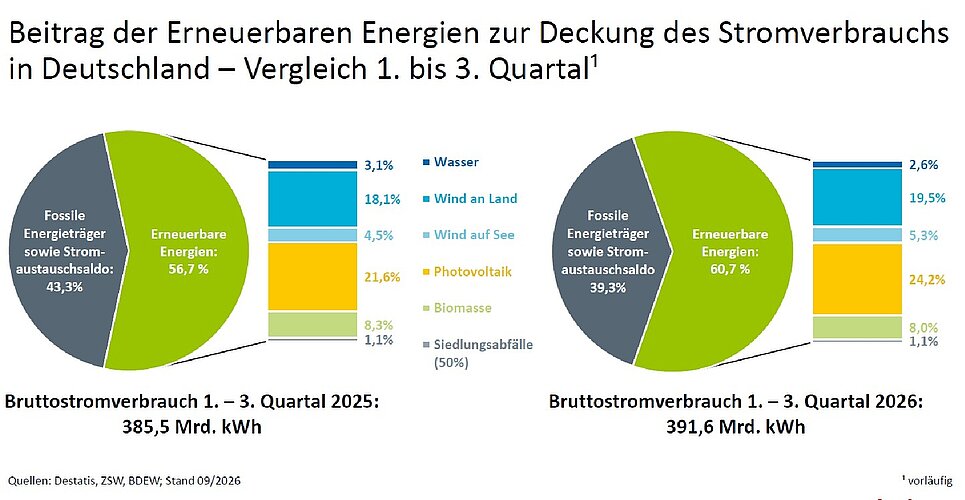
RENEWABLE. From January through September, renewable energy sources accounted for 60.7 percent of Germany’s electricity consumption. According to the BDEW and ZSW, wind and solar power in particular saw an increase compared to 2025.
The share of renewable energy in German electricity consumption rose significantly in the first nine months of this year. According to preliminary calculations by the German Association of Energy and Water Industries (BDEW) and the Center for Solar Energy and Hydrogen Research Baden-Württemberg (ZSW), it stood at 60.7 percent. That was four percentage points higher than in the same period last year. At the same time, gross electricity consumption increased by 1.6 percent.
From January through September, renewable energy plants generated a total of 237.5 billion kWh of electricity, as the associations announced in a press release dated October 1. Compared to the first three quarters of 2025, this represents an increase of 8.7 percent.
Electricity production from offshore wind energy rose particularly sharply, with an increase of 19.8 percent. Photovoltaic systems generated 13.9 percent more electricity, while onshore wind turbines generated 9.1 percent more. In their joint analysis, the BDEW and the ZSW attribute this development to the continued expansion of wind power and more favorable wind conditions.
Hydropower followed the opposite trend: due to low precipitation levels, its electricity generation fell by 14.3 percent. Biomass production decreased by 2.1 percent. However, the higher yields from wind and solar energy more than offset these declines.
Photovoltaic Expansion Rises to 11,800 MW
The two associations also reported growth in the expansion of generation capacity. According to the market master data registry, photovoltaic systems with a total of 11,800 MW of new capacity were registered for the first nine months. In the same period last year, the figure was 11,000 MW. For onshore wind energy, newly commissioned capacity rose to 3,500 MW—up from 3,100 MW in the first nine months of 2025.
Offshore expansion was also significantly higher. So far this year, new offshore wind turbines with a capacity of 1,300 MW have been connected to the grid. By comparison, the total for the entire year of 2025 was 500 MW.
BDEW Chief Executive Kerstin Andreae attributes the increase in the share of renewables both to the expansion of renewable energy facilities and to their integration into the power grid by grid operators. At the same time, she calls for decisions on the further development of the Renewable Energy Sources Act (EEG) as well as faster procedures for expanding distribution grids. According to the association, 99.96 percent of renewable energy facilities are connected to the distribution grid. There, they are increasingly competing with industry, commercial users, battery storage systems, and heat pumps for grid connection capacity.
Solar Power Accounts for the Largest Share
In total, power plants and renewable energy facilities in Germany generated 393.6 billion kWh of electricity from January through September. That was 6.3 percent more than in the same period last year. Photovoltaics accounted for the largest share, at 94.7 billion kWh. This was followed by onshore wind energy (76.2 billion kWh), biomass (31.3 billion kWh), offshore wind energy (20.8 billion kWh), and hydropower (10.3 billion kWh). Fossil fuels accounted for 156.1 billion kWh.
This compared to gross electricity consumption of 391.6 billion kWh. A year earlier, according to the BDEW and ZSW, the figure was 385.5 billion kWh. Thus, renewables covered 60.7 percent of gross electricity consumption in the first three quarters. In terms of total gross electricity generation, their share stood at 60.4 percent. According to the two associations, the share of gross electricity consumption is used as the benchmark for energy policy expansion targets. This calculation follows European guidelines and the German federal government’s target definitions. (ds)