
Friday afternoon. There is an excited queue outside the electronics store - everyone is waiting for the same thing: the new Ärzte album. Twelve new songs, none of which anyone has heard yet. No singles on the radio, no videos on music television. The tension is high. Today, an album release happens differently: a push notification on your cell phone, a click on the "New Music Friday" playlist - that's it.
This development is no coincidence, but the result of a disruptive innovation that has fundamentally changed the music industry. But how could a decades-old practice be replaced by something new so quickly? Whether loud and wild or quiet and creeping, innovations only catch on if they are understood and communicated. To better understand this, it is worth taking a look at the different faces of innovation.


From small steps to earthquakes: Innovations have many faces
But not all innovation is the same. There are different approaches and approaches when you want to bring something new to the market.
But what good is an innovation if no one knows about it or understands it? The acceptance of innovations in society depends on how they are communicated to the population.
Whether it's a small update or a world-changing technology such as energy generation through nuclear fusion - every innovation needs the right communication to gain acceptance.
Disruptive - the market is shaken up
The most radical form of innovation is disruptive innovation. Here, the market is shaken up by a completely new way of thinking and something entirely new is created. This can also displace existing markets, triggering a veritable revolution. But this is precisely where the risk lies: anyone who leaves the familiar path is moving into unknown territory. Change always requires acceptance in order to happen. The development of disruptive innovations is costly, time-consuming and often characterized by uncertainty as to whether the market is ready for the new - or whether it understands it at all. This is why the right communication to the outside world is essential.
This was also the case with the Swedish music streaming service Spotify. At a time when music was mainly bought - whether on CD or as a download - and owned, Spotify introduced a radical new model: Music on demand, ad-financed or by subscription - with no ownership at all. This concept turned the entire music industry on its head, changed the consumer behavior of entire generations and forced established players such as labels, music creators and distribution platforms to rethink.
It is precisely such far-reaching upheavals that need to be properly communicated to the target group in order to really catch on. People are often initially skeptical of anything that leaves their comfort zone. The right introduction is needed to turn this skepticism into enthusiasm. The new thing must be explained clearly without going too deeply into the technology. For customers to be convinced by an idea or a product, they usually don't want to know how something works, but how it makes life easier or enriches everyday life. The benefits must be made unmistakably clear so that a bridge can be built between the technical vision and the application in reality. The right communication determines whether the disruption fizzles out or becomes a game changer.
Incremental - small steps towards innovation
In contrast to disruptive innovation, incremental innovation is much quieter, but no less significant. These are small, incremental improvements to existing products, services or processes. They do not change the world in one fell swoop - but they keep companies competitive, improve user experience and ensure long-term progress. It is often precisely these small changes that are perceived as particularly useful in everyday life, without the label "innovation" being immediately attached to them.
LEGO is a good example. The basic principle of the colorful building blocks has remained the same for decades - but the company is continuously improving the quality of materials, building instructions, target group access and thematic orientation. Today, there are special sets for adults, including architecture, technology and film series, as well as more sustainable materials and digital companion apps. The brand manages to develop familiar products in a modern way - keeping them relevant without losing their identity. This is precisely the strength of incremental innovation: it optimizes what already exists, increases efficiency and user-friendliness - without reinventing the wheel.
Such innovations don't need a big stage - but they do need the right communication. Because even the seemingly small things deserve visibility if they create real added value. Innovation communication is less about the big narrative and more about trust, precision and brand strength. Innovation takes a back seat to the brand - and this is precisely how it can quietly impress.
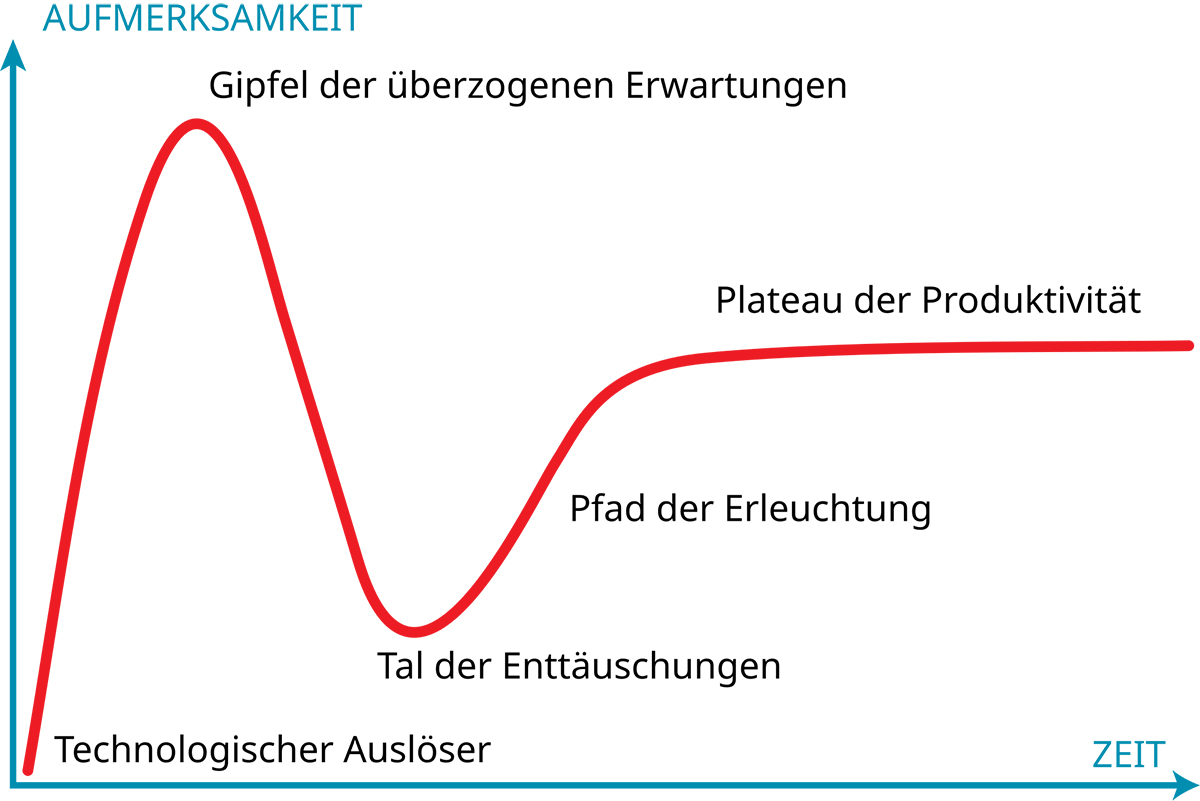
Action - reaction: the hype cycle
In order to be able to communicate your own innovation, it is important in the first step to know how the target group might react to such innovations. This is exactly what the Gartner hype cycle describes. It illustrates the phases of public attention and reaction to a technological innovation.
The hype cycle describes the typical process that many new technologies and innovations go through in public perception - a kind of emotional rollercoaster ride. It starts with the technological trigger, when a new idea first attracts attention, often without a market-ready product. Expectations then skyrocket - this is known as the peak of exaggerated expectations. Euphoria reigns here, with many promising revolutionary changes. But reality catches up: In the trough of disappointment, the first weaknesses become apparent, projects fail and interest rapidly declines. Only those who persevere reach the path of enlightenment, where sensible applications and realistic assessments gradually become established. In the end, the innovation reaches the plateau of productivity - it is mature, practicable and increasingly widely used. A pattern that shows how much communication, expectation management and perseverance play a role in the success of innovations.
When the idea of music streaming emerged, many were excited by the vision of being able to access millions of songs at any time - without having to buy or own anything. The media went into overdrive, with talk of the "future of music". However, disillusionment followed shortly after the launch: artists criticized the low income, labels doubted the model and users were also initially hesitant. The hype seemed to be fizzling out. But Spotify remained consistent, explained its model transparently, optimized the user experience and built a strong brand. Today, music streaming is firmly anchored in everyday life - the euphoria has given way to more realistic expectations and Spotify is considered the standard when it comes to music consumption. A prime example of how an innovation can successfully ride out the hype cycle through clever communication and perseverance.
Branding - the ultimate solution for everything?
The key lies in trust. Successful brands enjoy advance trust - they have to explain less and are allowed to take more risks. Particularly with large tech companies, but also with toy or fashion brands, customers do not follow the product, but the brand.
One example: LEGO. For decades, the brand has stood for creativity, quality and community. Those who buy LEGO do not expect a technical revolution, but an experience. New products are often bought blindly - because the brand is convincing. That is the power of a strong brand identity.
But how do you gain such deep customer trust? The answer lies in the right branding. Branding is more than just a beautiful logo or a catchy slogan - it is the targeted design of a brand with the aim of conveying its own values, a suitable appearance and, above all, emotions. A strong brand creates recognition, reliability and identification. LEGO, for example, has been communicating the same core messages for decades: creativity, quality and community. These values run through every detail - from the product design to the packaging concept to the brand communication. Anyone who has ever bought a LEGO set knows what they are getting - not just technically, but also emotionally. Good branding therefore ensures that brands are not only understood rationally, but also experienced emotionally. It builds a relationship over time - and it is precisely this relationship that creates trust.
The power of communication
In the end, it is not just the quality of an innovation that determines its success - but whether it is understood, accepted and supported. And this is precisely where the power of communication comes into play: it builds bridges between ideas and everyday life, between vision and trust. Those who communicate continuously and credibly create more than just attention - they create loyalty. Brands that people trust can dare to try new things without having to constantly justify themselves. They can try things out, surprise people and sometimes fail - and yet their customers continue to follow them. Spotify has shown the way: the radical change from physical albums to anytime streaming was not only implemented technically, but also accompanied emotionally - with clear language, intuitive user guidance and communication that promised more than data transmission: Music for everyone, anywhere, anytime. If you build a strong brand and communicate it consistently, you create the basis for innovation to be perceived as an invitation rather than a disruption. Trust is no coincidence - it is the result of good communication.