
Interview: How Does Knowledge Transfer Work in Agriculture?
July 22, 2026
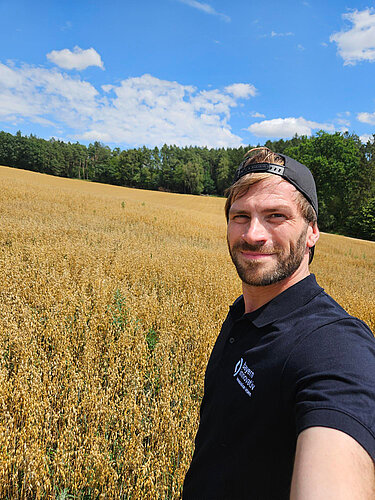
How does new knowledge from research, experimental farms, and companies find its way to where it’s needed—on farms? In this interview, Christian Metz, head of the Bavarian Digital Agriculture Competence Network (KNeDL), explains why knowledge transfer is so important for agriculture and how it can be successfully implemented.
Mr. Metz, why is knowledge transfer so important in agriculture?
In agriculture, sharing experiences and mutual support have always played a major role. Without cooperation, it’s difficult to thrive in this challenging environment. Knowledge transfer is particularly important in agriculture because the demands are constantly changing. Issues such as climate change, new regulatory requirements, digitalization, and sustainable production methods require farmers to continuously update their knowledge. Only in this way can farms operate in an economically viable, environmentally conscious, and sustainable manner.
How is knowledge shared in agriculture?
Knowledge is shared in a wide variety of ways. These include traditional advisory services provided by associations or the government, technical schools, continuing education programs, agricultural trade journals, and trade shows. At the same time, digital formats such as webinars, online platforms, podcasts, and social media are playing an increasingly important role today. However, direct exchange between practitioners remains particularly valuable.
What role do networks like KNeDL play in knowledge transfer?
Networks like our KNeDL connect stakeholders from research, business, and the field and serve as an interface and hub for the exchange of knowledge and experience. This creates direct pathways to innovation, allowing new ideas to be put into practice more quickly. At the same time, we play an important role in bridging the gap between theory and practice.
How exactly?
New technological developments are transferred to agricultural practice, and conversely, the specific requirements and challenges from the field are fed back to research and policy-making. In addition, we guide projects from concept to implementation, facilitate matchmaking between relevant stakeholders, handle coordination tasks, and provide an overview of ongoing developments, offerings, and innovations.
In this way, networks like ours help ensure that knowledge is not only available but also purposefully interconnected, presented in an understandable format, and effectively put into practice.
How can knowledge transfer be brought to life?
One key component is experimental and demonstration farms. They test new methods, varieties, or technologies under real-world conditions and present the results in a way that allows farms to apply them in practice. This makes scientific knowledge clear, tangible, and practical—as seen, for example, in the “real-world lab” on the Rott and Inn rivers operated by the State Institute for Agriculture (LfL).
Our upcoming traveling exhibition, “Smart Agriculture Bavaria,” also presents digital developments in agriculture in an interactive, vivid, and tangible way. The goal is to provide farmers with a practical overview of current technologies and to help them understand their specific benefits for day-to-day farm operations. At several stations, applications from the fields of crop production, livestock management, farm management, and innovation will be presented.
What challenges exist in knowledge transfer in agriculture?
A major challenge is presenting complex information in a way that is understandable and applicable to everyday life. Not every innovation can be immediately applied to every farm, because conditions vary greatly. In addition, many farmers have little time for continuing education in their day-to-day work. Access to digital resources is also not equally available everywhere.
What is needed for successful knowledge transfer in agriculture?
In my view, the most important ingredients for effective knowledge transfer are close collaboration between research, extension services, and on-the-ground practice; communication on an equal footing; and low-barrier access to knowledge and technology. It is crucial that information is not only available but also presented in a practical manner and made easy for farms to use. This also includes clearly identifying challenges and pointing out concrete initial solutions.