


What motivates people to make a decision? Why do they choose a particular product or service? It is often not the obvious reasons that tip the scales, but deeper needs, subconscious desires or emotional longings. It is essential for companies to understand these mechanisms - but how do you gain this crucial insight? How can you recognize what really drives the target group? And above all, how can this knowledge be put to good use? If you sharpen your focus and understand what really motivates people, you can achieve great things.
A look into the past: cigarettes for freedom
The year is 1929 in New York. The young, good-looking Shirley sits comfortably on a park bench and smokes. One after the other. As if her life depended on it. The glances she receives bounce off her. "That's not proper for a young lady," a passer-by says to her. He's right, at least back then. In a world where women have to fight for their rights, for freedom, it really isn't proper for a lady to take a drag on a cigarette. They had to be obedient, modest and reserved. Obscene stimulants such as cigarettes, which had long been part of the male population's image, were out of the question. Shirley does not smoke, she protests. For her, cigarettes are a piece of revolution - torches of freedom.

In the early 1930s, it was certainly not a priority for women to be allowed to smoke. And yet sales of cigarettes rose sharply during this period - because many women started smoking just like Shirley. This was the result of a marketing stunt devised by the American Edward Bernays. His question was not how to sell more cigarettes to women, but what could be sold to women with cigarettes. What did women want most at that time? Exactly, freedom. Freedom through cigarettes? Bernays exploited precisely this desire for freedom among women to market cigarettes. He paid smartly dressed women to smoke on the street. When the women were asked about the indecent gesture of smoking, which was considered a taboo for women at the time, they were told that the cigarettes were "torches of freedom" for them.
There is no question that exploiting the difficult situation of women like Shirley for capitalist purposes is morally very questionable. Especially because it was already clear at the time that smoking was unhealthy for the body. However, it is also clear that Bernay's campaign worked. Sales of cigarettes and the number of female smokers increased immensely. But was Bernays just lucky and had a good nose? No, there is a method behind it. He gained an insight into the wishes and needs of his target group - he gained the insight.
People don't buy things because they want to own them. They buy things to satisfy a need in them. Nobody goes to the gym because they want to exercise. People go to the gym, for example, to look better or to improve their heart health. These motivations are valuable knowledge for those offering services. If you know your customers' insights, you can optimize your product or service for the target group. For example, a gym for people who want to look better can be equipped with lots of mirrors and good lighting for photos, whereas a gym for people whose health is a priority might use fewer mirrors and information boards on cardio health or more medically trained staff.
Insight is a data-driven but emotionally interpreted insight into deeper customer needs that goes beyond the obvious facts. It combines analytical data with psychological, cultural or emotional motivations and explains not only what people do, but why they do it. Insight thus opens up a new perspective for companies.
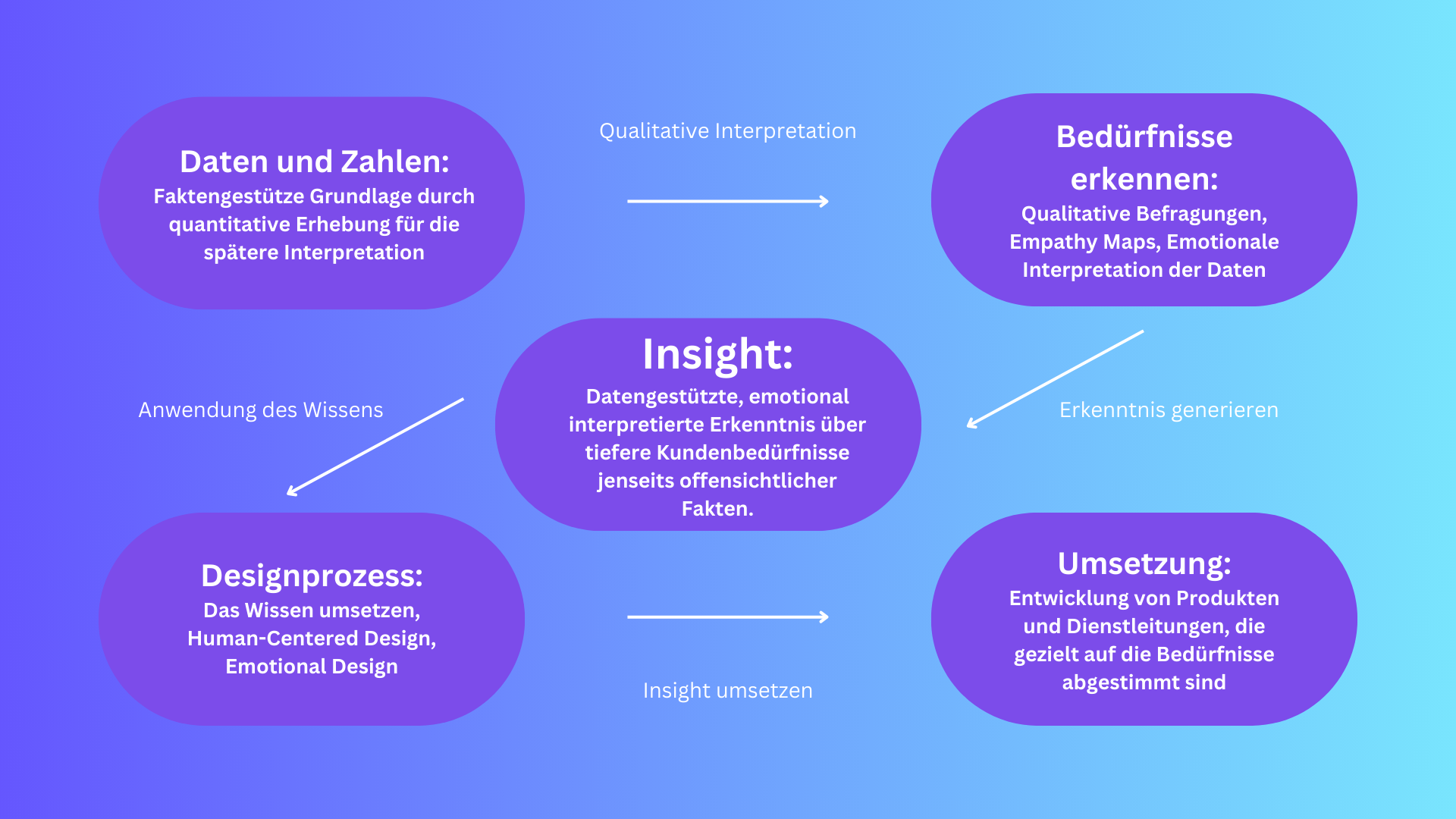
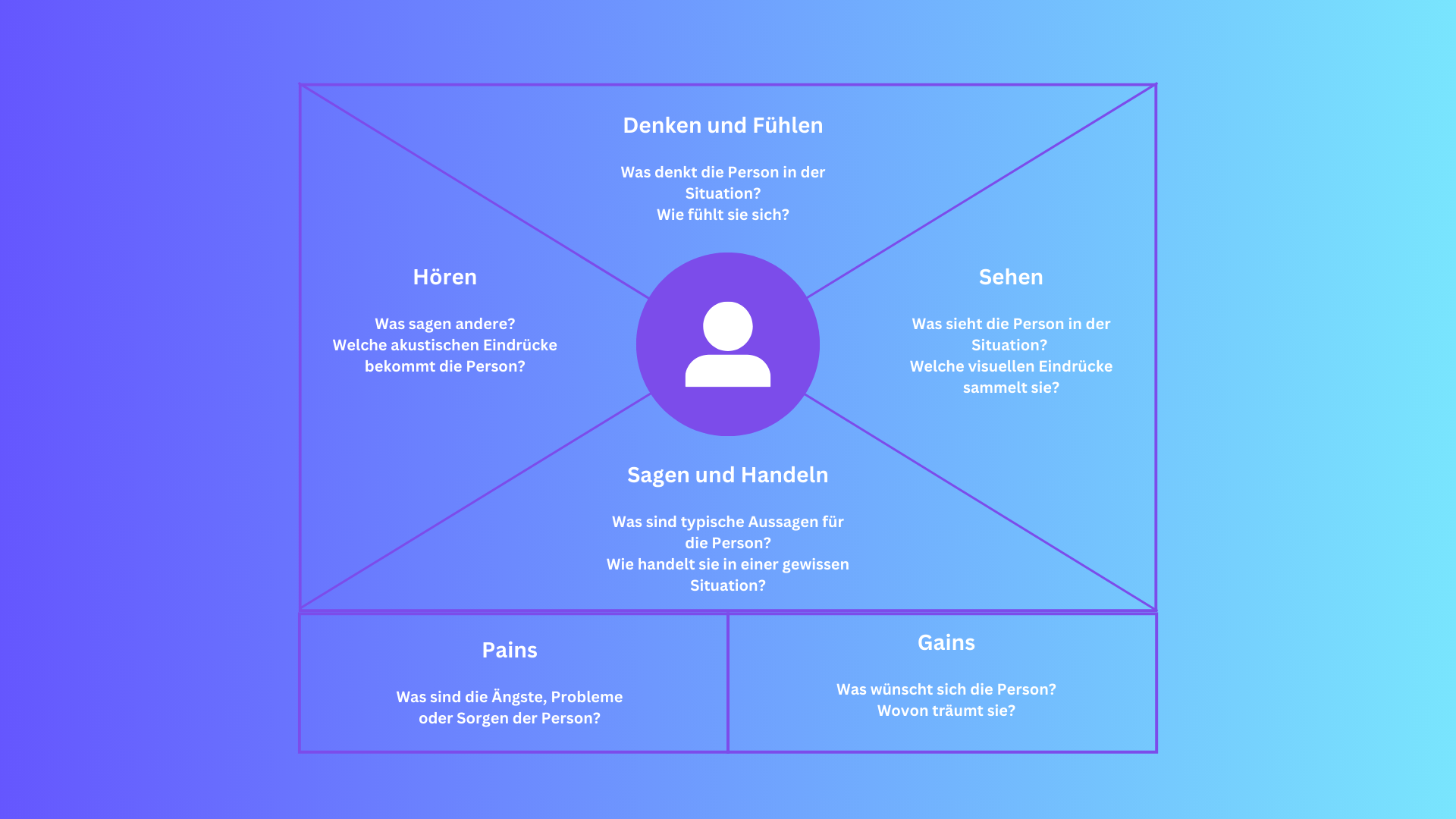
Insight: Recognizing needs
The importance of having an insight into the needs and emotions of your customers is now clear. But how do you get such valuable insight, what gives you the overview?
Having insight means knowing the deep needs and emotions of your customers that drive their (purchasing) decisions. So first of all, you need the hard data and facts. Who buys what and when? This can all be answered using figures. Quantitative analyses help here. However, what makes insight so valuable is not knowing how or what is bought, but why. The motives cannot be fathomed by quantitative studies. This requires a qualitative approach and, above all, a great deal of empathy and knowledge of human nature.
There are various ways of gaining an insight into the needs of customers. One of them is rather obvious: simply ask! Qualitative surveys, for example with guided interviews, give you first-hand insight from the target group itself. The right questions and, above all, the trust of the interviewees are key here. This often works better the more personal and natural the conversation is. It is also important to free yourself from your own theories and assumptions, perhaps even prejudices. In many cases, the customer's motives are not as obvious as they might seem. Sometimes the people themselves are not even fully aware of what drives them. In addition to interviews, observations from everyday life always help. However, care must be taken here to ensure that no conclusions are drawn "from the gut", as this could unconsciously incorporate prejudices or personal, unfounded feelings.
Outlook: Knowledge is power, but what do you do with it?
Knowing what drives your customers, what they are looking for, what they believe in and what they really need is valuable. Probably the most valuable thing a company can have. Getting hold of this information requires tact and sensitivity. But what do you do with this valuable information once you have it?
One way to incorporate insight into the design process of products or services is the principle of human-centered design. Human-centered design (HCD) focuses on the needs, abilities and limitations of the user and ensures that products and services are designed to be intuitive, accessible and user-friendly. The process is iterative and is based on continuous feedback from users in order to optimize solutions in a targeted manner. The key principles here are understanding users through empathy, the clear definition of problems (pain points) and creative ideation. Through prototyping and joint testing with the users, insights can be gained at an early stage and transferred to iterative optimization, i.e. step by step and in regular exchange with the target group. This results in a solution that is not only functional, but also truly needs-based.
Incorporating the user's emotions into the product design: Professor of Cognitive Science Donald A. Norman writes about this in his book "Emotional Design - why we love (or hate) everyday things". He describes how good design should not only be functional and user-friendly, but should also evoke emotional reactions. He distinguishes between three levels: visceral design (immediate aesthetic effect), behavioral design (user-friendliness and functionality) and reflective design (meaningful, long-term emotional connection). In the context of human-centered design, this means that an insight should not only serve to develop functional solutions, but should also include the emotional perspective of the user. This ensures that a product or service is not only useful, but also truly inspiring and offers added value - exactly what is needed for customers to enjoy using it in the long term.
Insight only unfolds its full value when it is actively incorporated into the design process and used to directly address and satisfy the needs of the target group. With the help of various tools, such as human-centered design, products or services can be designed that really add value for the customer group.
Foresight: Knowledge is responsibility
The Freedom Torches were a complete success - perhaps even the start of a revolution in marketing. However, Bernays should not be taken as an example, at least not without reflection. The right insight gives companies power, but with great power comes great responsibility. Bernays used his power to manipulate people like Shirley into buying. On top of that, a purchase with negative effects on the health of consumers. This is morally very questionable. Dealing with the psyche and needs of customers requires empathy and sensitivity.
A good insight is more than just a number or an observation - it is an insight into the inner self, the needs and wishes of the target group. It provides a well-founded overview of all the information and shows what really matters to them. Only with the right perspective can this insight be used in a targeted way to design products, services and communication in such a way that they are not only functional, but also emotionally appealing. And finally, you need the foresight to use this influence responsibly. Because insight is powerful - it can inspire people, but it can also manipulate them. It's not about manipulating people, but about understanding them and developing solutions that offer them real added value.
Shirley will continue to smoke with confidence. She doesn't care that the cigarettes endanger her health, or at least not as much as the feeling of freedom that the cigarettes give her. Maybe she just doesn't know it yet. On the park bench, she is unaware that she is being manipulated by Bernays. She gets up and strolls elegantly to the next street corner, still holding the glowing cigarette between her index and middle finger as if it were the most natural thing in the world. A kiosk is waiting for her there and the sales clerk hesitantly hands her the next packet. He is surprised, you can tell by the look on his face. He is probably judging young Shirley too. But that is exactly what encourages her in her decision to buy. She doesn't want to smoke, she wants to be taken seriously, she wants equality, freedom.
The story of the "Freedom Torches" shows that Insight can be misused - but it also shows how powerful it is. Companies that use insight correctly not only create more successful products, but also a sustainable and appreciative relationship with their customers. Because the right insight is crucial - for success, for trust and for the future of innovation.