
Sustainable mobility for the European Metropolitan Region of Nuremberg
"Where do we want to live and how?" or "Where do which companies develop and why?". Questions like these will play a major role in determining the attractiveness of a location in the future. Sustainable transport is an important factor here. The European Metropolitan Region of Nuremberg rises to the challenge. 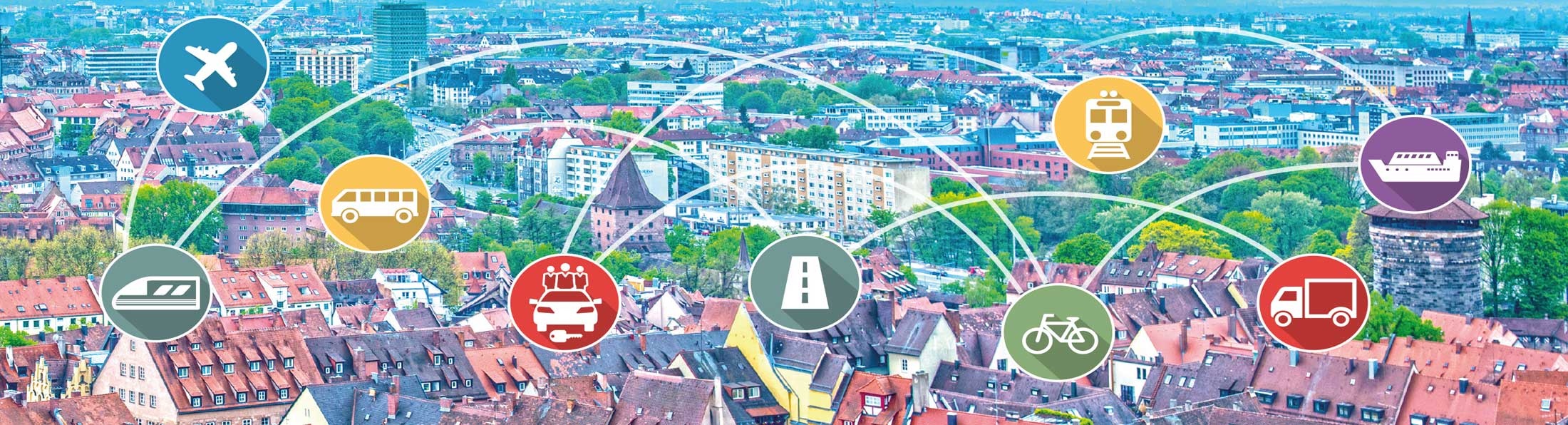 Sustainable mobility in Nuremberg: population and economy booming. (Photo credit: iStock©boerescul) That it is good to live and work in the European Metropolitan Region of Nuremberg, shows impressively its rapidly increasing population and booming economy. The "EMN" currently includes more than 3.5 million inhabitants. Around 170,000 companies and about 1.9 million employees generate a gross domestic product of almost 130 billion euros. This makes the EMN one of the economically strongest regions in Germany.
But as population and employment grow, so does the volume of traffic. Every day, 150,000 people commute to the core area of the city of Nuremberg and more than 50,000 people beyond. With more than 200 million passengers and over 14,000 square kilometers annually, the Greater Nuremberg Transport Authority (VGN) is the third largest in the Federal Republic. A high volume is also recorded by motorized individual traffic and daily delivery and commercial traffic. The limit value of 40 µg/cubic meter nitrogen dioxide is also exceeded in the city of Nuremberg.
In 2017, the annual average value was 43 µg/cubic meter. By comparison, Munich reaches 73 µg/cubic meter here. Andreas Mäder, Managing Director of Verkehrsverbund Großraum Nürnberg GmbH is certain that the pressure to act in terms of traffic avoidance and climate protection places public transport at the center of consideration. "In this context, the expansion of public networks and park-and-ride and bike-and-ride sites in the direction of multimodal nodes are coming into focus," he said."
Clean Air Immediate Program"
With the Clean Air Immediate Program" adopted at the end of 2017 together with the participating federal states and municipalities, the German government aims to support effective measures to improve air quality. The measures in the immediate program, which has a funding volume of one billion euros and is expected to run until 2020, range from the electrification of urban commercial transport, the retrofitting of diesel buses in local public transport with exhaust aftertreatment systems, the digitalization of municipal transport systems, and the electrification of cabs, rental cars and car-sharing vehicles, as well as the electrification of bus fleets in local public transport.
Furthermore, projects for the improvement of logistics concepts, the bundling of traffic flows as well as bicycle traffic are promoted; it includes the environmental bonus, i.e. the purchase premium for e-cars. "In addition to its original goal of keeping the air in cities clean, the Clean Air Emergency Program makes an important contribution to climate protection at the municipal level as well as to the change toward sustainable, future-proof mobility in Germany," said long-time mayor of the city of Erlangen Dr. Siegfried Balleis, who is today special representative for the "Immediate Clean Air Program" of the Federal Government.
The EMN leads the way
Whoever wants to realize sustainable mobility must also think about energy-related challenges and solutions and implement them synergetically, Rainer Kleedörfer is certain. "Transport turnaround and energy turnaround belong together and also include effective solutions in the heating market. Reducing individual transport with combustion engines, strengthening local public transport, expanding the network of bicycle paths, and successively converting the remaining individual transport to electromobility are effective measures. Of course, the electricity for electromobility must come from renewable energies, ideally generated decentrally in the spatial context of consumption. This creates added value locally, enables participation and promotes acceptance," says the head of corporate development at N-ERGIE Aktiengesellschaft.
The EMN wants to rise to this challenge. At an "Accelerator" in March 2018 with over 50 top representatives from science, administration, business and environmental protection associations in the European Metropolitan Region of Nuremberg, a bundle of concrete solutions was developed. The package of measures is intended to enable the 2030 climate protection targets to be achieved in the subject areas of buildings, energy and transport. The planned reduction of 11 million t CO2 corresponds to the required reduction of around 40 percent of the 30 million t CO2 emitted today. With the planned measures, the EMN is well on the way to placing itself at the forefront as a location in the global competition for attractiveness to people and companies.