
- Bayern Innovativ
- eMagazine
- Detail
Sustainable materials from mushroom mycelium
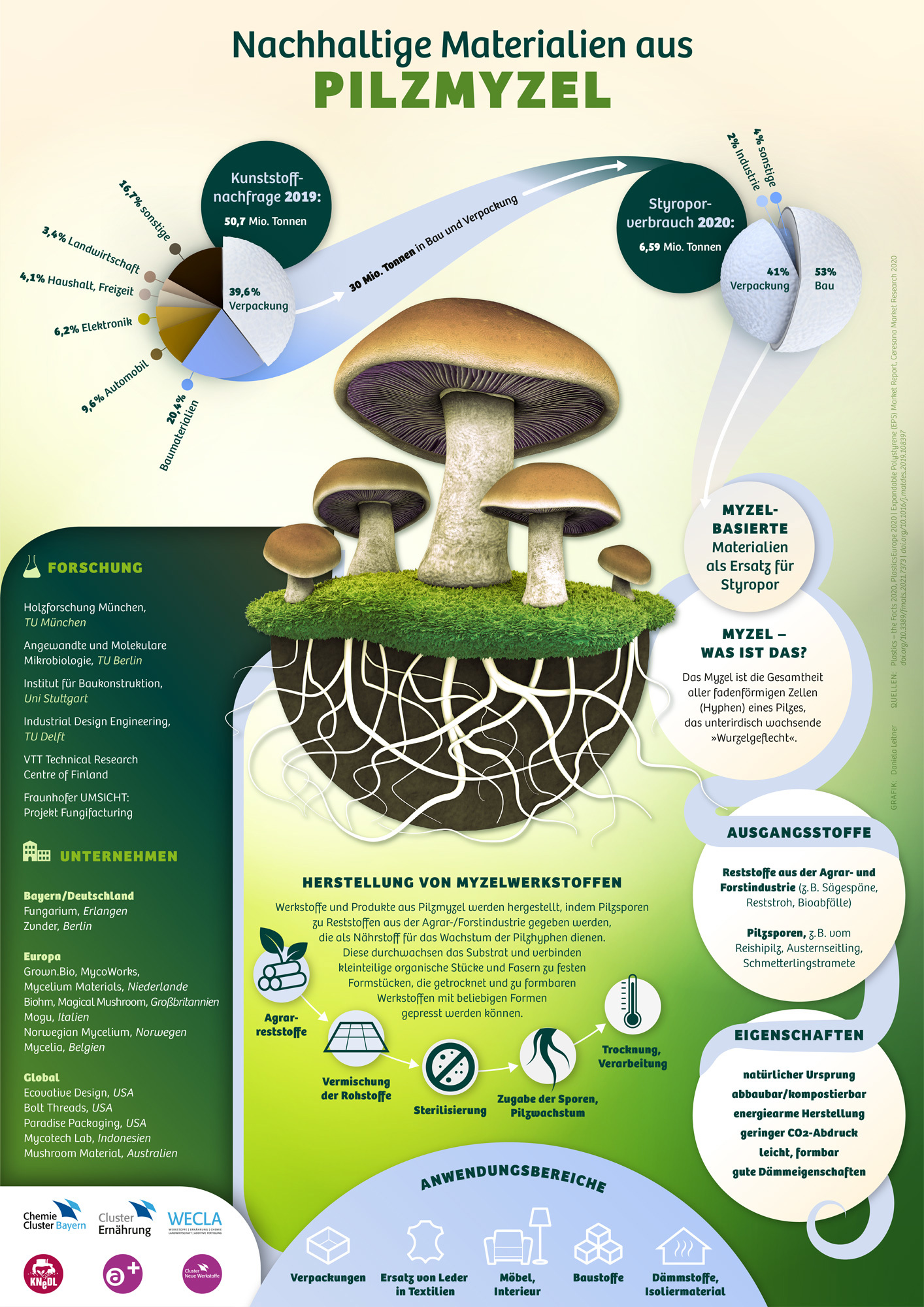
Fungi have already been used commercially for many decades to produce ingredients or active pharmaceutical ingredients. For some years now, the innovative utilization potential of fungi has been demonstrated in new types of materials that serve as sustainable substitutes for Styrofoam, leather or building materials. For this purpose, fungi grow on natural residues and form a fungal mycelium, which is further processed into the product. In the cross-cluster project WECLA, the New Materials Cluster, the Nutrition Cluster, the Chemistry Cluster Bavaria, the Coordination Office Additive Manufacturing and the Competence Network Digital Agriculture Bavaria have prepared information on future technology fields to show background and application potentials.

Many people are passionate "Schwammerl" seekers and it is also common knowledge that yeast is needed for the production of beer, wine and bread. However, mushrooms can do much more. It is assumed that there are several million species of mushrooms, of which only about 120,000 have been described so far. This alone suggests that numerous new applications will arise from the use of new fungal species, from active pharmaceutical ingredients to production organisms for sustainable basic chemicals to vegan alternatives for meat.
Although fungi have long been used industrially to produce penicillin or citric acid, start-ups and experts from research, design and architecture have only been working for a few years on using fungi to produce sustainable materials for sustainable products. To be more precise, they are using fungal hyphae for this purpose. These thread-like cells of a fungus form the so-called mycelium, the totality of all hyphae. It is the underground growing "root network" of a stand fungus. The Schwammerlsucher does not normally see the mycelium, since only the above-ground fruiting body is of interest.
In addition to the typical edible mushrooms, one also knows numerous tree mushrooms, such as the oyster mushroom or the tinder fungus. These grow on diseased trees or dead wood and break down the lignocellulose, of which the wood is composed, to obtain needed nutrients from it.
Fungal culture for material production
These fungi can be grown in culture on organic residues. Residual materials from agriculture or forestry, such as straw, wood residues, sawdust, hemp hurds, reed residues or spent grains, are suitable as starting substrates. The fungi partially degrade the lignocellulosic components of the plant residues and form a three-dimensional mesh. This compacts the initial substrate into a natural composite material that is both stable and lightweight.
Depending on the cultivation conditions, the fungus used and the substrates selected, various material properties can be achieved. Thus, strong, robust or soft and flexible materials can be produced. If fibrous residues such as hemp fibers are incorporated into the substrate, natural fiber composites can also be produced from the mycelium. Thickness, texture, feel and, in some cases, color can also be customized. The size and shape of the biomaterial can be influenced by growth in prefabricated molds. Drying and pressing processes are used to give the material its final shape.
Standardized process conditions are necessary to ensure consistent product quality. When working with natural materials, this is often not easy. The start-up Fungarium from Erlangen is therefore developing a new approach: artificial intelligence is used to process regionally and seasonally occurring residual materials from agriculture into mycelium-based materials with the same properties and quality. The algorithm calculates the best combination of residual material and fungus in each case to enable the desired properties with consistent quality.
Advantages and challenges
Mycelium-based materials have numerous advantageous properties. In addition to being resource-saving, low-energy and low-carbon, the products are also degradable or compostable after processing. The lightweight and malleable material also has good insulating properties.
Fungal biomaterials also have versatile application potential. In addition to replacing Styrofoam as a packaging material, they are also being used to develop more sustainable alternatives for leather. From furniture, design and interior products to construction and insulation materials, laminate substitutes and acoustic panels, many applications are conceivable.
Despite the advantageous properties of mycelium-based materials, challenges remain, such as access to and logistics of biogenic residual and waste materials and the establishment of industrialized processes. A challenge also remains to achieve consistent product quality. This applies, of course, during the upscaling process, but especially when regionally and seasonally different residual materials are used.
Not least, it is also important to convince business and end customers of the advantages of mycelium-based materials and to build up marketing in the user industries.
Pioneers and their products
The U.S.-based company Ecovative Design, for example, has been developing mycelium-based materials since 2007 and has established a mushroom farm to produce mycelium-based materials on a commercial scale in a continuous process. A hemp fiber-reinforced mushroom composite is being manufactured for the construction industry as an insulating material with flame-retardant properties. In addition to impact-resistant packaging material for computer manufacturer Dell or furniture maker Ikea, a sustainable alternative for foam and vegan leather is also produced.
Mogu from Italy produces mycelium-based design products for interiors. These include various 3D-molded acoustic panels for sound absorption and flooring, as well as tiles coated with bio-based resin.
Other companies producing mycelium-based products include Grown.Bio, Biohm, MycoWorks, Mycelium Materials Europe B.V., Zvnder, Bolt Threads or Mycotech Lab. Among other things, these companies produce substitutes for leather that can be used in the textile industry to make shoes or bags. In addition, there are also startups that specialize in the production of meat substitutes with the help of fungal mycelium.