
Dynamic grid rates are holding back batteries
October 5, 2026
Source: E&M powernews
Author: Susanne Harmsen
STUDIES. Neon has examined dynamic grid tariffs for battery storage on behalf of four energy companies. Under real-world conditions, the results for distribution grids are negative.
The Berlin-based energy consulting firm Neue Energieökonomik (Neon) has published a study on dynamic grid tariffs for battery storage in the distribution grid. The study was commissioned by E.ON, EWE Netz, Green Flexibility, and Enspired. The study concludes that a dynamic grid tariff only slightly increases the economic benefit of battery storage systems, even under ideal conditions. Under realistic conditions, however, the system benefit could actually decrease.
The Federal Network Agency plans to use dynamic grid tariffs to incentivize battery storage systems to operate in a manner that benefits the grid. The tariffs are intended to reduce the cost of grid access in areas where wind and solar power would otherwise be curtailed. In regions where redispatch power plants would need to be ramped up to resolve bottlenecks, however, grid access is to become more expensive.
Three Substations Analyzed
For the study published on September 25, Neon simulated the operation of large-scale batteries in 2025. The analysis focused on three locations in the distribution networks of Edis Netz, EWE Netz, and Bayernwerk Netz. The authors selected the substations at the high-voltage/medium-voltage (HV/MV) level because of their comparatively high redispatch requirements.
The simulations compared storage operation with and without dynamic grid fees. In doing so, Neon examined different variants of symmetric, regional active-power prices. In the central scenario analyzed, the grid fee was set at 10 a.m. the previous day based on a forecast of grid load.
Battery storage systems have so far been used primarily on a market-driven basis. They charge when wholesale prices are low and feed power back into the grid when prices are higher. In addition, they can provide balancing power for transmission system operators. According to Neon, however, grid congestion is not factored into the decision to deploy them. Depending on the market situation, storage systems can therefore either exacerbate or alleviate grid congestion.
Hardly Any Additional Benefit
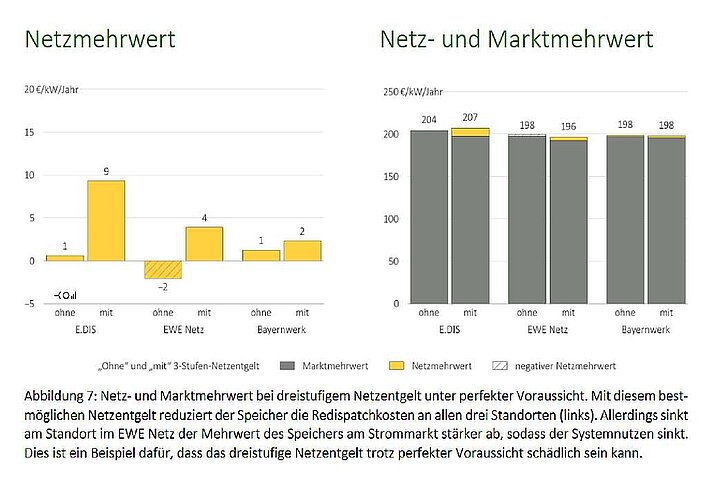
In a theoretical ideal scenario, the study finds that the additional system benefit of a dynamic grid fee is minimal. Neon assumes a perfect forecast of congestion and a continuous price signal for this scenario. Under these conditions, redispatch costs do decrease by 3 to 15 euros per kW of storage capacity per year.
However, this is offset by reduced benefits from the electricity market. The dynamic grid fee results in the battery shifting electricity from low-cost to high-cost hours less frequently. According to the study, the resulting decline in market value is of a similar magnitude to the savings from redispatch. Overall, even under these theoretical conditions, the system benefit increases by only zero to four percent.
Neon does not evaluate the reduction in grid load alone. The study counts both the added value of the storage system in the electricity markets and its contribution to reducing redispatch costs as system benefits. Accordingly, a measure is only economically viable if both effects together increase the system benefit.
Forecasts Worsen the Outcome
Under realistic conditions, the study finds that the outcome is even more negative. If grid tariffs are set the day before based on forecasts, the signals too rarely match the actual congestion at the substations examined. In all three cases, this reduces the system benefit of the storage facilities. “In the distribution grid, the dynamic grid fee for storage facilities examined does more harm than good,” concludes Anselm Eicke, a partner at Neon and co-author of the study.
Click on the graph to view the full image
Source: Neon
Little Redispatch at the Sites
At the same time, Neon sees only limited need for action at the grid level examined. The three substations were selected because of their comparatively high redispatch requirements. Nevertheless, according to the study, significant curtailment occurs in only 7 to 16 percent of the time. Therefore, in more than 80 percent of the time, a dynamic grid fee would not be able to prevent curtailment.
In addition, the battery storage systems examined already behave in a manner that is largely beneficial to the grid even without a grid fee. This limits the additional potential for a price signal. According to Neon, the results cannot be readily applied to the transmission grid. There, larger and more frequent redispatch requirements can, in principle, create a higher potential benefit from dynamic grid tariffs. However, Neon lacks public data on the quality of corresponding congestion forecasts to conduct a robust assessment.
The Neon study on battery grid fees is available online. (sh)