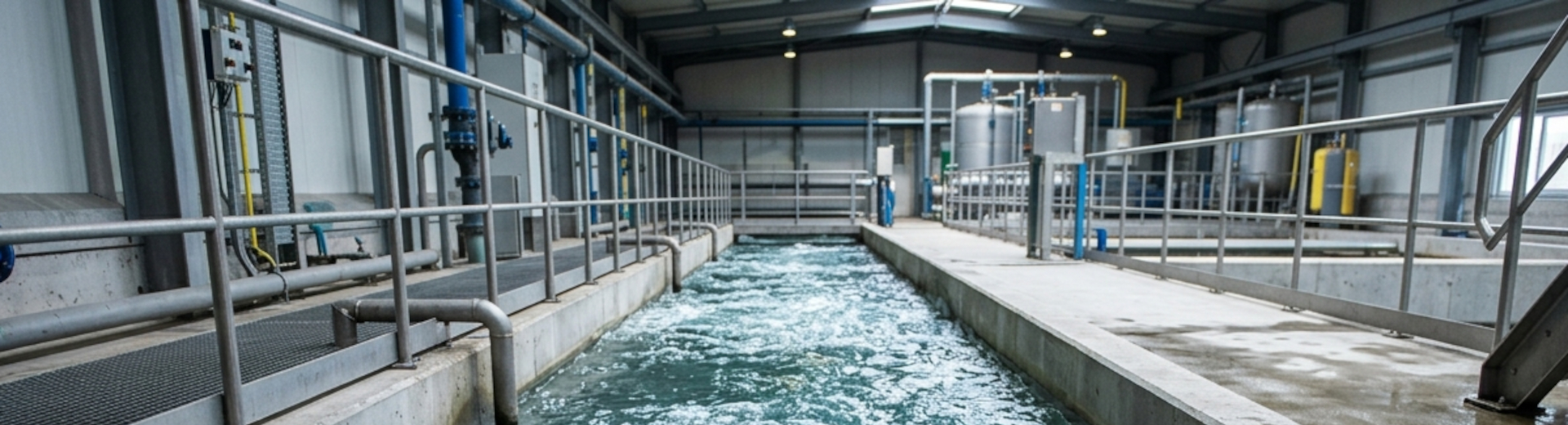
Borken uses the heat from treated wastewater
Borken is banking on wastewater heat: A subsidized pilot project aims to supply public buildings with climate-friendly heat via a cold district heating network in the future
June 15, 2026
Source: E & M powernews
Stadtwerke Borken plans to supply public buildings in its heating network with energy from treated wastewater in the future.
Through a subsidized pilot project on the use of wastewater heat, the City of Borken, the District of Borken, and Stadtwerke Borken aim to advance the development of a climate-friendly heat supply for public buildings. The plan is to connect several public properties, including the wastewater treatment plant, a school, and other government buildings.
According to a press release, the goal is to largely wean the heat supply off fossil fuels and advance municipal heat planning. The Federal Ministry for the Environment has approved 6.1 million euros in funding for the construction of a cold district heating network. The project is considered a municipal climate protection model project and is scheduled to be implemented by summer 2030.
The project focuses on utilizing heat from the wastewater treatment plant’s effluent. Unlike many comparable projects, the energy is not extracted directly from the sewer system but only after the treatment process is complete. According to the project partners, this provides a particularly stable and hygienically safe heat source.
To this end, a heat exchanger is to be installed in the wastewater treatment plant’s effluent stream. The recovered environmental heat is then fed into a cold local heating network. The treated wastewater maintains temperatures of at least 10 degrees Celsius even in winter. According to the project participants, a temperature drop of just 1 degree Celsius can yield 768 kW of heating capacity.
Decentralized large-scale heat pumps with buffer storage tanks are planned to actually supply heat to the connected buildings. They raise the temperature to the levels required for heating and hot water. “By utilizing wastewater heat, we are tapping into a renewable energy source that has been largely untapped until now, right here on site,” says Ron Keßeler, managing director of Stadtwerke Borken.
The total cost of the project is currently estimated at 10.5 million euros gross. Of this amount, the federal government will cover 6.1 million euros. The city, district, and Stadtwerke Borken will contribute the remaining 4.4 million euros.
The Potential of Wastewater Heat for Heating
The project is also being scientifically monitored. The state energy agency “NRW.Energy4Climate” points to the technology’s considerable potential. In the future, 10 percent of North Rhine-Westphalia’s building heating demand could be met by utilizing heat from wastewater treatment plants and sewer networks.
In addition to wastewater, Stadtwerke Borken is also investigating the use of drinking water as a heat source. In the “Wasserdicht” research project, they are collaborating with Münster University of Applied Sciences, Aqua Ecology, and the Institute for Climate Protection, Energy, and Mobility (IKEM) (as we previously reported). At the heart of the project is a pilot plant at the Trier water treatment plant operated by Stadtwerke Borken.
Using heat exchangers and heat pumps, the project aims to investigate whether the heat contained in drinking water can also be used economically for heating in the future. The results will be made available to other municipalities and utility companies. The project is funded by the federal government’s energy research program.
Author: Stefan Sagmeister