
November 25, 2026
The Blaibach Concert Hall in the Bavarian Forest uniquely combines culture, sustainability, and regional identity. How does it manage to combine high-caliber cultural programming with environmentally conscious construction and economic responsibility? What role do regional materials and modern energy concepts play in this? In this interview, Artistic Director Thomas E. Bauer offers insights into the creation, operation, and future of a venue that is far more than just a place for events.
“The use of granite has proven itself for centuries on the surrounding farms. Glass and granite—the materials of which the concert hall is primarily constructed—are building materials that define the identity of the Bavarian Forest.”
Thomas E. Bauer, Artistic Director of the Blaibach Concert Hall
Sustainability is playing an increasingly important role in the construction and operation of public buildings. How is this reflected in the case of the concert hall—what specific measures to conserve energy and resources have been implemented?
Several years ago, at the suggestion of a regional company, we began working to make our organization climate-neutral. A key part of this effort was the purchase of certificates to offset CO2 emissions. I was never entirely convinced by this approach, but it served as a starting point for addressing the issue. It was fascinating to address the issue of resource conservation while calculating our carbon footprint, and I believe there is still great potential in this area. As a result, for example, we’ve made sure to use the most climate-friendly modes of transportation possible for our artists’ travel to the venue. We’re currently on the lookout for more innovative forms of carbon offsetting.
What role do renewable energy sources play in the building’s operations? Does the building have its own energy plan?
When the building was constructed, we had to be very mindful of construction costs. At that time, the most cost-effective heating method was a gas-fired system. We see things differently today, and a feasibility study has already been conducted for our site that will lead us toward geothermal energy in the medium term.
What sustainable measures were deliberately incorporated into the construction and operation of the concert hall? Were there any particular challenges—whether in the choice of materials, energy efficiency, or the long-term operational strategy—and how were these resolved?
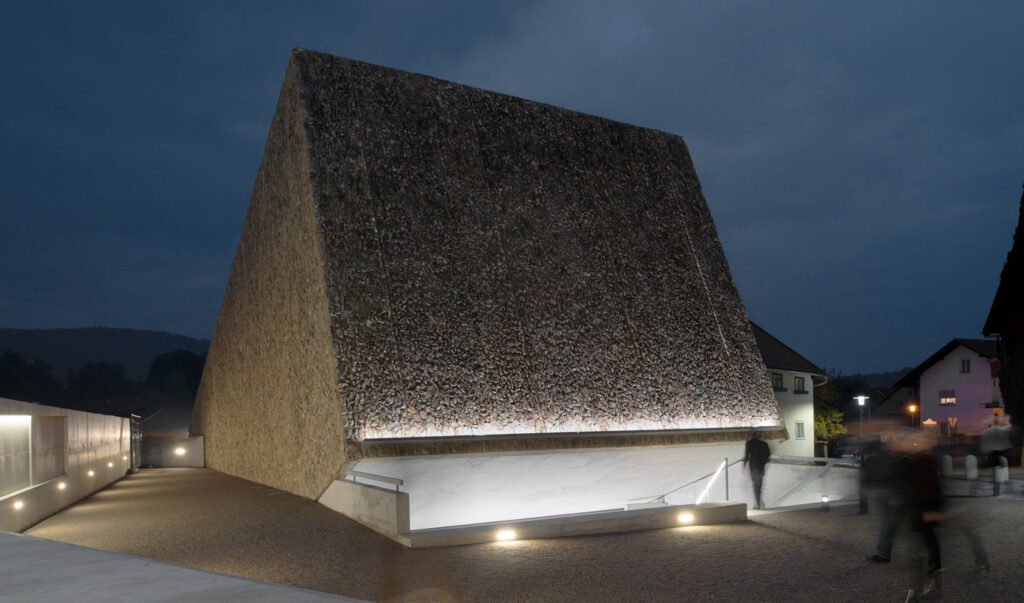
Our decision to use glass foam gravel concrete represented an innovation in concert hall construction. This material has particularly advantageous insulating properties, allowing us to forgo additional insulation measures and keep overall heating costs within reasonable limits. The floor plan was limited to what was absolutely necessary. This means we do not have to supply energy to unnecessary spaces, thereby achieving high energy efficiency. A major consideration, for example, was the design of the façade, for which we used exclusively granite from the nearest quarry. It might be going too far to discuss this here, but we’re also concerned with preserving an institution focused on artistic production. Today, programming is too often overshadowed by the need to address social issues.
What influence did the topography of the site have on the building’s design, and how was this challenge integrated into the architecture of the concert hall?
It’s quite simple: The experience of the last two centuries shows that the classic “shoebox” is the model that offers the best acoustics and is the most cost-effective from a construction standpoint. Since the site was sloped, we tilted our shoebox and partially buried it. So the basic concept was actually finalized on two or three pages after a bottle of beer. In practice, however, it turned out to be a rather complex structure …
Regional materials such as granite were used in the construction of the concert hall. What considerations went into the choice of these materials, and how do they contribute to the concert hall’s sustainable design?
Regional materials were more cost-effective to source, and we were under enormous cost pressure. The use of granite has also proven itself for centuries on the surrounding farms. Together with glass, our second main material, it represents a style of construction deeply rooted in the identity of the Bavarian Forest. Although the concert hall appears extravagant at first glance, it is actually much more traditional and durable than many a Tuscan villa on the outskirts of town.
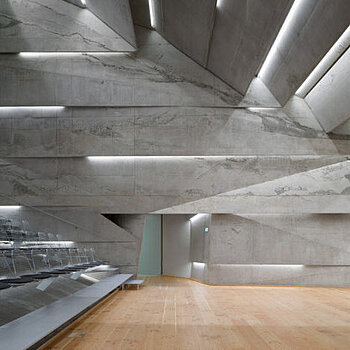
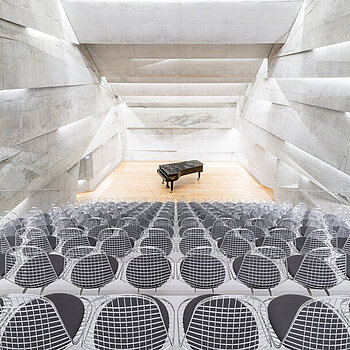
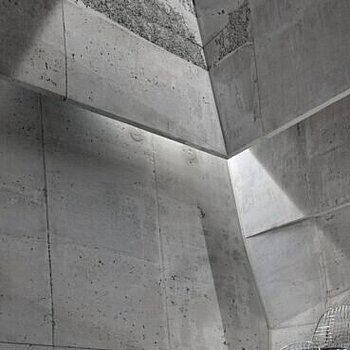
The walls in the concert hall are made of an innovative material (foam glass aggregate concrete). What makes this material so special?
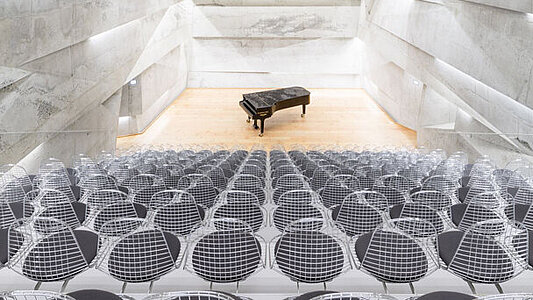
In addition to the outstanding insulation properties I’ve already mentioned, we were particularly surprised by the material’s acoustic properties, since there was virtually no prior experience with it. These properties likely make the concert hall one of the world’s best auditoriums in terms of acoustics. There’s also an aesthetic aspect. The glass foam aggregate concrete is wonderfully irregular and creates magnificent, random reliefs that lend the space a unique dynamism.
What impact has the concert hall had on the local economy and the region’s image? Has it led to a sustained increase in interest in Blaibach?
Our venue is recognized worldwide. This marketing effect is priceless and results in approximately 30,000 people visiting a village with 2,000 residents each year. The effects are obvious. Where the municipality of Blaibach does not capitalize on this, the indirect economic benefits accrue to the district.
What synergies exist between the concert hall and other regional stakeholders (artists, artisans, tourism, restaurants, etc.)?
I’ve never considered myself a mere contributor to the regional economy. However, the concert hall itself has already created several jobs through its own operations. And, of course, the hotel and restaurant industries benefit considerably, because our audience travels an average of 200 kilometers to attend. They need a place to stay and good food, and they also explore the surrounding area. For example, we had our new ticketing system designed and programmed in Cham, and of course the specialized event technology also comes from here. The list goes on.
What are the next steps planned to further develop the concert hall toward climate neutrality?
We’ve already taken several steps, such as conducting a feasibility study on the energy transition for our building. Currently, there are new electric vehicle charging stations at the Konzerthaus, and we’re generally open to further developments and regularly assess which innovations can be meaningfully implemented.
To what extent does the Konzerthaus serve as a model for other cultural institutions in Bavaria in terms of sustainability and climate protection? What are the most important lessons learned from this project—could they be applied to future projects?
In many respects, the Konzerthaus can be viewed as a best-practice model. That’s why I’m constantly receiving visits from local governments across Germany who find the project fascinating. But anyone planning something like this needs to know: The main focus must be on the financial stability of the venture. After all, the audience comes solely because of the many stars they can get incredibly close to in Blaibach. This means high ticket sales and numerous public and private sponsors are essential. Furthermore, it’s crucial to find a responsible person who will bear the risk if the project doesn’t go as planned. Architecture, the business model, climate protection, and sustainability form the necessary framework, but they are not the main drivers of success.
Sustainable and circular construction is also becoming increasingly important at the European level. What opportunities and challenges arise from EU-wide regulations, funding programs, or collaboration with international partners? Are there any international or European models that have played a role in the planning and implementation of the sustainable concert hall? To what extent can the concert hall itself serve as a best-practice example for comparable projects in Europe?
As far as I can tell, there is no comparable project worldwide, which is why the “Blaibach case” has caused such a stir. Often, EU or federal funding programs don’t suit us because rural regions aren’t trusted to deliver a cultural program at the highest international level. Those programs are more or less focused on regional educational initiatives. My experience, however, is that people are now fed up with constantly being lectured to. The concert hall simply offers the highest quality for an interested audience, which is why we don’t need any marketing campaigns at all to sell out the venue. What does concern us, though, is the issue of cohesion, particularly with regard to the Czech Republic. Recently, there has been an interesting federal funding project that supports international cooperation among cultural institutions. Within this framework, we’ve established contacts in Chile for an exciting concert hall initiative. Fair trade, sustainability strategies, and environmental considerations play a central role in the planned collaboration.