 Accessibility

 Language
6G as a communication basis for the digital society
The invisible operating system of our future
30.04.2026
Machines are running in a production hall, continuously supplying data about their status. The network not only transmits this information, but also processes it directly. Deviations are detected early, processes are automatically adjusted and downtime is avoided.
What becomes clear here: Communication is becoming the basis of networked and intelligent systems. Data is no longer just transmitted, but evaluated in real time and used to make decisions. This is exactly where 6G comes in.
It is not just about higher speeds, but about a new form of networking. 6G is intended to serve as a platform that supports a wide range of applications - from industry to logistics and medicine.
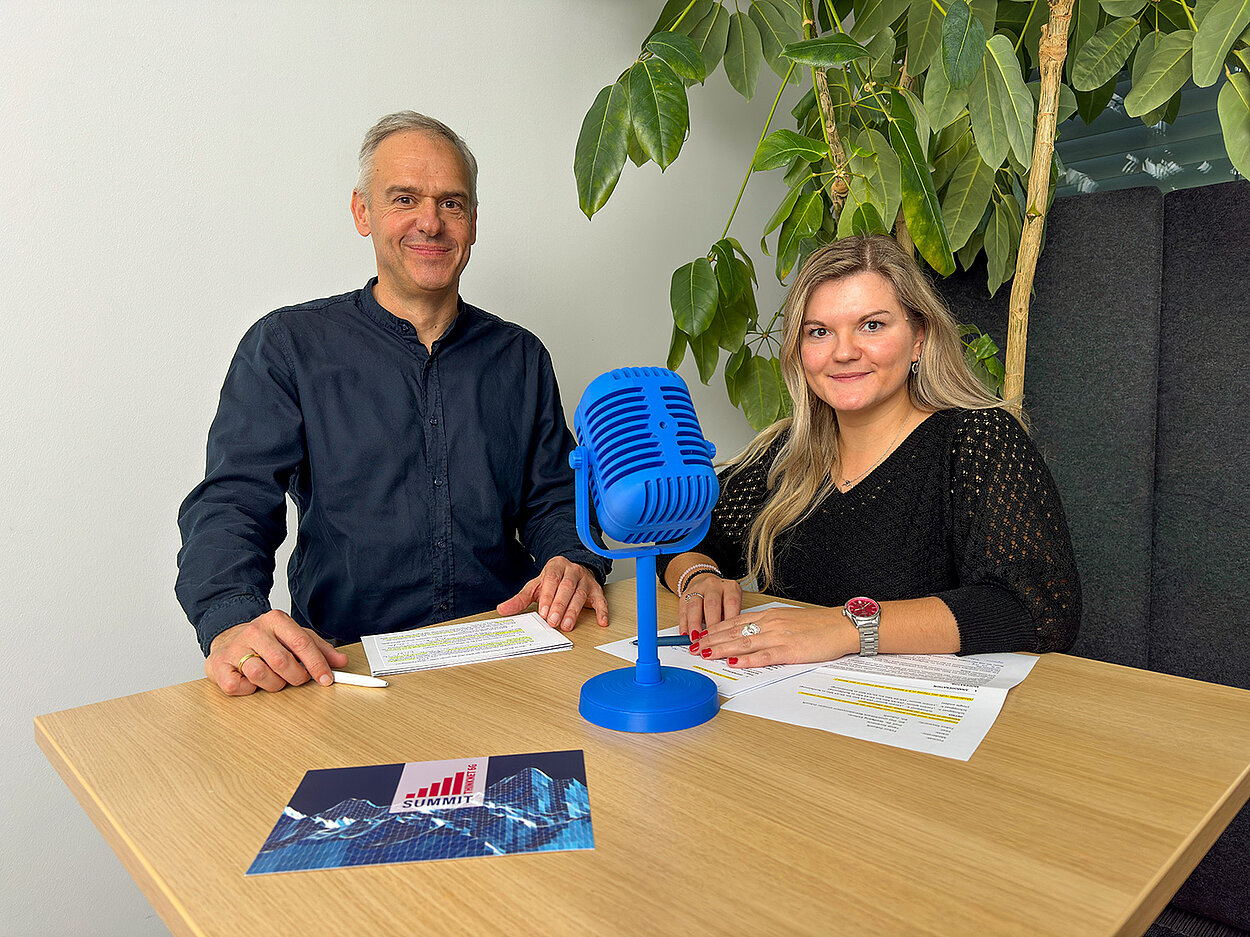
In our Innovation Leben podcast, Dr. Tanja Jovanovic talks to Prof. Dr. Wolfgang Kellerer, Head of the Chair of Communication Networks at the Technical University of Munich and spokesperson for Thinknet 6G, about the current state of development, specific fields of application and the question of what role companies can already play today.
Why do you think 6G is not just another mobile communications standard, but a real paradigm shift?
Prof. Dr. Wolfgang Kellerer: With 6G, it is very important that we talk about a fundamental communication platform for the digital society. It is becoming increasingly important that all services and applications, from medicine, as we have just heard, to autonomous driving, are covered and supported by 6G. As you have just said, it is about an operating system that is available everywhere. There are clear requirements for this: fast data rates, low latency, high availability and energy efficiency. That is very important.
6G is about communication between people and machines and between machines themselves. Added to this is the availability of data and the use of artificial intelligence. This will play a central role.
So we are talking about an intelligent communication network.
What specific challenges from industry and production can 6G solve?
Prof. Dr. Wolfgang Kellerer: As I said, this affects all areas. The aim is to support a wide variety of applications. Very low latencies in the control of systems are crucial, for example in industry, logistics or even for operations and diagnoses in hospitals. This is about low latency and extremely high availability. The connection must not be interrupted.
At the same time, communication with the environment plays an important role, for example in autonomous driving. Vehicles must communicate reliably with each other. This must be absolutely fail-safe.
So in short: 6G is faster, more connected and serves as the basis for many smart systems?
Prof. Dr. Wolfgang Kellerer: Exactly. It's about "faster, higher, further", but above all about smart systems.
Artificial intelligence will play a major role in this, as will data. This means that we not only have a network that transmits data from A to B, but one that can also process data.
These are sensors that are connected to the system, or 6G itself can act as a sensor, i.e. as a radar system that provides information about the environment. This is new, it has never been done before.
The aforementioned scenarios can only become reality if we continue to develop 6G. Right?
Prof. Dr. Wolfgang Kellerer: Exactly. If we don't start researching these topics now and developing solutions step by step, then the whole thing won't go any further. The path leads via standardization, then to implementation and finally, with the target horizon of 2030, to the first 6G systems going into the field.
"6G is an intelligent communication network that will be available to everyone everywhere in the future. This means that services such as robot control or remote diagnostics in medicine can be used by everyone - no matter where they are."
Prof. Dr. Wolfgang Kellerer
Head of the Chair of Communication Networks, Technical University of Munich
We also want to involve small and medium-sized enterprises, i.e. the users directly. What opportunities are there for SMEs, especially when it comes to topics such as data in real time or the demand for "faster, higher, further"?
Prof. Dr. Wolfgang Kellerer: Basically, the same applies to small and medium-sized enterprises. They often have very good ideas and can think ahead with such a system, further develop their products and devices and increasingly network them.
In a digital society, everything will be networked. Without networking, many things will no longer work. At the same time, it should be so simple that you don't have to deal with the details of how this networking works. A fail-safe network provides the connection and can offer additional, intelligent services, for example.
The aim is for these technologies to be so easy to use that they can be used for all applications and are also available to small and medium-sized enterprises.
What entrepreneur doesn't like to hear that processes are becoming simpler, employees can be relieved and scaling is possible? After all, this is a clear economic factor. I would be interested to know: Where are we specifically in Bavaria today in terms of development? Are there any innovative projects that you can share with us?
Prof. Dr. Wolfgang Kellerer: You already mentioned it: We started 6G research in good time - also in Bavaria.
One of the major projects in Munich is the 6G Future Lab Bavaria. There, we are working on various aspects of 6G, including digital twins. This involves the question of how environmental information and the status of the network can be recorded and how this can be used to improve both innovative services and network control.
Specifically, it is about fast handover and more efficient resource management in the network to support applications in medicine or the control of robots, particularly in the field of haptic robotics.
What do you think companies should do now to be 6G-ready?
Prof. Dr. Wolfgang Kellerer: What you can do now is to think about it: What would I need so that my product or service can benefit even more from communication? You should consider both communication and artificial intelligence and ask yourself: If a network is available everywhere, how can I further improve my products and make them more attractive?
It is important not just to do this quietly, but to actively seek dialog, for example via our Thinknet 6G platform, in exchange with researchers and also with large-scale industry. In this way, requirements can be recognized and taken into account at an early stage. The key is to seek dialog and not be afraid to ask questions.
This means that if I am a company that is active in manufacturing, for example, and I realize that I need to monitor my systems more closely at an early stage, I can think about this directly and consider how 6G can help me. And how can I then find access to the Thinknet 6G?
Prof. Dr. Wolfgang Kellerer: For example. Or approach universities and take part in large research projects. And actually just join in. We welcome anyone who can contribute additional use cases and applications. There are now also large testbeds at universities. You can try out such applications there.
That is a very important point: there is already a lot that can be tested. Companies also have the opportunity to use this infrastructure.
Prof. Dr. Wolfgang Kellerer: Exactly. I think that's also important. We now have campus networks at universities that didn't exist before. There you can try out such applications in the academic world without having to be a network operator yourself.
If you had to give a medium-sized company a tip for the next two years, what would it be?
Prof. Dr. Wolfgang Kellerer: To think about how such intelligent communication can improve products. What could I do if I had a fail-safe communication network that is powerful and available everywhere? How could that improve my product?
Would you say that 6G is high tech or deep tech?
Prof. Dr. Wolfgang Kellerer: High tech. Definitely.
And what personal hope do you associate with a world in which 6G becomes possible?
Prof. Dr. Wolfgang Kellerer: I think 6G is first and foremost a communication technology. It should bring people together and at the same time ensure that everyone can participate.
If a communication network is available everywhere and works intelligently, everyone can benefit from it equally. Services such as robot control or remote diagnostics in medicine can then be used regardless of location. This is an important aspect for our digital society.
The interview was conducted by Dr. Tanja Jovanovic, Head of Marketing & Innovation and Member of the Management Board, Bayern Innovativ GmbH, Nuremberg.
Your contact

