The NAWAREUM in Straubing
A House Full of Ideas for a Sustainable Future
November 27, 2025
From the Passive House standard to an insect-friendly garden and interactive exhibits, the NAWAREUM in Straubing demonstrates how sustainability can be consistently implemented at every level and brings it to life for visitors of all ages.
What does a museum look like that not only addresses sustainability but embodies it in every aspect? The NAWAREUM in Straubing provides a clear answer. The building itself meets the highest energy standards; the exhibition inspires with positive examples of environmentally friendly practices; and the museum’s operations, events, and garden all follow a holistic approach. In this discussion, Dr. Vanessa Roden, Director of NAWAREUM; Ines Zirngibl, Curator; Annette Hartmann, museum educator, and Florian Völkl, building services and outdoor facilities, along with Peter Turowski, head of the Central Services Department at TFZ, share insights into how a comprehensive concept is implemented, what technical solutions lie behind the energy-efficient building, and how they succeed in involving people with very different backgrounds.
Sustainability is at the heart of the NAWAREUM—how is this commitment reflected in the museum’s overall concept, from the exhibition to the building itself?
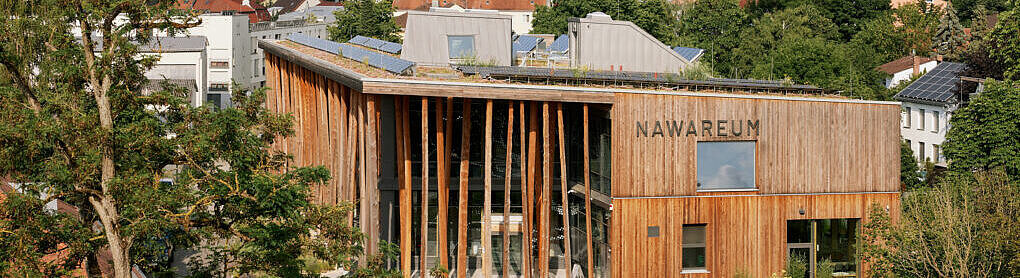
Sustainability permeates the NAWAREUM at every level—from the building itself to the exhibition and its operations. The museum building meets passive house standards: it features highly effective insulation and numerous building components made from renewable raw materials, primarily wood. Energy is supplied by renewable sources—using near-surface geothermal energy, solar thermal energy, and photovoltaics.
The exhibition aims to inspire visitors with positive examples of sustainable action.
In doing so, we convey scientific and technical fundamentals, demonstrate how the climate system works, address the consequences of climate change and environmental destruction, and present solutions in the areas of renewable energy and renewable raw materials.
Our museum education program also focuses on exploring sustainability. The entire museum follows a holistic approach: For example, when making purchases, we give preference to regional partners, sustainably operating businesses, and eco-friendly materials and products. At events—both internal and external—we prioritize avoiding food waste and single-use plastics and opt for more environmentally friendly alternatives.
In the museum shop, we offer upcycled products and goods made from renewable raw materials, preferably from regional suppliers. And last but not least, our nature-oriented, insect-friendly garden serves as a model for sustainable landscaping.
The building was constructed to passive house standards and uses only renewable energy—could you give us a brief overview of the most important technical systems and how they work together?
Part of the electricity demand is covered by a photovoltaic system consisting of 151 modules, covering an area of 271 m² and achieving a maximum output of 53 kilowatts. The remaining electricity is purchased from 100 percent renewable sources.
For heating and, above all, cooling—which poses the greater challenge in such a well-insulated building—a combination of several systems is used. First, in the summer, 41 geothermal probes extract cold from the ground. If this is not sufficient, two heat pumps take over the cooling. Both systems utilize what is known as “building component activation”: a form of underfloor heating that can be used for both heating and cooling.
In addition, the air from the ventilation systems can be cooled using solar cooling via a DEC system (Desiccative Evaporative Cooling; cooling through evaporation and drying). Fifty-five solar thermal collectors with a total surface area of 128 m² are used as the heat source for this.
The building is also heated via heat pumps and a district heating connection to the wood chip heating plant of the Technology and Support Center (TFZ). All ventilation systems are equipped with central heat recovery.
What has been your experience with the building’s energy efficiency during ongoing operation? Are there any measurable successes or specific insights?
The photovoltaic system allows us to use about 98 percent of the electricity we generate ourselves. This covers about one-fifth of our total electricity needs.
We draw approximately 20,000 kilowatt-hours annually from the district heating network—a figure roughly equivalent to the heating demand of two to three modern single-family homes. The vast majority of heat generation is therefore provided by the heat pumps.
Overall, the building’s operation has proven to be very energy-efficient—even though we currently lack the means to compare it with other museums of this kind for a more in-depth assessment.
"Sustainability and climate protection are the focus of the exhibition. To this end, we rely on strong visual elements: Numerous graphics and works of art illustrate complex issues—such as climate change and its consequences—in a way that is clear and easy to understand. At the same time, it was important to us not only to address problems but also to highlight concrete and positive real-world examples that already exist."
Ines Zirngibl
Curator, NAWAREUM
How do you manage to involve different age groups as well as people with varying circumstances and needs?
Diversity and inclusion are at the heart of our exhibition planning. The exhibition is easily accessible for people with limited mobility or families with strollers. To appeal to as many people as possible, we rely on a multi-layered educational concept that caters to different interests, age groups, and needs.
With our diverse school group programs, we reach students of all ages—from elementary school through 13th grade. We also offer special information days for teachers. The exhibition itself is designed so that it can be explored independently by adults as well as by children ages 12 and up. For younger guests ages 6 and up, there is a dedicated children’s trail as well as interactive and playful stations that also encourage adults to participate. In addition, we provide in-depth information aimed at particularly interested visitors and covering more technically challenging topics.
The program is complemented by special workshops and guided tours that can be customized upon request to meet the specific needs of each group. Guided tours for people with visual impairments and in sign language are also offered. These were developed in close collaboration with inclusive organizations and counseling centers. In this way, we ensure that everyone—regardless of their circumstances—can not only passively experience the exhibition but also actively participate and contribute.
What makes your museum garden special, and what role does it play in educating visitors about topics such as biodiversity, the circular economy, and renewable resources?
In our museum garden, we completely avoid synthetic pesticides and rely on drought-resistant plants that are specifically adapted to water scarcity—watering is kept to a minimum. We sometimes deliberately leave so-called “weeds” or accompanying plants in place. This promotes biodiversity and attracts beneficial insects, allowing us to avoid the use of chemical pesticides.
We use only organic fertilizers, such as granulated compost or targeted green manure. These measures improve soil quality, increase humus content, and thus enhance the soil’s ability to retain water and nutrients—which in turn results in healthy plants. On a smaller scale, we also compost directly on site to keep organic waste in the cycle. We leave many plants unpruned over the winter to provide shelters for insects and small animals—another contribution to ecological diversity.
In addition, we feature plants in the garden that can be used for energy, as raw materials, and for medicinal purposes. In this way, the garden becomes a place for learning about biodiversity and the potential of renewable resources.
What considerations were paramount when selecting materials for the exhibition, and how were regional, renewable, or recyclable materials specifically used?
When designing our permanent exhibition, we were aware that the materials used would have to withstand high visitor traffic for many years. Durability and resilience were therefore key criteria. At the same time, the materials should be as natural as possible to align with the concept of our passive house and create a pleasant atmosphere.
Environmental friendliness and the possibility of reusing the materials were particularly important aspects for us. As a result, we opted for renewable raw materials: for example, we use spruce wood that has been treated with an eco-friendly wood stain. Some display boards and seating were covered with rapeseed oil-based linoleum for greater durability.
Other seating is made from collected plastic, which was processed and transformed into seating using a 3D printer. The chairs, in turn, come from other museums: Discarded chairs were refurbished and put to new use here.
Of course, there are many more examples throughout our museum. Nevertheless, for some elements we had to resort to less environmentally friendly materials—particularly where specific requirements, such as certain fire safety ratings, had to be met and no suitable alternatives were available on the market.
Our general goal, however, remains to reuse all materials after they have served their original purpose—whether in the permanent exhibition or as part of our special exhibitions.
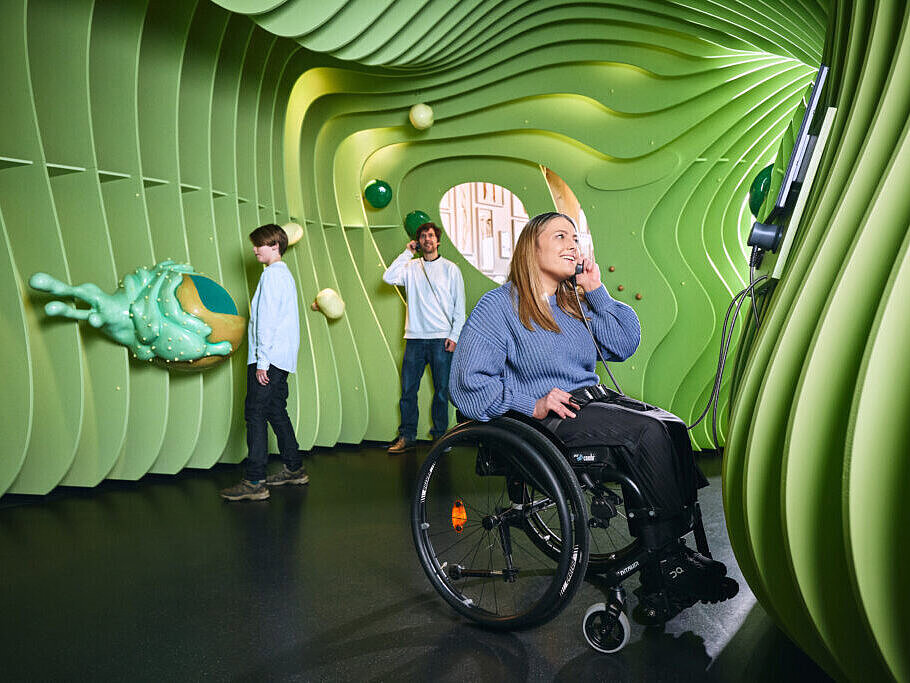
Which exhibit or display element would you describe as particularly impressive or impactful in terms of environmental education?
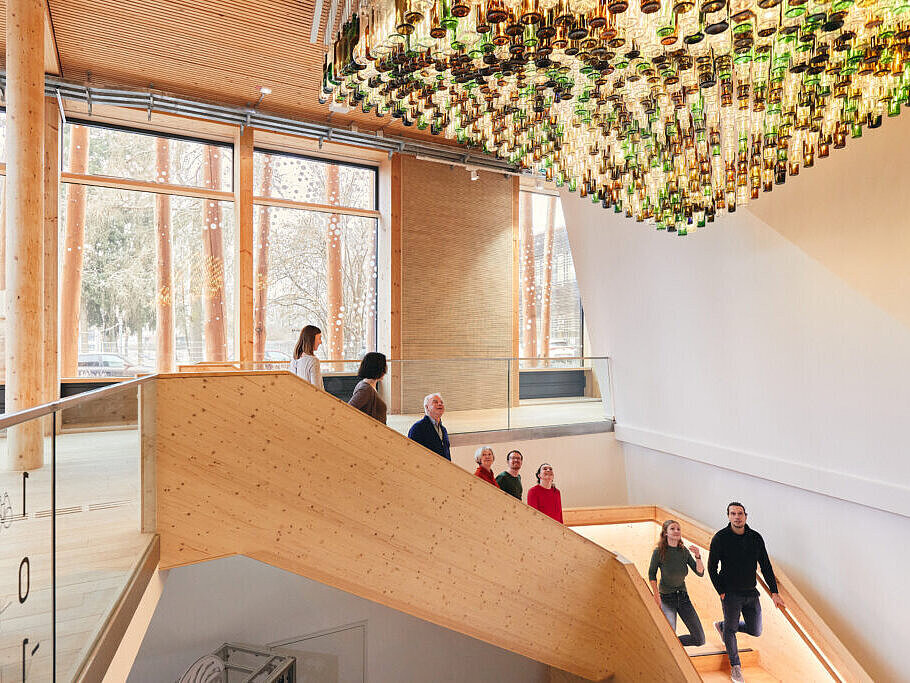
Even the first exhibition area makes a strong impression: Here, our visitors encounter Planet Earth—in all its beauty, but also with the history of its development and the growing impact of humans. This introduction powerfully conveys how long and to what extent humans have influenced life on Earth.
Throughout the entire exhibition, we rely on strong visual elements: Numerous graphics and works of art make complex issues—such as climate change and its consequences—vivid and easy to understand.
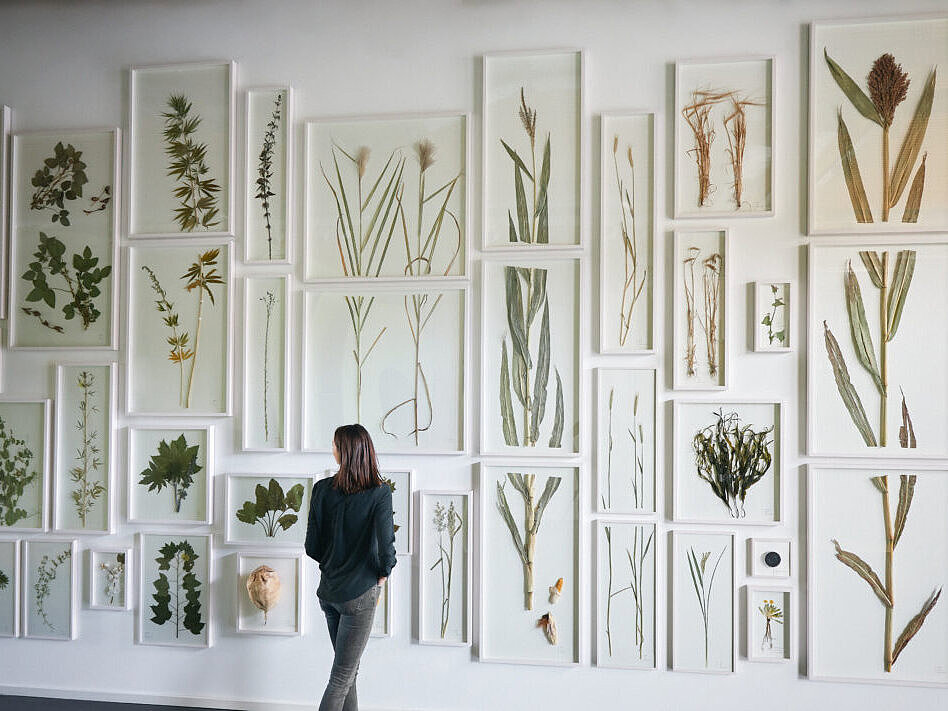
At the same time, it was important to us not only to address problematic situations but, above all, to highlight concrete, positive examples from our everyday lives that already exist. For example, we present a wide variety of everyday products made from renewable raw materials instead of petroleum. The “Restaurant Earth” playfully demonstrates how sustainable and healthy eating can be achieved. Our herbarium wall and the museum garden illustrate the diverse uses of plants. And how do all these renewable energy sources actually work? Visitors can experience this firsthand through hands-on activities.
It is precisely this combination of showcasing human impacts and presenting practical, everyday solutions that, in our view, makes our exhibition particularly effective for environmental education.
What are the practical benefits of collaborating with numerous partners (KoNaRo, TUM, C.A.R.M.E.N. e. V.)? Under what conditions can this collaborative approach serve as a blueprint for other museums?
The NAWAREUM is part of the Technology and Support Center at the Competence Center for Renewable Raw Materials (TFZ). Numerous experts from the TFZ and C.A.R.M.E.N. e. V. were involved right from the start in developing the exhibition concept and content. The life cycle assessment was conducted by researchers at the Technical University of Munich (TUM).
This close professional connection is a great asset for us. It not only enables us to provide well-researched content but also facilitates a continuous exchange of ideas. We continue to work closely together today to further optimize our permanent exhibition, organize joint events, and leverage synergies—for example, in public relations.
What advice would you give to other museums or public institutions that want to become more sustainable?
It’s not easy to offer universal recommendations, as the circumstances vary greatly. We had the great advantage of being able to help design a new building with sustainable construction from the ground up.
Many museums, on the other hand, are located in existing buildings that are in need of renovation and have less flexibility when it comes to energy supply. However, if a new construction is planned or sufficient funds are available for renovation, sustainability should definitely be taken into account from the very beginning—that is, as early as the planning phase. Fortunately, this has now become standard practice.
There is more flexibility when it comes to procurement: here, for example, used furniture, display cases, or other furnishings can be utilized. There are special exchange platforms for this purpose, such as those offered by the German Museum Association or within Bavarian government agencies (for example, eGon). Here, too, it’s worth engaging in exchanges and seeking out cooperation partners. We ourselves have found many pieces of furniture through classified ads or our local waste management agency (ZAW Straubing-Bogen).
A lot can also be achieved in the area of print products—for example, through sustainable printing processes and reduced print runs. Overall, there are a multitude of ways to act more sustainably. Often, it’s the smaller steps that, when added up, can make a big difference.