Sustainable Exhibition Operations
The House of Bavarian History in Regensburg embodies a sustainable museum of the future
November 19, 2025
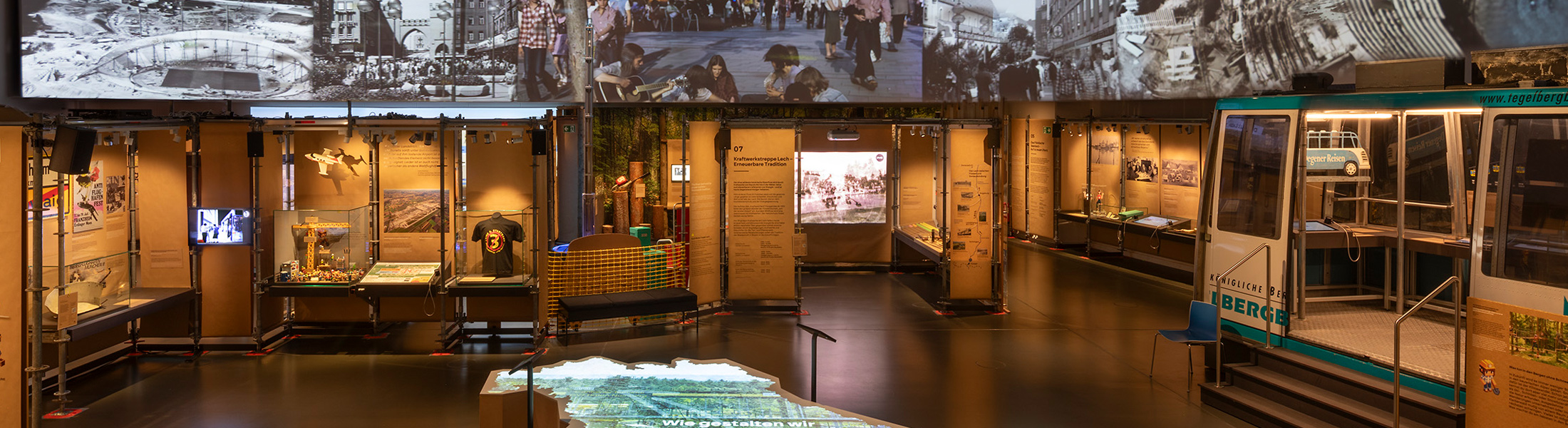
The 2024 Bavaria Exhibition “Ois anders: Major Projects in Bavaria 1945–2020” at the House of Bavarian History placed a clear focus on sustainability and aimed to keep the exhibition’s ecological footprint as small as possible. Sustainability was not only addressed as a thematic focus but was also integrated as a central principle in the planning and implementation. From the selection of reusable materials to collaboration with service providers committed to sustainability, numerous measures were taken to design the exhibition in a resource-efficient manner.
In late December 2024, Christina Schmitt, Head of Museum Operations, Collections, and Prevention, and Alexandra Ermann from the curatorial team for the special exhibition spoke in an interview about their experiences implementing sustainable measures in an exhibition setting. They explain the challenges they overcame, the specific solutions they developed, and how these approaches can serve as a model for future exhibitions.

"Artistic integrity and sustainability are not mutually exclusive in exhibition design. However, a certain openness is required when it comes to sustainable and unconventional approaches to exhibition design."
Alexandra Ermann, a member of the curatorial team for the special exhibition at the House of Bavarian History
An exhibition with a negligible environmental footprint—that was the goal pursued by the House of Bavarian History with the 2024 Bavaria Exhibition, “Ois anders: Major Projects in Bavaria 1945–2020.” How did you come up with the idea of making the 2024 Bavaria Exhibition as sustainable as possible?
Alexandra Ermann: Sustainability is a principle that is always at the forefront of our museum’s operations. In the case of the Bavaria Exhibition, this was compounded by the fact that sustainability was a central theme of the exhibition itself.
Key aspects such as climate protection, nature conservation, and ecology recur time and again in all the major projects covered and in the discussions surrounding them. This provided the impetus to design the Bavaria Exhibition itself in a sustainable manner and to test this concept as a comprehensive experiment. Since this special exhibition is taking place here on site, where operations are already highly sustainable, we were able to respond flexibly and comprehensively to all considerations and requirements.
We discussed these aspects intensively from the very beginning and continuously integrated them into the planning process to establish sustainability as a guiding principle.
What were the biggest challenges during the planning phase?
Alexandra Ermann: When planning the exhibition, we deliberately deviated from conventional design concepts from the very beginning. The exhibition designer was involved early on and embraced the idea of sustainability from the start. Even the first draft reflected this approach. The project management team and the design firm worked intensively on various aspects, such as the display cases, support systems, and materials.
We always made sure to use as little material as possible. Throughout the process, ideas were developed and solutions were repeatedly adapted to achieve the sustainability goals. Another key approach was to minimize the construction of new elements and instead reuse materials. Where new materials were necessary, they were selected so that they could later be recycled by type or upcycled. The reusability of the materials and exhibition structures after the exhibition’s conclusion was also a central focus of the planning.
Can you tell us more about specific examples of reusable and upcycled materials?
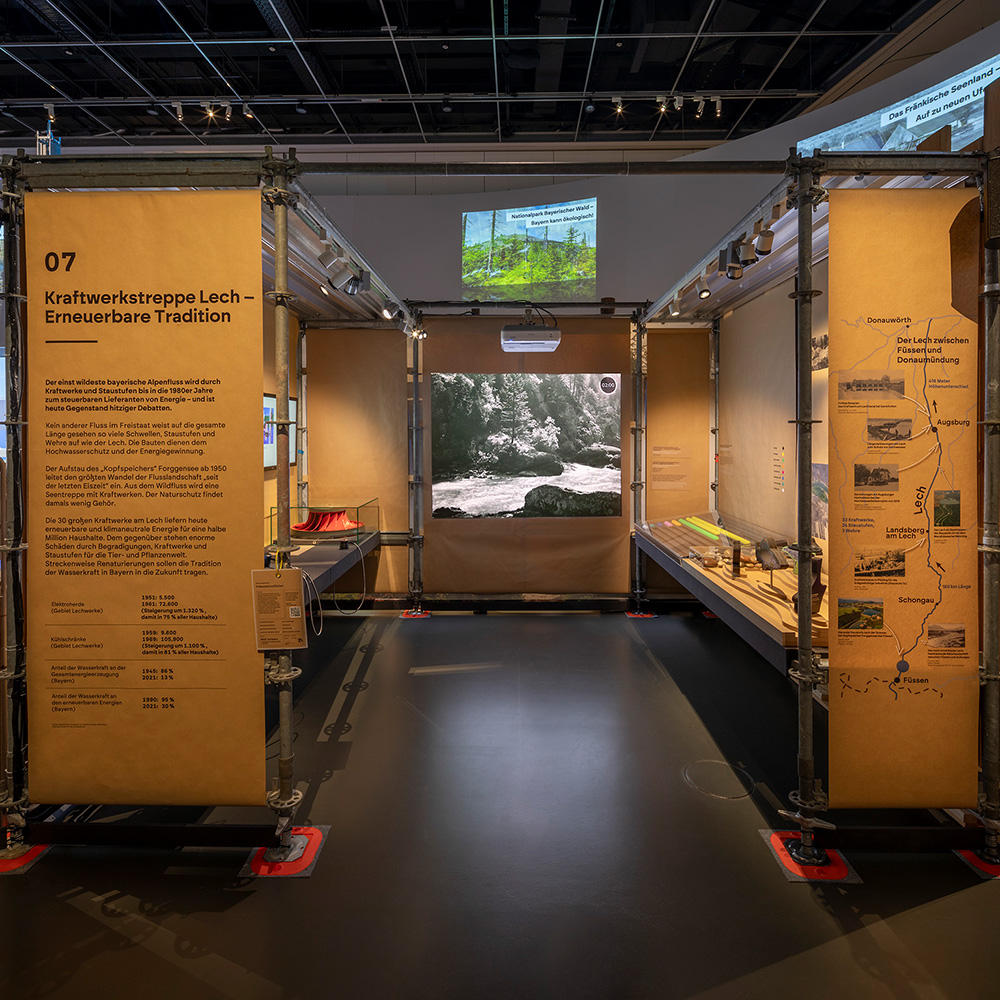
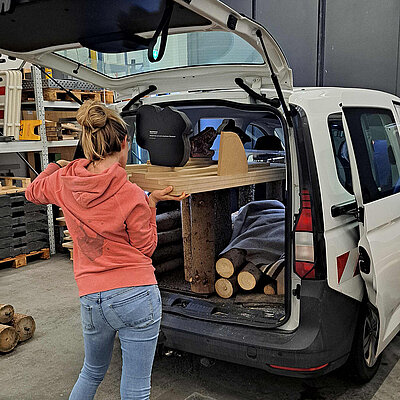
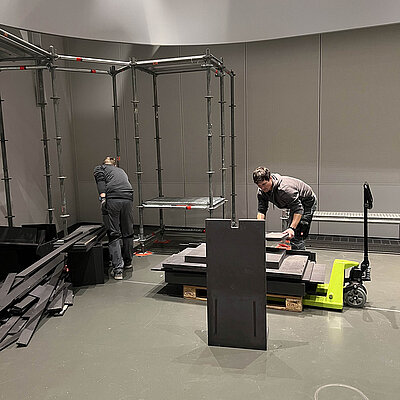
Alexandra Ermann: The scaffolding, which forms the basis of our exhibition structure, will be reused as-is on the construction site. Lighting and media technology, as well as the furniture and display cases, will be reused in-house for future projects. The panoramic screen, a central element of the exhibition, was already used in another exhibition in 2020 and will continue to be used. We try to use these resources for as long as possible before they need to be replaced. Materials that we do not keep in-house are sent to the local university to be processed in its workshops. Large graphic prints also find a new use, for example, in a social project that turns them into bags and backpacks. Paper is disposed of normally, and we donate large cardboard displays to a preschool.
Implementing sustainability in exhibition design often involves logistical challenges. What difficulties have you encountered in practice?
Alexandra Ermann: Our motto is: We don’t make any new purchases unless there’s a permanent location for them.
Regardless of “Ois anders,” this guideline is put to the test especially in exhibition construction, since new fixtures are often necessary there. Limited storage space makes it difficult to store larger exhibits or modules permanently. Managing this storage space and providing reusable furniture and modules for temporary exhibitions requires careful planning. We are constantly working to create space and identify locations so that we can also provide the materials needed for large temporary exhibitions or state-wide exhibitions. However, not every exhibition we host can draw on our full inventory, and new materials are still needed.
In addition, the organization of off-site storage plays a role: This requires weighing the CO₂ impact of transportation and carefully coordinating the availability of necessary elements. Furthermore, the selection of service providers is crucial: We make sure to work with providers who are also committed to sustainability. In this context, for example, we examine whether short transport routes are possible. The supplier of the scaffolding for the “Ois anders” exhibition, for instance, is based in Regensburg, which significantly shortens transport distances.
Now that the “Ois anders” exhibition is in its final phase, another key aspect is coordination between the various exhibition teams and museum operations regarding the reuse of display cases and modules. These are either transported directly to a new exhibition site or transferred to storage.
You plan to critically evaluate your measures after the exhibition. How will you assess the success of the sustainability measures? What indicators or benchmarks will you use for this assessment?
Alexandra Ermann: Evaluating the exhibition’s sustainability measures is complex, as this specific exhibition—in its form and design—will not be repeated. The focus is therefore on what insights can be drawn from the exhibition and applied to future projects. To this end, we have developed two approaches:
First, we conducted a CO₂ assessment of the transportation operations, including the logistics of service providers—such as those in the fields of media technology, graphic design, and installation companies. The goal was to quantify CO₂ emissions and identify which transport operations were particularly emission-intensive and where there is potential for reduction. We want to determine whether transport operations can be consolidated to avoid unnecessary trips, particularly during the dismantling and return transport of the exhibition objects.
Second, an external assessment of the materials used will be conducted to analyze their carbon footprint and sustainability. In this process, materials such as standard and recycled acrylic will be compared with possible alternatives. The results should indicate which materials should be prioritized or avoided in the future, depending on their environmental impact and practical usability.
Are the carbon footprints for the materials provided by the manufacturers, or is there a corresponding database?
Alexandra Ermann: The carbon footprint of transportation by truck and car is based primarily on emissions data made publicly available by the vehicle manufacturers. The calculations were performed internally. The kilometers traveled were documented. Business trips for research purposes were mostly conducted by train. The calculations of CO₂ emissions from rail travel are based on data from government institutions, such as the Federal Environment Agency. Despite the difficulties, we endeavored to collect all relevant data in order to produce as comprehensive an assessment as possible.
The assessment of materials, however, is currently being carried out by an external service provider due to its complexity.
Were there any creative solutions or innovative approaches that you were able to implement in the exhibition that are already applicable to other cultural institutions?
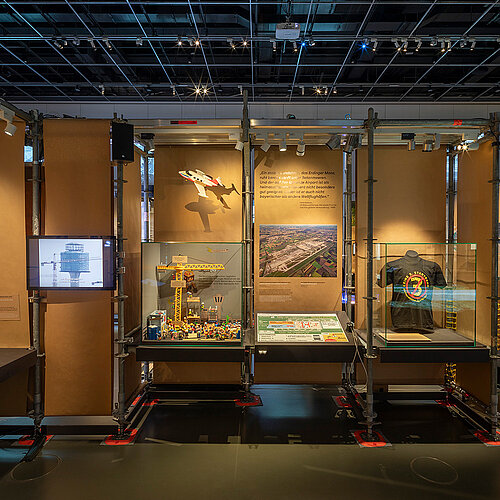
Alexandra Ermann: The exhibition features an unusual mounting system for text and graphics. Instead of traditional MDF panels or similar materials, we used recycled packing paper.
The paper’s durability was astonishing: All the panels that have been hanging since the opening on April 18 are still in use, without the need for reprints. In a few places, panels had to be taped together, though this is barely noticeable. The ease of handling and the aesthetic appeal of the packing paper were not initially foreseeable, but they became an important feature of the exhibition.
The exhibition deliberately avoided the use of additional materials. Cables were laid visibly, and screens were not recessed into walls but mounted on panels with minimal use of materials. The display cases also came entirely from the museum’s existing inventory, which required precise planning to assign the appropriate objects to them. While the display cases and objects do not always harmonize perfectly, this was accepted in the interest of sustainability.
In the long term, the museum plans to use only standardized display cases in specific sizes to ensure greater reusability. Custom-made display cases built specifically for individual objects will thus be a thing of the past.
Do you use your own staff to design an exhibition, or do you collaborate with external experts?
Alexandra Ermann: The conceptual framework always comes from the museum’s respective curatorial team. The design implementation is outsourced. The sustainability aspect is integrated into the request for proposals, so that the designers take our sustainability goals into account. This includes, among other things, the standardized modular system for display cases mentioned earlier.
Are sustainability considerations in exhibition design perceived as a restriction on artistic freedom?
Alexandra Ermann: At the House of Bavarian History, sustainability is now regarded as a fundamental obligation for all designers and service providers.
So far, we’ve always found a receptive audience for this concern. There is, therefore, an enormous willingness to embrace this approach. Artistic standards and sustainability are not mutually exclusive. However, a certain openness is required when it comes to sustainable and unconventional approaches to exhibition design. The Bavarian exhibition “Ois anders” is a good example of this.
How important is internal communication within the team in this context? How do you involve your team in sustainability processes to foster employee awareness and engagement?
Alexandra Ermann: Internal communication is a crucial factor. It’s about involving all employees, keeping them informed, and working toward a common goal. We place great emphasis on regularly aligning our goals and pulling together as a team. It’s essential to focus on an overarching goal—in building operations, for example, energy savings. This unified focus is a key component of our success. In addition, we have an in-house Sustainability Working Group that meets every two months to collaboratively advance the issue of sustainability. The topics discussed are communicated to all employees.
To wrap up, here’s a question for Natascha Zödi-Schmidt, Head of Communications and Public Relations at the House of Bavarian History: Since the summer of 2024, the museum has been a certified “sustainable destination.” Are there any specific communication strategies to make the topic of sustainability more tangible?
Natascha Zödi-Schmidt: We are very pleased to be part of the “Sustainable Travel Destination Regensburg” initiative. The city of Regensburg has established its own portal and target audience segment for sustainable tourism and actively promotes this concept by featuring partners who have earned the certification under the “Sustainable Destination” brand.
For us, sustainability is an ongoing theme that permeates all areas of our work, including press and public relations. Whether we’re drafting press releases for exhibitions or other projects, or speaking at our annual press conference, this topic always has a prominent place.
In addition, visitors will find, for example, a large banner right at the museum highlighting our energy-saving measures. We’re also continuously working on our website, which features a dedicated page on sustainability.
What recommendations do you have for other museums or cultural institutions that want to embark on a path toward greater sustainability? Where should they start?
Natascha Zödi-Schmidt: When launching a major project, it’s important to define clear goals, especially regarding energy conservation and sustainability.
At the House of Bavarian History, thanks to the support of the director, Dr. Richard Loibl, we’ve been able to continuously optimize these goals. It’s also important to maintain a certain openness when it comes to sustainable and unconventional approaches to exhibition design.
Read more about the House of Bavarian History as a certified Passive House.