Coburg Innovation District: Where a City Fosters Creativity
On the Occasion of the State Prize for Bavarian Creative Hubs
A new component takes shape layer by layer on the 3D printer. At CREAPOLIS Makerspace, the open workshop at Coburg University of Applied Sciences, prototypes are developed, designs are tested, and technical ideas are brought to life immediately. Not far from there, people interested in AI and entrepreneurship gather at the AI Breakfast Club. Over coffee and breakfast, they share practical experiences, discuss initial ideas, and make new connections.
On the site of the former freight yard and slaughterhouse, uses that would otherwise be scattered across the city are now clustered closely together: workshops, startup spaces, research, design, theater, and events.
Where goods were once loaded and animals processed, prototypes, business ideas, and cultural initiatives are now taking shape. The Coburg Innovation Quarter demonstrates how an inner-city industrial wasteland can evolve into a hub for creativity—not through a rigid master plan, but through active use, networking, and municipal courage.
An Industrial Brownfield Becomes a Development Site
The approximately six-hectare site south of downtown Coburg was dominated for decades by freight handling and slaughterhouse operations. The freight yard was decommissioned in 1997 and gradually dismantled starting in 2007. The slaughterhouse was permanently shut down in 2013. Since then, the site has been steadily undergoing development.
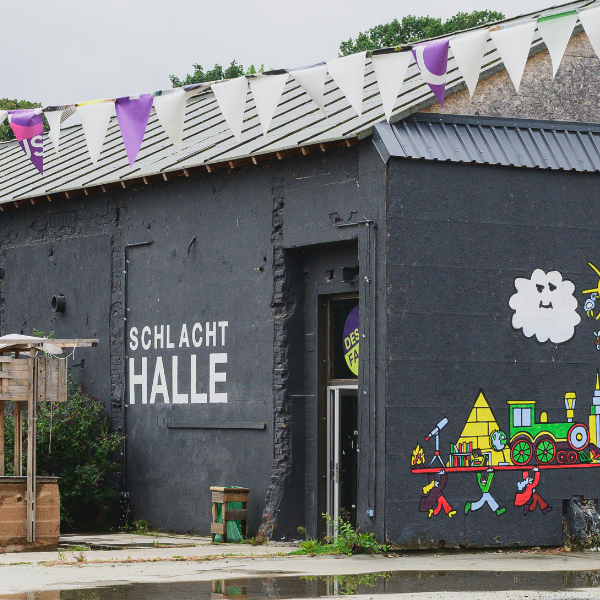
The city of Coburg did not simply renovate the site and then lease it out entirely. Instead, it is focusing on phased revitalization, temporary uses, and a variety of stakeholders. Buildings are being renovated step by step, open spaces are being experimented with, and new uses are being integrated. Here, the unfinished state is not merely a transitional phase, but part of the concept. Thus, on April 28, 2025, the university’s Design Factory opened on the former slaughterhouse grounds as a creative interim use. There, student work is publicly exhibited, events and discussions are held, and new forms of exchange, collaboration, and knowledge transfer are tested as part of a real-world laboratory.
The journey to today’s Innovation Quarter did not start from scratch. Since the early 2000s, the Design Workshop—a project of the City of Coburg’s Economic Development Agency—has been helping to bring designers together and foster networking within Coburg’s creative economy. With the Innovation Quarter, this scene—which has grown over the years—gains a shared physical focal point: a place where different disciplines come into direct contact with one another, but also where different interests and visions converge. Business, academia, culture, the creative scene, and urban development each have their own perspective on the site’s future. Reconciling these perspectives isn’t always easy, but for Eric Rösner, authorized signatory of the Economic Development Agency, it’s part of the process: “Discussions and debates are part of the process. The important thing is to return to a shared vision. And we’re succeeding in doing that.”
Ideas Take Shape
This approach is particularly evident at the CREAPOLIS Makerspace at Coburg University. The open workshop features 3-D printers, laser cutters, and CNC mills alongside traditional tools. Students work here alongside aspiring entrepreneurs and members of the public.
What emerges layer by layer from the 3-D printer is, at first, an experiment. A shape, a joint, or a technical idea can be immediately tried out, built, tested, and modified. What initially exists only on paper or in conversation becomes tangible here.
Right next door, Zukunft.Coburg.Digital offers spaces for startups and coworking. Other key components of the innovation ecosystem include the university’s BauLab, the Designfabrik, HUK-COBURG’s InnoVilla, and the Center of Responsible Intelligence.
This physical proximity creates short lines of communication. Anyone working on a prototype can draw on technical expertise. Anyone starting a business can connect with the university, the business community, and other startups. Anyone organizing a cultural event can make use of the neighborhood’s spaces and networks.
Stage, Workshop, and Public Space
The Innovation Quarter also includes the Globe, the temporary venue for the Coburg State Theater. It has quickly become a major attraction for visitors. Not far from there, the Alte Pakethalle regularly hosts exhibitions, markets, workshops, concerts, and other events. In 2025 alone, around 17,000 visitors gathered there. The program included, among other things, the Coburg Sustainability Days, the Swap Meet, the Tattoo Convention, and the Outside Rodeo. In previous years, events such as the Black Market and It’z Jazz took place there.
Thus, the neighborhood brings together theatergoers and the startup scene, academia and design, businesses and creative professionals. For a city the size of Coburg, this concentration of people with such diverse professional and cultural backgrounds is particularly remarkable: What would otherwise be spread across multiple locations is concentrated here within just a few hectares. As a result, the area doesn’t fit neatly into any single category—whether industrial park, cultural hub, university campus, or startup incubator. It’s a little bit of everything, and that’s precisely why it’s more than the sum of its parts.
A City That Embraces Development
Behind the neighborhood lies a long-term municipal strategy. The city is committed to phased development rather than a fully completed end result. Historic buildings are preserved and reinterpreted, interim solutions are tested, and new stakeholders are brought on board.
The developments of recent years demonstrate that this principle works. CREAPOLIS arrived on the site in 2018, followed in 2022 by Zukunft.Coburg.Digital, which offers coworking spaces and services for entrepreneurs. In 2024, the Research Center for Responsible Artificial Intelligence was added, followed in 2025 by the university’s Design Factory. Thus, not all of the uses that are now an integral part of the neighborhood were originally part of an overarching master plan. Nevertheless, a clearly organized model underlies this open structure. The City of Coburg owns the site. The City of Coburg’s Economic Development Agency plays a central role in the development and day-to-day operations. It coordinates development, manages buildings, leases space, organizes events, and connects the various stakeholders. The individual facilities have different operating entities and funding sources. “Not every idea can be implemented immediately or exactly as originally envisioned. That’s why we’re deliberately developing the district step by step and adapting the concept where necessary,” Rösner emphasizes.
It is precisely this openness that makes the Innovation Quarter a hub for creativity. The State Prize for Bavarian Creative Hubs honors places that provide the cultural and creative industries with space for exchange, innovation, and collaboration. In Coburg, this space is created through the interplay of higher education, business, startups, design, technology, and culture.
The State Prize thus recognizes not only the repurposing of a former industrial brownfield site. It also honors a vision of urban development: organizing urban space in such a way that diverse stakeholders can come together, try new things, and forge their own connections.
A Future Full of New Possibilities
Once a prototype is completed in the Innovation Quarter’s open workshop, the real work often just begins. Does the design work? Does the file need to be modified? Is a different material needed?
The Coburg Innovation Quarter is not yet complete either. Its unique appeal and allure lie in the fact that the space can continue to evolve—alongside the people who use it and the partnerships that support it.
On the site of the former freight yard and slaughterhouse, new forms of work, culture, and public life are emerging today. The city didn’t plan creativity down to the last detail. It simply gave it space to flourish.