From Talk to Action: Sustainability, PATHOS-Style
November 25, 2025
How can a theater become more climate-friendly? At PATHOS theater in Munich, the answer is: try things out, learn, and keep going. Whether it’s a carbon footprint assessment, a plug-in solar system, a green roof, or a “climate impact cost” ticket—the team breaks new ground without hesitation. With flat hierarchies, quick decision-making processes, and a great deal of openness to new ideas, concepts quickly become reality. What makes this special is that it actually works. Emissions are falling, even though the theater is staging more performances and reaching a larger audience. This is made possible by an approach that views sustainability not as a technical challenge, but as a way of life.
And what sounds like a vision of the future elsewhere has long been part of everyday life here: The entire team works part-time. Out of conviction. To make more room in life for family, art, and community involvement. At PATHOS, sustainability means not only environmental responsibility but also social responsibility. A look behind the scenes at a theater that keeps things simple—and in doing so, sets an example.
What prompted you, as a theater, to actively engage with sustainability, and how has that momentum continued to develop within the team?
Inspired by a series of Zoom events organized by the Network of Independent Theaters (NFT), we began working on a carbon footprint assessment in 2023. Fortunately, we happened to be right in the middle of the testing phase for the BKM’s new, nationwide carbon footprint calculator, so we had a good tool at our disposal from the very beginning.
Also in the spring of 2023, the Süddeutsche Zeitung published an article about easy-to-install plug-in solar systems. The team at PATHOS theater has always been eager to embrace anything new, so we said, “Let’s just give this a try right away.”
Ultimately, this step was a combination of new knowledge at the right time, favorable opportunities, and our open-minded attitude toward new ideas.
How did you go about calculating your carbon footprint? And were there any findings that particularly surprised you or gave you pause for thought?
We jumped right into the pilot phase of BKM’s carbon footprint calculator and worked our way through the questions listed there. A certain amount of persistence with our landlord to obtain the energy consumption data, as well as some ingenuity in charting the mobility emissions from our productions and our audience in Excel, were definitely helpful.
What surprised us, when compared to the carbon footprints of other theaters, was that our audience’s travel—at 11%—is a comparatively minor factor, and that the energy consumption of our venues and their IT infrastructure is almost entirely negligible. The major source of our carbon footprint is our productions, which involve the travel of people and materials, transportation trips, and overnight stays.
You were able to reduce your emissions even though both the number of performances and audience numbers have risen significantly. Which strategies were particularly effective in achieving this?
To be honest, we’re still a bit in the dark when it comes to answering that question ourselves. It seems most likely to us that the mere fact that we evaluate the emissions from each production in detailed follow-up discussions with all production teams—and then send the teams a graph summarizing the results—already raises a fair amount of awareness among the artists. This assumption is reinforced by the fact that, for the next carbon footprint report—which is currently in the works (for 2024)—there has been another significant reduction in production emissions.
Apparently, raising awareness of the issue and discussing it with the teams is already a fairly effective measure. Those who work with us regularly often proudly report on the emissions they’ve saved compared to before. They’re glad that their efforts are recognized and appreciated.
How did the idea for the climate impact ticket come about? How are your audience and those around you reacting to it? What considerations went into the specific pricing structure?
After completing our first carbon footprint assessment for the year 2022, we asked ourselves (in the spring of 2024) what we should do with our findings. At first, we considered so-called “offsetting” of emissions, but as we researched further, we quickly realized that this was just a smoke-and-mirrors approach. Through a comparison portal run by the Consumer Protection Agency, we then came across the Klimaschutz+ Foundation and got in touch with its board. It soon became clear that the Climate Impact Cost Ticket was a good solution for us.
Thanks to our small size and flat organizational structure, we can act quickly when introducing new initiatives, so in July 2024, we decided to simply give it a try starting with the following season in September. The response from the audience has been exceptionally positive: On average, one-quarter to one-third of the audience buys a Climate Impact Cost Ticket—even though this is something completely new for them as well.
Despite structural limitations, you were able to implement measures such as plug-in solar panels and a green roof. What did you learn in the process? Were there any measures that couldn’t be implemented so far?
In fact, we have very little influence over the structural conditions of our building because we’re just tenants there. Our landlord had already planned measures such as replacing the leaky windows and installing a solar system on the roof; however, these items aren’t at the top of their priority list, and other buildings on the property take precedence over ours.
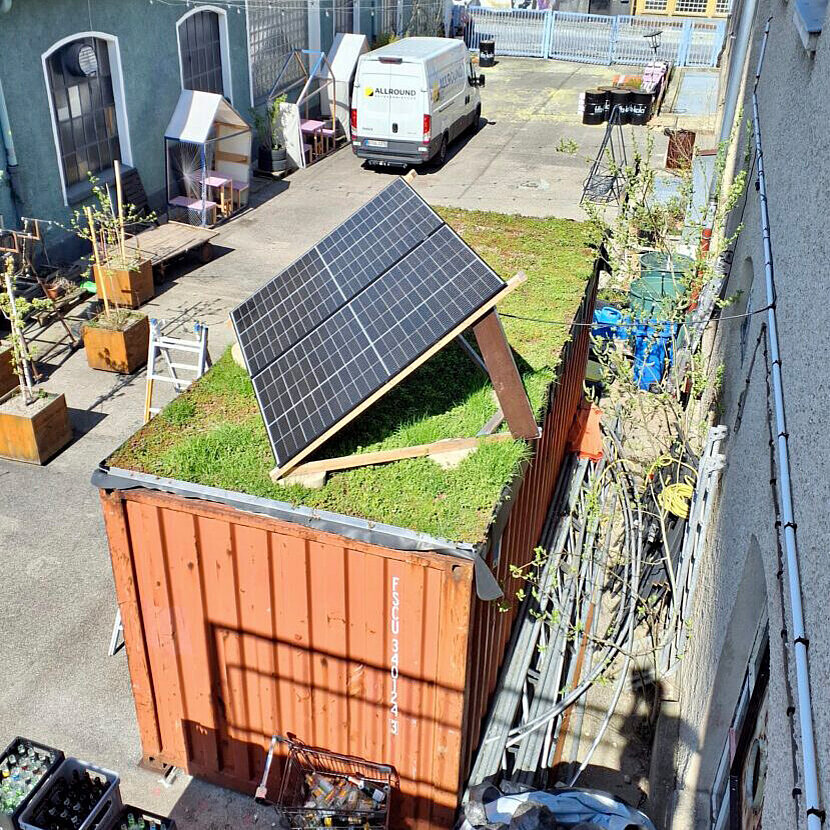
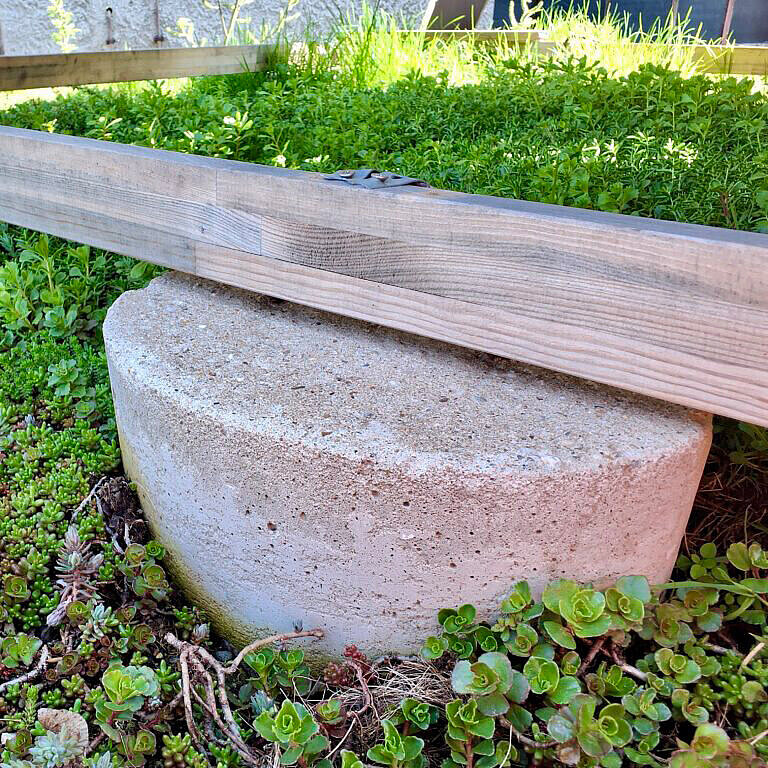
This made it all the more convenient that we didn’t have to ask anyone for permission to make changes to our container in the courtyard. So we put the container’s roof to sustainable use in two ways: with a plug-in solar system and a green roof.
The main lesson we learned from the plug-in solar system was really just how incredibly easy it is to get such a system up and running. So easy, in fact, that we installed another one just a year later—on the building’s facade above the door leading to the courtyard.
We came across the green roof project in July 2024 during a visit by the NFT network to the UFA Factory in Berlin. There, Werner Wiartalla, the technical director of the UFA Factory, gave us a tour of the very inspiring grounds. After one member of our team completed a green roof training course at the Siebenlinden Ecovillage, we had the expertise in-house and were able to implement our first green roof project right away in October. This is yet another example of the short time span between the initial idea and its completion at our company: Speed and quick decision-making are clearly our strengths here.
What potential do you see in the planned removal of the pavement in the courtyard?
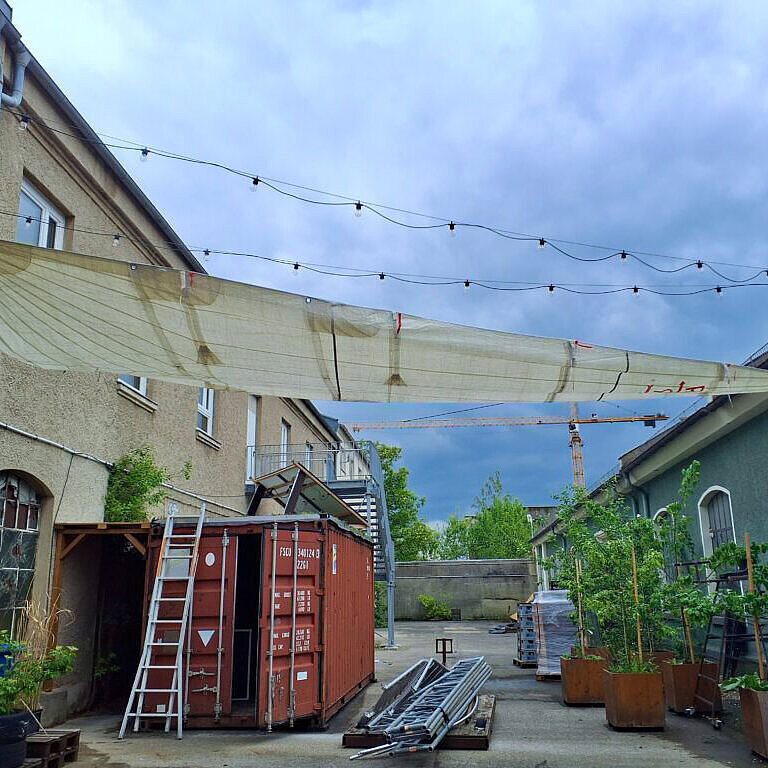
Our beautiful courtyard is currently completely covered with asphalt. Not only is this bad for the microclimate in the already heavily paved creative district—because the ground heats up significantly in the summer—but it’s also a missed opportunity to create a beautiful garden that’s a pleasant place to spend time. Specifically, large sections of the asphalt are to be removed and planted, with only a few access paths remaining paved—in part to ensure that accessibility for people in wheelchairs remains convenient. The greening of the container facades and our building depends entirely on having sufficient root space right next to the walls—another argument in favor of removing the paving.
With the “DAS GRÜNE DACH” network, you’ve created a platform for exchange and networking on the topic of sustainability in culture. How did you experience the launch—and what are the plans for the future?
The launch in February 2025 was a huge surprise success for us. We were completely overwhelmed by the broad interest shown by politicians, government officials, and a wide variety of cultural institutions in networking around the topic of sustainability.
Three things are important to us regarding the network:
- It’s not us at PATHOS theater who want to be the focus of future collaboration; rather, the “stage” for future meetings should rotate from institution to institution depending on the topic, strengthening sustainability at each location—even though we’re currently responsible for coordinating the meetings.
- We want to include all cultural institutions in Munich and not make any selections based on their sponsoring organization or artistic discipline. After all, it is precisely the diversity of perspectives that is so valuable.
- The sustainability officers at these institutions come from a wide variety of professional backgrounds within their organizations—including public relations staff, dramaturgs, facilities management staff, members of the financial control or central procurement departments, workshop managers, production managers, KBB staff (*Artistic Operations Office), master technicians, and so on—so we have an extremely diverse range of perspectives on the topic of sustainability and on internal processes and departments. This diversity is our most important resource. We don’t need outside knowledge in the form of lectures or workshops right away; instead, we’ll start by simply drawing on the expertise and experience we already have in-house.
How do you manage to anchor sustainability—especially social sustainability—not merely as a technical or organizational task, but as an artistic and social ethos within the theater’s operations?
At PATHOS, we are one of the very few theater companies where every position is filled exclusively on a part-time basis—so our staff still have time outside of work. Some of us are also active in the arts, while others work in completely different fields, so we’re constantly able to draw on valuable “outside” perspectives from our own colleagues. We therefore don’t face the problem found in some theaters where staff become completely absorbed in the organization and are largely cut off from the outside world.
The part-time model is also a key component of social sustainability, because it allows people to have time for their families (we have many children here!) and other activities in their lives.
What would you recommend to other cultural institutions that are just starting out and want to move toward sustainable operations?
Just get started! Don’t be afraid that you can’t solve the entire climate crisis all at once—that’s simply not realistic; otherwise, it would probably have happened already. Don’t forget that not everything has to be perfect on the first try! A small change is better than none at all. Just take that first step. And then another one.