Accessibility

 Language
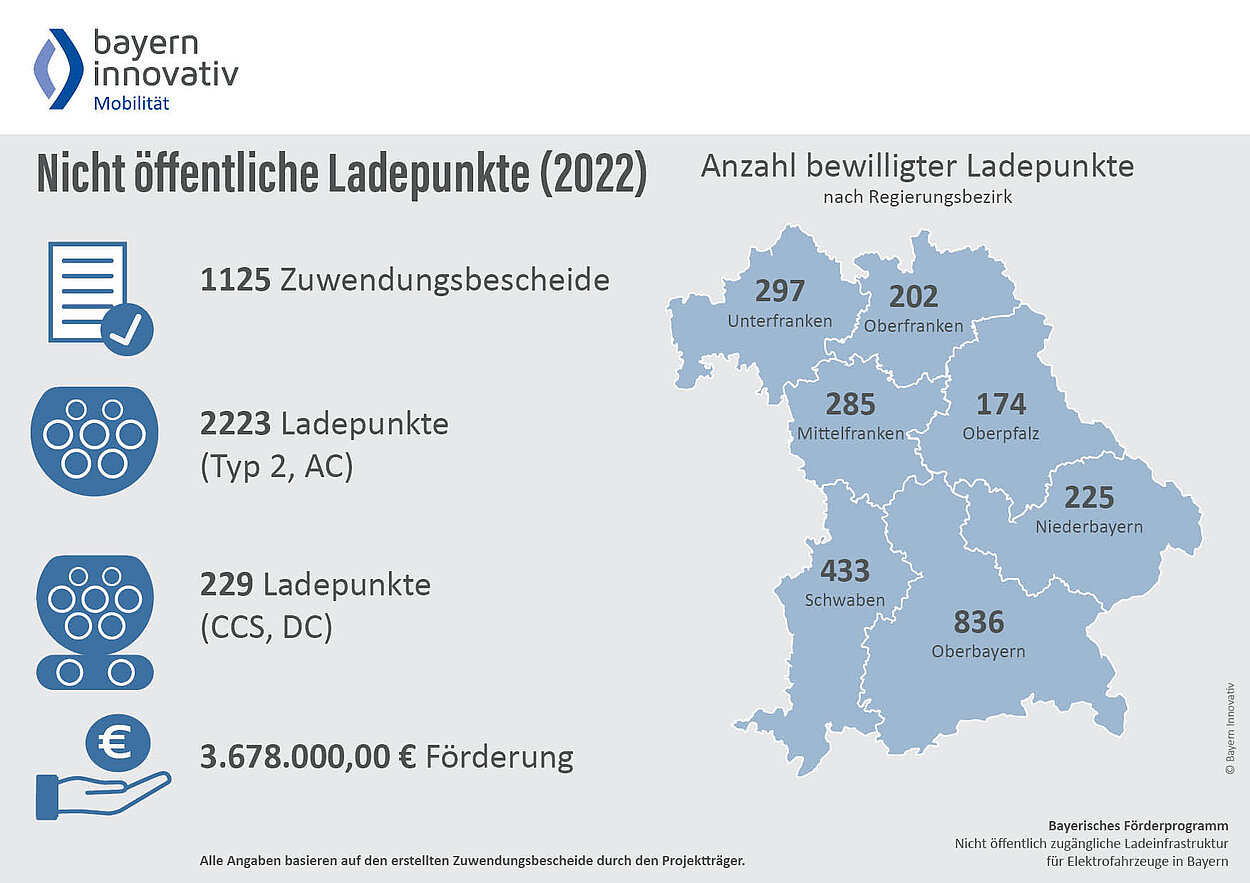
Electromobility makes a key contribution to the transition to climate-neutral mobility. A systematic, nationwide and demand-oriented charging infrastructure is a mandatory prerequisite for the market ramp-up and thus for the success of electric mobility and the achievement of the climate protection targets set by the German government and the EU Commission.
As part of the "Non-publicly accessible charging infrastructure for electric vehicles in Bavaria" funding program, Bayern Innovativ GmbH is the project sponsor.
The Bavarian State Ministry of Finance and Home Affairs is amending the administrative regulations of the Bavarian Budget Code (BayHO) on the basis of Art. 5 Para. 2 of the Bavarian Budget Code as of 01.01.2023. Amendments primarily concern the principles for awarding contracts in the General Auxiliary Provisions for Grants for Project Funding (ANBest-P and ANBest-K), Chapter 3.
For all projects approved before 01.01.2023, the following General Auxiliary Provisions for Project Funding Grants (ANBest-P and ANBest-K) apply:
General ancillary provisions for grants for project funding to companies(ANBest-P)
General ancillary provisions for grants for project funding to municipal bodies(ANBest-K)
For all projects approved after 01.01.2023, the following general ancillary provisions for grants for project funding (ANBest-P and ANBest-K) apply
General ancillary provisions for grants for project funding to companies(ANBest-P)
General ancillary provisions for grants for project funding to municipal bodies(ANBest-K)
Funding is provided for the procurement and installation of non-public, stationary charging points for electric vehicles in Bavaria. The Free State is providing funding of around 3 million euros for this purpose. The funding does not apply to e-charging points that are used purely for private purposes (see 1. What is funded?).
The funding has been exhausted. Unfortunately, it is no longer possible to submit an application.
Applications that have already been submitted and proof of use can be processed under this link.
1 What is being funded?
The object of the funding is the construction of stationary charging points for electric vehicles in Bavaria, including the necessary grid connection.
Only charging points that are not publicly accessible will be funded. A charging point is defined as not publicly accessible if only persons who must be known by name to the funding recipient are permitted to use the charging point, e.g. hotel guests (more under "Frequently asked questions"). Non-public accessibility is based on the current version of the Charging Point Ordinance (LSV).
The funding program comprises four funding objects:
1.Charging at tourist businesses
- Charging points for electric vehicles at tourist businesses in Bavaria (normal and fast charging points eligible for funding)
2. municipal charging
- Non-commercial municipalities in Bavaria can apply for a maximum of nine charging points (normal and fast charging points eligible for funding)
3. fleet charging ("mixed fleet rate")
- Charging points for different charging requirements for fleets (at least one fast charging point)
4. charging company vehicles at the employee's home
- Charging points for employees' company vehicles at home
2 Who can submit an application?
This depends on the funding object:
1. charging at tourist businesses:
- Natural and legal persons who are active in the tourism sector, for example operators of hotels, vacation homes/apartments or campsites, are eligible to apply.
2. municipal charging:
- Exclusively municipalities (non-commercial).
3. fleet store ("mixed fleet rate"):
- Natural and legal persons who are commercially active.
4. charging of company vehicles at the employee's home:
- Natural and legal persons who are economically active as employers.
3. what are the main requirements that must be met?
- The charging locations must be in Bavaria.
- Grants may only be approved for projects that have not yet been started. The start of the project is deemed to be the award of a delivery or service contract attributable to the execution of the project. This may only take place after receipt of the funding decision.
- The threshold value of the de minimis regulation must be taken into account when calculating the funding.
- The subsidized measure must be completed and invoiced within twelve months.
- The charging points must comply with the current version of the Charging Point Ordinance (LSV). The charging points must be able to communicate with other components of the electricity grid (e.g. dynamic charging).
- If the electricity is to be sold, the total charging costs must be based on the regional costs for publicly accessible charging points. In addition, the relevant regulations must be complied with (calibration law, price labeling ordinance, etc.).
- The subsidized charging points/charging devices must be operated with green electricity at all times.
- A subsidy notice must be affixed to the charging point.
4 How is funding provided?
Funding is provided as partial funding with a flat-rate upper limit as an earmarked grant in accordance with the proof of use to be submitted after the charging points have been put into operation.
- Charging facilities for electric vehicles are funded with a maximum of EUR 1,500 per charging point.
- The maximum number is ten charging points per charging location, except for municipal charging. Here, the maximum number across all charging locations is nine charging points.
- The maximum funding amount is up to 90% of the eligible costs.
5 How can I apply for funding?
Applications are submitted in a simple procedure.
The application window is expected to be open until the end of the year.
6. announcements:
8. frequently asked questions
Any premature commencement of measures is ineligible for funding. All commissions, orders or procurements prior to receipt of the positive funding decision and outside the "set-up period" specified in the funding decision cannot be funded. The automatic confirmation of receipt of the application does not constitute a funding commitment or funding notification.
Under this funding program, only electric vehicle charging points that are not publicly accessible are eligible for funding. With regard to the Charging Point Ordinance, the project sponsor is guided by the fact that the charging point user must be known to the funding recipient by name or in person with regard to their business activity. This must be specified by means of appropriate signage at the respective funding point.
- Only the online application is sufficient for the application. No additional documents need to be uploaded.
- The upload option only becomes relevant after the charging points have been installed or commissioned to document the costs incurred or as proof of implementation.
- However, please do not forget to print out the online application, sign it and send it to us as a paper version.
- For newcomers from the tourism sector to the topic of charging infrastructure, we offer a guide "Electric mobility in tourism" on this page under DOWNLOADS (for the first funding item: charging at tourist businesses)
- For local authorities getting started with charging infrastructure, we offer important information on this page: Electromobility in Bavarian municipalities
- For companies, we offer important information on this page: Electromobility in companies
- Initially, no commission or order may be placed before receipt of the funding decision.
- The project must be completed and settled by December 31, 2023, i.e. charging points must be installed and the proof of use submitted. If this is not possible for unforeseeable reasons for which the applicant is not responsible, we strongly recommend timely coordination with the project sponsor.
- Once the charging points have been commissioned, they must remain the property of the grant recipient for at least twelve months and be operated in accordance with the guidelines. After one year, a short report on the use of the charging points is due. The project sponsor will provide a document template for this purpose.
Yes, but a grid connection with green electricity will usually be necessary because a PV system cannot guarantee the required green electricity supply at all times (i.e. independent of time and weather conditions). This also applies if stationary buffer storage systems are used, as these are usually far too small to fully charge an electric car.
The funding guideline does not specify any requirements for funding items 2.2.1 "Charging at tourist businesses", 2.2.2 "Municipal charging" and 2.2.4 "Charging company vehicles at employees' homes". In the funding object 2.2.3 "Fleet charging ("mixed fleet use")" different charging requirements are assumed. Therefore, the "combination of normal and fast charging points" is funded, i.e. at least one charging point with max. 22 kW and one charging point with more than 22 kW charging power.
As long as the use of the electric car charging points (Type 2 or CCS) is not impaired by other charging processes, charging devices with additional plug systems are also eligible for funding. However, the funding amount relates to the number of electric car charging points (Type 2 or CCS) in accordance with the Charging Column Ordinance.
As many applicants still have a gray electricity contract and are bound by deadlines, the project sponsor defines the installation in 2022 as the conversion phase. A corresponding green electricity contract would therefore have to be in place at the latest after commissioning of the charging points or from 01.01.2023.
Frequently asked questions about 2. communal charging
In the non-commercial sector, municipalities can apply for up to a maximum of 9 charging points in total under "2.2.2 Municipal charging", regardless of the charging location (e.g. 9 charging locations with one charging point each or one charging location with 9 charging points).
Own companies are classified as part of a municipality and therefore also fall under the overall upper limit of max. 9 charging points.
In the commercially active sector, the same requirements apply for municipalities as for other applicants.
Frequently asked questions about 3rd fleet loading ("mixed fleet use")
The subsidized charging points are primarily intended for charging electric company vehicles or the company's vehicle fleet. Private e-vehicles belonging to employees may only be charged if this is done to a lesser extent and the charging of the e-commercial vehicles or vehicle fleet is not impaired as a result.
If you have any questions about the funding program, please contact us at the following e-mail addressContact by mail
Contact us