Accessibility

 Language
Interview: Three questions for Kathrin Hagemann
08.10.2025
In our short series "Three questions for...", we interview selected personalities on various topics. Among other things, the questions address topics that are discussed by the interviewees in the form of keynote speeches or other activities at Bayern Innovativ events.
Today we are giving our short interview to Kathrin Hagemann, Product Manager V2X, Yunex Traffic.
Kathrin Hagemann is one of the speakers at our network conference "Innovations for the mobility of the future" on 20.11.2025 in Munich.
Dear Kathrin, what inspired you personally to focus on your presentation topic "C-ITS from the road to the future"?
Kathrin Hagemann: Above all, I am inspired by the idea that we should not think of transportation as isolated units, but as a unified overall system. Vehicles, infrastructure, people - when everything communicates with each other, completely new possibilities for mobility arise. In my work with C-ITS (editor's note: Cooperative Intelligent Transport System), I have experienced how big the difference can be when cooperation is the focus - both professionally and technically as well as on a human level. I am inspired by the idea of cooperation, not everyone for themselves, not everyone against everyone, but all together. C-ITS builds on exactly that - cooperation between countries, between road infrastructure, transport operators and vehicle manufacturers, between technical devices and always between people. This is exactly what motivates me: to show how we can turn individual parts into a networked, functioning whole.
What key challenges do you currently see in the design of sustainable solutions for the mobility of tomorrow and how can your experience help to solve them?
Kathrin Hagemann: The biggest challenge for me is the diversity of approaches. The issues in future mobility are diverse, complex and influence each other. If I change small things in one place, it has an impact on many others. One approach alone is rarely successful, different approaches combined are. And that makes it more difficult - because again, many people from different areas have to come together. There are also different standards, interests and speeds. Everyone works on their own - but mobility only works when people work together. My experience shows that it helps to build bridges: between the automotive industry, infrastructure operators, cities and regulators. The important thing here is to make the central part of interoperability tangible and to create practicable, uniform standards.
How do you think mobility will change in the next five to ten years, and what role will your topic play in this?
Kathrin Hagemann: We will see more connectivity in the coming years - vehicles, roads and cities will talk to each other. We can already see the first signs of this today: millions of vehicles, hundreds of traffic lights, kilometers and kilometers of equipped infrastructure. I assume that this will be a matter of course in five to ten years' time. C-ITS in the sense of the ITS directive plays a key role here because it provides the common language. Without this language, there can be no cooperation. And without cooperation, mobility remains piecemeal - with C-ITS, it can become a whole.
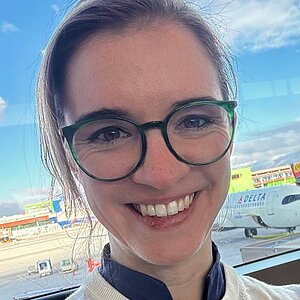
My experience shows that it helps to build bridges: between the automotive industry, infrastructure operators, cities and regulators. It is important to make the central part of interoperability tangible and to design feasible, uniform standards.
Kathrin Hagemann
Product Manager V2X, Yunex Traffic