Accessibility

 Language
Intelligent protective textiles - when textile structures become functional sensor systems

14.04.2026
Protective textiles are traditionally seen as passive barriers. They insulate against heat, protect against mechanical influences or prevent the penetration of liquids and particles. However, current developments in the field of intelligent textiles are fundamentally expanding this understanding. Textile surfaces are increasingly developing into functional systems that capture, process and transmit information - and thus add an active, data-based dimension to their traditional protective function.
Integration of electronics in textile structures
At the heart of this development is the direct integration of electronic functions into textile architectures. In contrast to attached components or modular wearables, sensors and conductivity are embedded directly into the textile. This is done, for example, by using conductive filaments that are based on metallic coatings such as silver or copper or consist of intrinsically conductive polymers. Such yarns can act as sensor tracks, antennas or contact structures within woven, knitted or nonwoven fabrics, turning the textile itself into a functional carrier of electronic systems.
Textile surfaces as distributed sensor systems
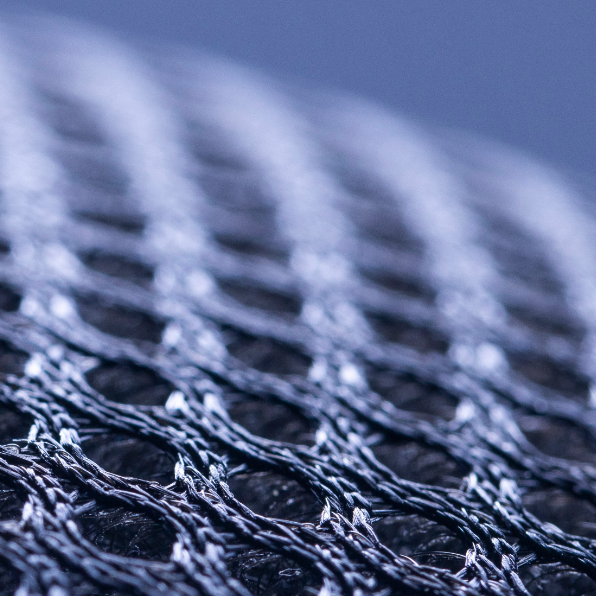
A central technological approach is the use of textile surfaces as large-scale, distributed sensor systems. Through the targeted integration of conductive yarns, sensor networks can be realized that record mechanical deformations such as stretching or pressure as well as temperature curves or changes in humidity. Knitted structures in particular offer advantages here, as their mesh architecture enables a high degree of elasticity and adapts well to complex geometries. Changes in the electrical resistance of the conductive structures can be directly correlated with physical loads.
Different measuring principles and sensor effects
In addition to resistive measuring principles, other physical effects are also used. Multi-layer textile structures, for example, enable the targeted use of distances between individual layers: If the material is compressed, a measurable electrical signal changes - the textile reacts to pressure or load. Specially equipped fibers can also generate temperature-dependent signal changes and thus act as integrated temperature sensors. In this way, various sensory functions can be integrated directly into the textile structure without the need for additional components.
Energy supply and data transmission in textiles
Another innovation focus is on textile-integrated energy supply and data transmission. Conductive yarns not only carry signals, but can also be used to distribute energy within the textile. Flexible energy storage systems, such as thin-film batteries, and energy harvesting concepts are also being investigated. These include approaches in which kinetic energy or temperature differences are converted into electrical energy. The aim is to develop textile systems that are as self-sufficient as possible and function independently of external electronic devices.
Technical challenges in integration
The main challenge lies less in individual technological components than in their robust and reliable integration into textile production processes. Spinning, weaving and knitting processes must be adapted so that functional yarns and structures can be processed reliably. At the same time, the resulting textiles must remain mechanically resilient, wash-resistant and comfortable. The contact between the flexible, soft textiles and comparatively rigid electronic components is particularly challenging, as high demands are placed on reliability and durability.
New applications for protective and operational clothing
Intelligent textile sensor systems open up new application possibilities for protective and operational clothing. Textiles can detect stress situations in real time, provide early warning of critical conditions or document operating conditions. Protective clothing is thus developing from a passive item of equipment into an active component of safety and assistance systems - an approach that is becoming increasingly important, particularly in complex and dynamic operational environments.
Outlook: textile systems instead of individual functions
Current developments illustrate how textile technologies are increasingly moving towards systemic solutions. The close link between materials science, textile technology and electronics is opening up a broad field of innovation, the industrial implementation of which is being intensively pursued. It will be crucial to design intelligent textile systems in such a way that they can be used reliably, durably and economically in real applications.
The question of how such intelligent textile systems can be reliably and economically transferred into applications is also the subject of the "Textiles for protection and extreme environments" forum. Among other things, it will discuss which technological approaches have proven themselves in practice and which developments will shape the next generation of protective textiles.
Sources:
Smart Textiles and Sensorized Garments for Physiological Monitoring: A Review of Available Solutions and Techniques
Smart Textile Design: A Systematic Review of Materials and Technologies for Textile Interac-tion and User Experience Evaluation Methods
Textile-Based Mechanical Sensors: A Review
Smart textile with integrated wearable electrochemical sensors - ScienceDirect