Accessibility

 Language
Bones from the 3D printer: moving away from standard solutions towards personalized medicine
Additive manufacturing as a driver of regenerative medical technology
18.02.2026
Bones have an amazing ability to heal. In many cases, this process happens all by itself. But what happens when this ability reaches its limits? When stability alone is not enough and the body needs support to truly regenerate?
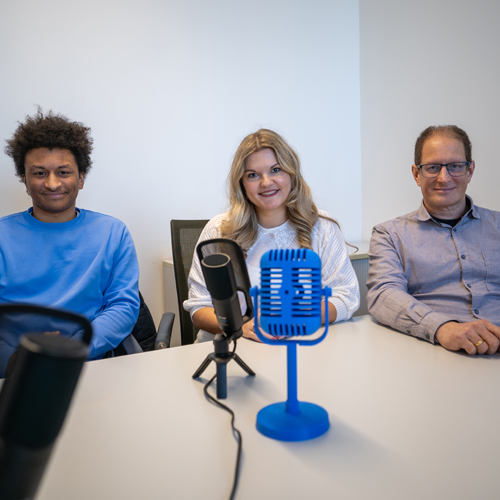
The focus is on a medical development that addresses precisely this issue: Implants that do not remain permanently in the body, but create space for new growth. Materials that disappear while bone cells grow through fine structures and enable healing. The answer to these challenges does not come from the traditional laboratory, but from the 3D printer. But how is this technology changing the way we deal with bone injuries? What does it mean for patients, doctors and medicine as a whole? We discuss these questions in the following interview with Daniel Seitz, CEO of Agensmed GmbH, and Product Manager Leandro Seitz. Together with their team, they are developing innovative medical solutions that are revolutionizing the medical sector.
When does traditional medical technology reach its limits and why is new technology such as 3D printing needed?
Daniel Seitz: Standardized implants can never fit perfectly, as every patient is unique. Additive manufacturing, especially 3D printing, is therefore particularly suitable for medicine. Every bone is unique and changes over the course of a person's life, which is why it is never possible to predict in advance exactly what shape will actually be needed. Another key area is bone augmentation, which many people are familiar with from dental implants, for example. A long waiting period is often required before the bone can be rebuilt. Many of the materials used to date have reached their limits, meaning that autologous bone is still considered the best solution. With the help of additive manufacturing, new approaches can be implemented here that function much better biologically and at the same time enable an individual fit.
What makes your process so much more technically complex than the standard product?
Leandro Seitz: When we talk about an implant that is specially tailored to an individual patient, we are talking about a custom-made design. This is requested by the doctor and individually designed and manufactured by the manufacturer within certain guidelines. The doctor then checks the design and inserts the implant. In this case, the responsibility lies with the doctor. Our aim now is to develop this approach further and turn the Custom Made Design into a Patient Matched Device. To this end, we are pursuing certification in accordance with ISO/ASTM 52920, which defines a clear design framework with fixed sizes from A to Z. The doctor selects the appropriate size and specifies how it should be modeled. All parameters are standardized in advance. The doctor also decides on the use of the implant. In this case, however, responsibility for the product itself lies with the manufacturer.
Does this mean that there is very close cooperation between the doctor, patient and you?
Leandro Seitz: Exactly.
What can I prepare myself for as a patient? What is the advantage for me?
Leandro Seitz: This is a great advantage for patients because it is a purely mineral product. This means that no bone removal from the patient is necessary, nor is the use of animal or human donor bone. Instead, an individually manufactured implant is used, which can be easily inserted by the doctor. Despite the simple application, in which the block is inserted and the wound is then closed, you can be sure that the implant will be completely absorbed by the bone and eventually resorbed.
That really does sound like a dream of the future. How far along are we in the development process?
Daniel Seitz: Interestingly, this future has already been a reality for us for over ten years. The technology was developed over a long period of time in a predecessor group in Bayreuth, taken over by the BioMed Center Innovation research institute in 2012 and further developed there until it was ready for practical use. It was then handed over to Agensmed as a fully developed technology. However, the path from the laboratory to the market is a long one. A granulate that can be processed in the printer was first developed for 3D printing. After sintering, a microporous structure is created, which is what makes this technology so special.
It is already being used in veterinary medicine. Animals are actively treated and healed with it. Even large bone cysts, for example in horses, which are very difficult to treat, especially in the lower jaw, can be successfully treated. They heal very well within a few weeks. The fact that this already works so reliably surprised us positively. The approach is to customize the implant. The underlying technology requires targeted preparation of the material for the pressure, which in turn significantly improves biological healing. As the tissue grows into the pores, a bio-hybrid is created - a biologically activated implant that is accepted by the body from the outset and is much better integrated in the long term. This is precisely the decisive advantage over conventional block materials, where biological ingrowth has so far been much more limited.
Was there a key moment when it became clear what potential for change this technology has for medicine?
Leandro Seitz: In a way, yes. In discussions with partners, it was often suggested that titanium should be used for additional protection. This is precisely what we are deliberately avoiding. Our goal is an implant that is completely resorbed by the body so that no material residue remains at the end and the body heals completely without foreign substances.
Daniel Seitz: The decisive moment came with the first veterinary application. After extensive preliminary tests, a vet seized the opportunity to use the technology for the first time. Dogs with torn cruciate ligaments were treated. The subsequent feedback was clear: he had never experienced such rapid healing before. We were also able to clearly understand this effect. At this point at the latest, it was clear that the technology worked and was ready for the market.
You have been working in this field for more than ten years. What was the moment when the regulatory challenges as an SME became particularly clear to you?
Daniel Seitz: The biggest turning point was dealing with the regulatory requirements in terms of organization and time. Many people don't realize that the first step is always comprehensive risk management and forward-looking resource planning. Initially grasping this complexity was definitely a moment of uncertainty: can we even manage it? This made the support we received all the more important. An experienced employee is responsible for quality management in the background and has already set up a large part of the necessary documentation. We also benefit from our participation in the EU Inkjet-BioAM project, which covers a considerable part of the certification costs. This funding is deliberately designed to support companies on the path to MDR - a path that we have clearly chosen. Our goal is to initially be approved in Germany and German-speaking parts of Europe and, in the long term, internationally. While many companies have recently focused primarily on the US market, we have been focusing on the MDR right from the start. The fact that we have access to research funding is of enormous value to us.
You just mentioned MDR. Can you explain what that is exactly?
Daniel Seitz: The Medical Device Regulation, i.e. the EU Medical Device Directive, was introduced and replaced national standards. This initially led to considerable challenges, as the implementation was not technically optimal. One of the reasons for this was the silicone scandal in France. The directive specifies the criteria according to which medical devices must be approved. The main new aspect is that it sets much stricter requirements, for example for clinical studies, even for products that have been on the market for many years.
What three tips do you have for other small and medium-sized companies?
Leandro Seitz: It is important to take care of the administrative tasks in good time and at an early stage. Piles of paper should not be created in the first place, because it is crucial to establish clear structures and fixed processes, especially in a company. Otherwise you quickly end up in chaos.
Daniel Seitz: An office specialist is one of the most important first employees. Qualified specialists in the quality area, especially in quality management, are just as crucial. These roles should be filled early on and with a high level of technical expertise. Another tip is not to see the MDR as an insurmountable hurdle, but as an opportunity. The requirement for clinical studies is sensible and necessary. There is no point in fighting your way through the approval process if the market later rejects the product due to a lack of evidence.
Where do you see the biggest leaps in the development of patient-specific solutions in the next few years?
Leandro Seitz: I think the focus will be much more on individuality in the future. Implants will have to fit the patient perfectly, in our case the individual bone structure. At the same time, development is moving away from materials such as titanium, which remain permanently in the body. Many people do not want to live permanently with the knowledge that there are screws in their arm, for example. Medicine will continue to develop in this direction.
If you had one wish: what do you think medicine should look like in ten years' time?
Daniel Seitz: I would like to see significantly more basic research funded in order to really understand biological processes. It would also be important to make more responsible use of health data. If it is used anonymously and without personal reference, it can provide valuable impetus for product development. The often irrational fear of sharing such data should be reduced so that we can better understand what is actually happening in the body. On this basis, individualized therapies would become possible, such as tailor-made pharmaceuticals or the 3D printing of active ingredients. This is not just about individually adapted implants, but about personalizing the entire treatment.
I also hope that these technologies will relieve the burden on doctors and healthcare staff. They should once again have more time to talk to patients, look at people holistically and enable real healing instead of limiting themselves to pure treatment.
Leandro Seitz: From a political perspective, the most important thing for me would be to get more support for bureaucratic issues. Overall, processes should be simplified so that healthcare staff in particular are noticeably relieved and can concentrate more on the people who are ultimately at stake.
The interview was conducted by Dr. Tanja Jovanovic, Head of Marketing & Innovation and Member of the Management Board, Bayern Innovativ GmbH, Nuremberg.
Rethinking bones: how 3D printing is revolutionizing healing (28.01.2026)
Patient-specific bone implants from 3D printing are changing medical care. In this episode of the podcast, Daniel and Leandro Seitz from Agensmed GmbH provide insights into modern medical technology, resorbable materials and innovative approaches to bone healing - including a look at the I3 EU project inkjet-bioAM.
Your contact